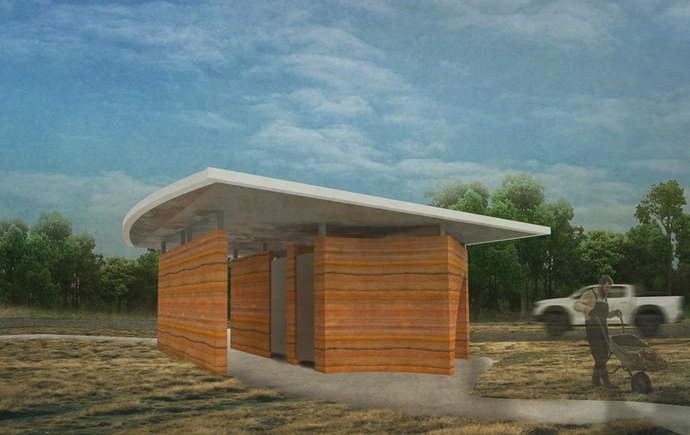
The Woombah Life Box is a series of mobile modules that manifest different functions of a typical community hall. The programs of these modules have emerged from findings derived from placemaking workshops that were facilitated by the student group at the beginning of semester, with local residents from Woombah, NSW.
Activation Strategies
Restrictive existing planning regulations and Woombah’s location in the heart of bushfire and flood prone areas has led to the proposal being self-contained and easily moveable in modular form.
As separate units, they can adapt to the changing social ecosystem that currently exists between Woombah and the surrounding localities.
The Learning Kiosk enables resilience education to be more widespread and accessible throughout the different localities. The Mobile Kitchen provides a practical and low-cost option as a community amenity for Woombah. The versatility of the Community Hub provides a performance space and facilities for a community health clinic for Woombians and other locals.
Building Elements
The different modules of the Woombah Life Box are intended to be easily assembled. Building elements have also been closely considered to be easily prefabricated or sourced from existing product lines found in hardware and outdoor retailers.
Practical Systems
To accommodate a low cost approach, cabinetry for the different modules are based on existing shelving systems and products available from hardware and outdoor retailers. The cabinetry system has been designed with considerations of the diverse and specific uses and equipment requirements needed of the different programs it serves. The system is also modular to easily adapt to changing circumstances that the community might face.
Learning Kiosk & Mobile Kitchen. Section & Elevation 1:20.
The modules feature operable elements that are based on a gas spring hinge system. These elements enable easy access to equipment, supplies or utilities (such as the kitchen sink in the mobile kitchen), but also provide extension of usable space (such as the performance stage).
Emergency and Evacuation Procedures
Activation during disaster situations is equally critical to the practical outcomes of the community’s needs with this design. The shelving system allows for the storage of essential emergency supplies. Existing programs can also be easily repurposed to the demands of evacuation procedures. The Mobile Kitchen can be mobilised to evacuation points to provide amenities to prepare and distribute food. The Learning Kiosk provides storage and pantries for essential emergency and food bank supplies, and can be converted to a redistribution centre. The Community Hub holds medical supplies and equipment, as well as providing dedicated amenities to be quickly converted to a health clinic.
William Cupido, Woombah Life Box
William Cupido, Activation Strategies
William Cupido, Building Elements
William Cupido, Practical Systems
William Cupido, Learning Kiosk & Mobile Kitchen. Section & Elevation 1:20.
William Cupido, Emergency and Evacuation Procedures
In the spirit of reconciliation Monash University acknowledges the Traditional Custodians of country throughout Australia and their connections to land, sea and community. We pay our respect to their elders past and present and extend that respect to all Aboriginal and Torres Strait Islander peoples today.