Monash University logo

Monash Art, Design and Architecture Graduate Exhibition 2023

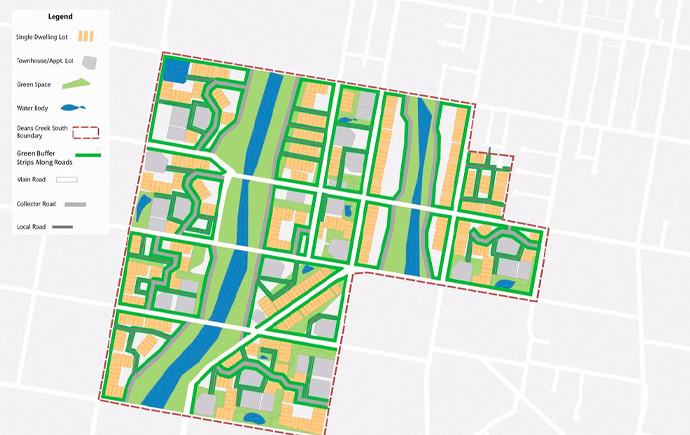
To create a more ecologically sensitive, climate resilient and flood-adaptive living environment in Colac Otway, Victoria, my project focuses on sustainable shared streetscape designs.

The shared street designs can be categorised into three types: Pedestrian-oriented shared streets (Green), Car-and-bicycle shared roads with walkways (Red), and roads with shared pathways (Black). These streetscape designs are inspired by Dutch Woonerf streetscape designs, which aim to promote active transport, increase greening, and facilitate a safe and inclusiveness shared space.

Pedestrian-oriented shared streets (Green Street)

Pedestrian-oriented shared street (Green Street) is a neighbourhood alley with the highest flexibility for pedestrians, active transport users and residents to walk and socialise in the shared space.

Only authorised vehicles can enter Green Street. Speed cushions are installed at the street entrances with a maximum 10 km/h speed limit to calm the traffic.

Canopy trees and vegetation will also be planted on the roadsides to enhance biodiversity and reduce heat.

Notably, bricks are the proposed materials for the surface as water can infiltrate and reduce runoff, which provides water for soil and vegetation while reducing flood risk.

Shared Road with walkway (Red Street)

Shared Road with walkway (Red Street) encourages active transport by providing shared roads and walkable pathways, with speed restrictions and road safety devices. The road limit is set as a maximum of 30 km/h to promote active transport in the community and reduce car usage.

Canopy trees and bushes can improve biodiversity while creating safe street spaces for walking.

Parking spaces will also be created on the roadside, which helps to solve essential parking issues and slow down local traffic.

Additionally, street lamps will be installed to provide lighting for safety while minimising the disturbance to residents and wildlife.

Road with Shared path (Black Street)

Road with Shared path (Black Street) separates car roads and shared pathways for the safety of active transport users. Black Street will also have vegetation planted on both roadsides that act as buffers for environmental and safety considerations.

The road surface material will be asphalt as it has better water removal ability compared with bricks, which provides safer road conditions for drivers.

Besides, street lighting will be provided for safety with the consideration of Biodiversity Sensitivity Urban Designs to mitigate anthropogenic impacts on wildlife.

Water Sensitive Urban Designs (WSUD) & Flood adaptive measures

Since some streets will likely be flood-prone and susceptible to flooding during extreme weather events, WSUD and associated flood adaptive measures will be introduced to prevent flooding or mitigate its impacts.

WSUD and associated flood adaptive measures are inspired by existing projects in Melbourne, Victoria.

Ideally, these designs help to reduce runoff and flood risks, enhance local flood adaptiveness and resilience, and promote sustainable stormwater management.

Biodiversity Sensitive Urban Designs (BSUD)

Streetscape greening with BSUD helps to create better living environments for residents and different species of plants and animals. Hence, some BSUD will be adopted to the streets in the central precinct to flourish local biodiversity, conserve the existing environment, and reduce impacts from climate changes and urban activities.

BSUD in this project is inspired by existing projects in Melbourne, Victoria, and academic works from Dr Georgia Garrard and associated scholars.

Ideally, these measures can enhance local biodiversity, ecological resilience and sustainability, also reducing pollution, heat and flood risks.

Road Safety Designs

Safety is a paramount element in streetscape designs and this project values the safety of all types of road users.

The design is inspired by existing works from the National Association of City Transportation Officials.

Speed restriction and vertical speed control devices will be adopted at pedestrian crossings to reduce vehicle speed and protect pedestrians.

Some low-volume roads will also have expanded parking spaces or curbs to create a chicane effect and slow down vehicles.

Streets will plant vegetation with adequate lighting between lanes that work as physical buffers and mitigate the impact of light, noise and dust.

Explore more

View all

Back to top