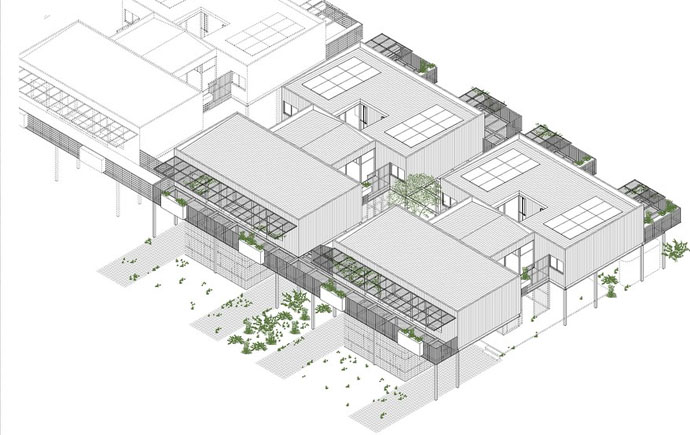
Connectivity between people and nature is vital, yet Cranbourne’s human-first planning has fractured this balance. This project restores Nature–Nature, Human–Human, and Nature–Human links by prioritising Country and ecology. Using land released by housing proposals, it creates a woodland and heathland corridor connecting the RBGC to nearby farmlands and remnant woodlands, supporting species like the Southern Brown Bandicoot. A cultural museum, Aboriginal Garden, and a contour-following walkway rebuild respectful relationships with the landscape.
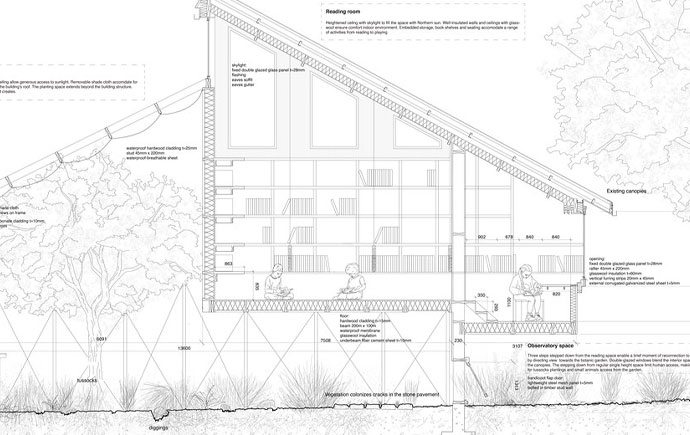
Boon Wurrung Cultural Museum Longitudinal Section 1:200 on A1
The built form is inspired by the terrain and ecology, following natural contour lines, weaving between existing trees, and extending into the wetlands via an elevated walkway to minimise disturbance, preserve vegetation, and offer a smooth, immersive spatial journey guided by the landscape.
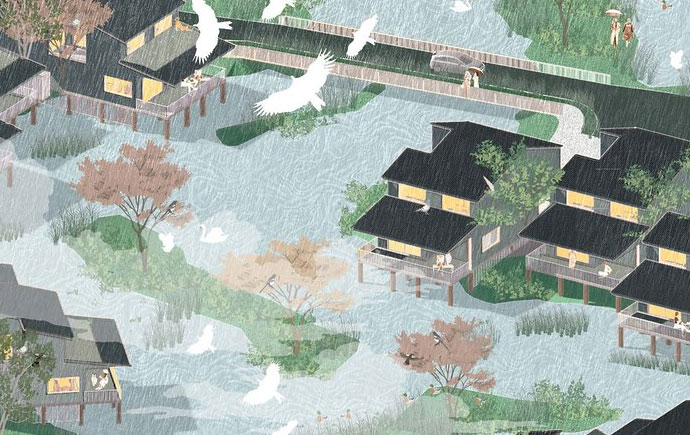
Proposed Corridor connecting Fauna and Flora
The site of Cranbourne surrounding RBGC has already been flooded with human-first design and planning, or even human-only design, completely neglecting the land. It requires rebalance and reconnection between humans and nature.
The design approach of the project strays away from the traditional human-centric or human first design. Instead, my design focuses on Country and the ecology first, instead of humans.
Moreover, the main function of my project is to reconnect. Reconnecting the lost connections between Nature - Nature, Human - Human, and Nature - Human.
1:20 Elevated Walkway Section on A1
Humans experience ecology from different levels, perspectives, and environments.
Careful design strategies such as leaving 6mm gaps in decking to allow small leaves and rainwater to drop through, attaching decking to joists indirectly to promote ventilation etc. were used to ensure building quality and effectiveness.
Ecological strategies include leaving 0.3metre gaps under walkway to provide safe shelter and hiding spots for small animals such as the Southern Brown Bandicoots, utilising helical piles to minimise soil and land damage etc. were used to not only preserve nature, but allowing the built form to benefit ecology.
Structural System
A hybrid structural system using timber glulam and corten steel is used to support the lightweight elevated form.
Materials are chosen carefully to reconnect Country and Human. Examples include internal timber inspired by traditional Boon Wurrung architecture to celebrate Country, using Rammed Earth finishes in interior spaces to "lift" Country into human space etc.
The green roof not only serves as a conventional roof, it is also an Aboriginal Garden lifted up, and allows human to walk on and interact with.
Spatial Experience
The journey through the project is a spiritual experience where humans are able to reconnect with Country, Land, and ecology architectually through integration of materials, views, and spatial experiences that allow humans to establish intimate and hands on relationships with nature, welcoming nature and Country into human space, promoting co-existence.
Jacky Wong, Boon Wurrung Cultural Museum Longitudinal Section 1:200 on A1
Jacky Wong, Proposed Corridor connecting Fauna and Flora
In the spirit of reconciliation Monash University acknowledges the Traditional Custodians of country throughout Australia and their connections to land, sea and community. We pay our respect to their elders past and present and extend that respect to all Aboriginal and Torres Strait Islander peoples today.