
PhD students present in Canada: by Andrea Cuesta Claros
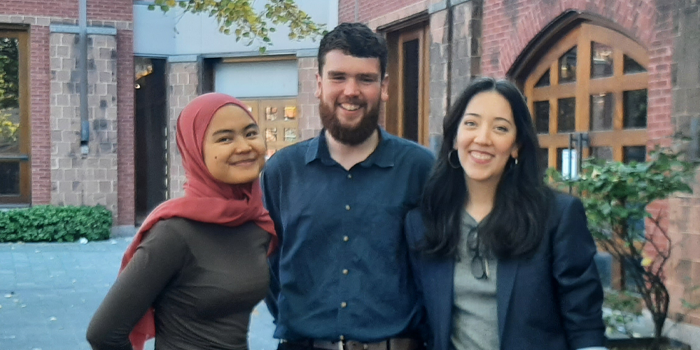
(L-R): Dianty, Jarrod and Andrea
It has been over three years since I moved to Melbourne to start my PhD. On my first day, I joined fellow PhD students Dianty Ningrum and Jarrod Grainger-Brown at a university café to meet with our primary supervisor, Shirin Malekpour. We introduced ourselves, chatted, laughed nervously, and headed off to a Monash-wide seminar on the Sustainable Development Goals (SDGs). What better way to start for us, three PhD students focusing on the SDGs, rather than attending an event about SDGs!
Although Dianty, Jarrod, and I started at the same time, and we are part of what I like to call our mini-PhD cohort, little did I know how these two people would become an integral part of my PhD journey. I am not going to lie; studying for a PhD can get lonely. Especially doing one through a pandemic, far away from home. However, Dianty, Jarrod, and a few other special MSDI PhD students have made the journey far less lonely and daunting.
About a year ago, travel restrictions were lifted in Australia. We knew that it was time to find conferences where we could present our research. We each had plans for conferences, summer schools, and fieldwork. Still, we applied to two conferences in common: the Sustainability Research Congress (SRI) in Brisbane (Australia) in June 2022 and the Toronto Conference on Earth System Governance (ESG) in October 2022. Luckily, we got accepted to both and off we went!
In both conferences, we each presented our research on the SDGs. Dianty is studying the SDGs in the context of local governments in Australia. She is interested in using the SDGs to enable bottom-up sustainability action in these regions. Jarrod is looking at the SDGs in the context of cities. With his research, he wants to help cities make the most out of the SDGs so the goals can support urban transformations. Finally, I am studying the SDGs in universities. I am particularly interested in knowing how the SDGs are transforming universities internally (in how we do education, research, campus operations, etc.) and externally (in how we relate to society).
We had great experiences at both conferences: people were very supportive and curious about our research. However, it was with fellow Early Career Researchers (ECRs) from both conferences where we knew that we had met our people.
I particularly liked how many ECRs attended the ESG Conference and the series of events specially created for us, research newbies. Through hikes, breakfasts, and a 'living library' (which was sort of a group speed dating session with established academics), we shared our experiences studying PhDs in different parts of the world and had candid conversations about being researchers. To my surprise, I already knew some ECRs that attended the conference. I finally saw face-to-face a 'pen pal' from the Netherlands, who I met during an online summer school last year, and I bumped into a high school friend from Mexico that I hadn't seen in almost 15 years!
Apart from the ECR events, we also attended online and on-site presentations. This year's ESG conference was organised by the University of Toronto, the University of Waterloo, and the Earth System Governance project around the topic of 'Governing accelerated transitions: justice, creativity, and power in a transforming world.' Put simply, the ESG project is an international group of interdisciplinary researchers interested in understanding and helping realise just and sustainable futures.
The talks varied and we had five days packed with talks and social events. I particularly enjoyed sessions about futures and knowledge integration. In the first one, on Collaborative Climate Futuring, we got to imagine futures by combining science-based climate change projections with more creative futures methods, such as science fiction prototyping. In the second one, a roundtable on the Politics and Relationality of Knowledge Integration, we got to listen to researchers working with Indigenous knowledges and community knowledge. We then reflected on our own experiences as researchers wanting to engage more profoundly with society in our work.
Finally, on our last day, we attended the taskforce day. During this day, conference attendees had the opportunity to meet with people working on specific governance and sustainability issues, organised in taskforces. These groups cover issues such as: ocean governance, planetary justice, governance of nature and sustainability, and of course, the SDGs. Jarrod and Dianty had already been collaborating for some time with the SDG taskforce. For me, this was the first time I met the team. I joined immediately.
Needless to say, I am excited for what will come next. Slowly, I have come to realise that the PhD journey is not as lonely as I thought. Talking about my research in conferences such as SRI and ESG has given me more confidence about the areas that I am researching and I am passionate about: university transformations. Hopefully, I can continue collaborating with the people I have met along the way, and continue having enriching and honest conversations with them.