
Vale Dr Eve Fesl
Vale Dr Eve Mumewa Doreen Fesl AM
21 October 1930 – 12 August 2023
Torres Strait Islander and Aboriginal readers are advised that the following tribute contains names and images of people who have died.
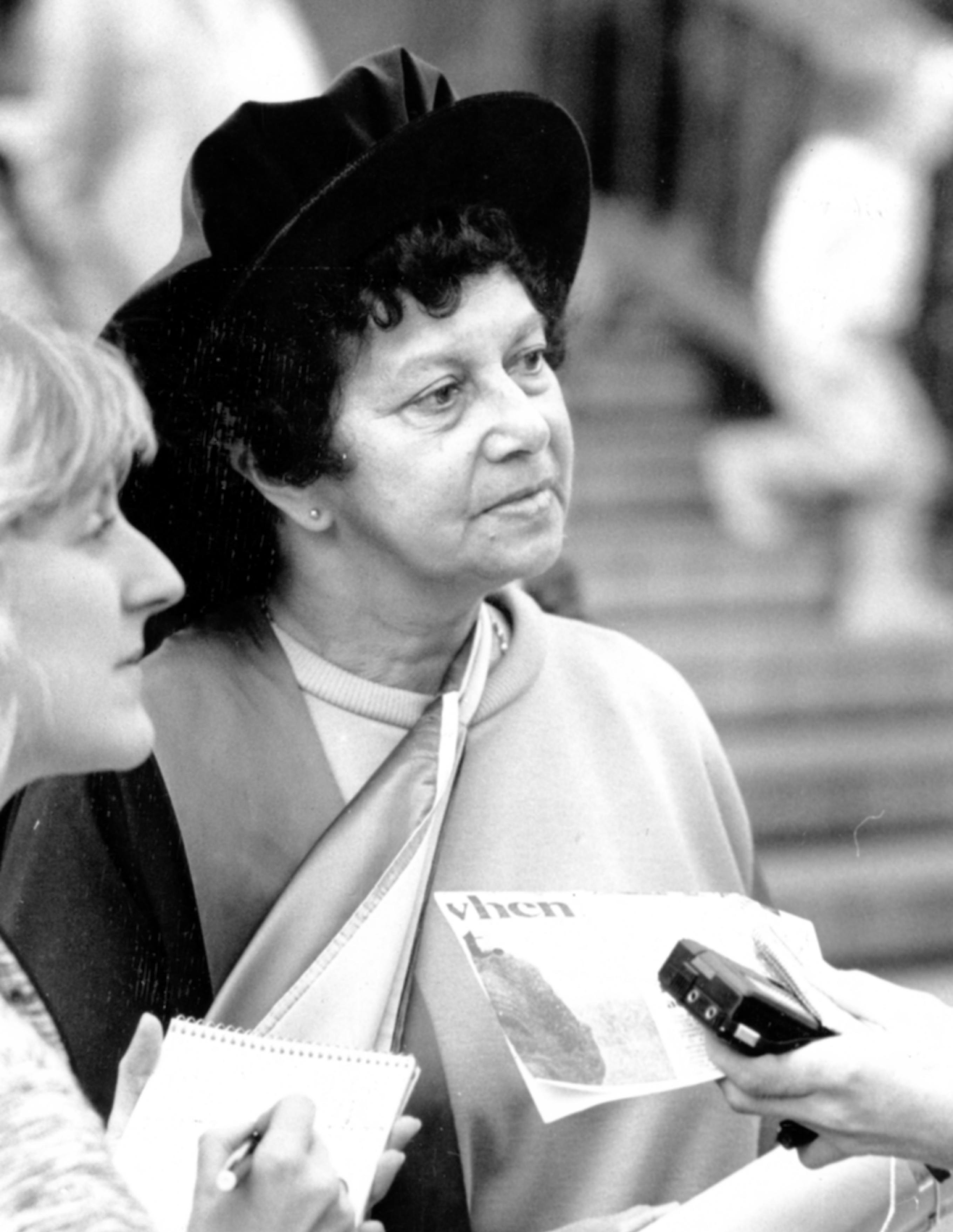
Photo caption: Dr Eve Fesl after receiving doctorate in 1989. Photographer Richard Crompton. Image courtesy of the Monash University Archives.
Dr Eve Fesl, who has died aged 92, made history when she became the first Indigenous Australian to receive a PhD from an Australian university.
Dr Fesl was a uniting force, diminutive in stature but a giant in personality who understood the power of language to sustain culture and educate the masses. Language was more than words, it was sounds; drawn from a landscape as old as humans, that could resonate through millenia and draw breath and tears straight from the first day.
Dr Fesl came to Monash in 1977 as a temporary research assistant in the Centre for Research into Aboriginal Affairs. In 1978 she was appointed Secretary of the Centre for Research into Aboriginal Affairs and in 1981 she took over from the late Professor Colin Bourke MBE as Director of what was to become known as the Koorie Research Centre, remaining at the helm until 1993.
Along with Professor Merle Ricklefs, she consulted with Aboriginal leaders and the University to increase the low numbers of Indigenous students. They sought inspiration from programmes developed elsewhere, particularly Canada to develop a bridging scheme – then known as the Monash Orientation Scheme for Aborigines – which offered Indigenous students over the age of 21 a year of preparation for university study. The orientation scheme curriculum was praised as a “programme of national significance” and led to a doubling of Aboriginal university graduates in the country.
Dr Fesl had wide experience in Aboriginal education and affairs and was involved in the Bandjalang (also spelled Bundjalung) Language programme which saw the introduction of this language into primary schools throughout Victoria. Prior to her work at Monash she worked as a liaison officer and assistant to Sir Douglas Nichols in the Ministry for Aboriginal Affairs (Victoria). She was also for a time, research assistant to the late conservationist Steve Irwin and sang a song to him in her mother tongue, Gubbi Gubbi, at a service to commemorate him following his death in 2006, which ended with a farewell cry that brought the audience to tears.
Evelyn Mumewa Doreen Serico was born in October 1930, the first child of Maurice and Evelyn Reen (née Monkland-Olsen) Serico. Her mother was a Gubbi Gubbi woman, while Maurice, a strapper and masseur at Queensland’s West Leagues Club (who was known as the man with the golden hands), was a member of the Gangulu people (also known as Ghungalu) of the Taroom district. On the night she was born, her mother took her out onto the hospital balcony where they looked up and saw the silver wings of a ‘plane piloted by Kingsford Smith on its first solo flight from the UK to Australia. Evelyn was comforted by this vision of a future in which her tiny daughter would also play a great part.
Eve and her brother, Nurdon (who in 1968 became Queensland’s first neuro radiographer) initially grew up on a sheep station. Their mother had been forcibly removed to the Barambah Aboriginal Reserve (now called Cherbourg) under the Aboriginals Protection Act. An Englishman who brought books to the reserve inspired her mother to give her children a good education, so she moved her family to the suburb of Bardon, Brisbane; a rare escape from Queensland’s tight Aboriginal reserves system which aimed to segregate Indigenous Australians from the wider community.
At Ashgrove State School, the young Eve was bullied by one of her classmates. Her response was to quietly train and beat them at school sports. It taught her how to personally handle racism and she was never called names again.
The determination and fighting spirit stayed with Eve and remained a defining part of her character. She came to Melbourne as a Queensland discus champion in the mid-1950s to train and was a member of the Australian Olympic Training Squad. Her desire to win against the odds was a catalyst for her proudest achievements in both academia and on the sports field, where she became a champion athlete and holder of Victorian and South Australian records in discus.
She made the training squad for the 1956 Olympic discus team. After missing out on a finals berth, she set her sights on the 1960 Olympics in Rome and learnt German thinking that she would get a job in Europe afterwards (though it turned out there was to be no discus at the Olympics that year).
Her study proved not to be in vain. She discovered a natural affinity for language and in her HSC, topped the state in German. Her score allowed her to study linguistics at Monash University where she went on to complete honours in anthropology, a graduate diploma in international law and finally a PhD in 1989, in which she documented her mother's Gubbi Gubbi language, driven by her concern that it was not being recorded properly.
Her knowledge of German led to marriage. One morning, she’d gone for a run along the beach with a friend when they ran into two men, one of whom was Franz Fesl, who hailed from Germany and they later wed.
In addition to her affinity for language Eve had a love of Country which led her to lend her voice to several conservation issues including the prevention of damming the Mary River. Her fight to stop the development of a freeway in Nunawading, Victoria, ended in her election as a local councillor. Preserving native wildlife was a cause close to Dr Fesl’s heart – she was a member of Victoria’s Save the Kangaroo Committee in the 1970s. In later years she was part of a volunteer workforce that restored and increased koala habitat on the Burpengary East acreage in Queensland she bought with husband decades earlier.
Dr Fesl was awarded "Scholar of the Year" in the 1986 NAIDOC Awards. In 1988 she was appointed a Member of the Order of Australia (AM) in the Australia Day (also known as Invasion Day) Honours and was awarded a Centenary Medal in 2001. In December 2016, she was awarded a United Nations ,Association of Australia award, for "community work and past achievements". And today in sport, netball’s Dr Eve Fesl First Nations Black Swans Award recognises a First Nations National Team player who demonstrates significant cultural leadership.
Dr Fesl’s other academic positions included Associate Professor in the Faculty of Education and Convenor of Murri Programs on the four campuses of Griffith University, as well as lecturer in the Oodgeroo Unit at the centre Queensland University of Technology. She was also a member of a number of national bodies including the Advisory Council on Multicultural Affairs, the National Museum of Australia’s Aboriginal Advisory Committee, the Aboriginal Literature Board and the Aboriginal Arts Board of the Australia Council.
In 1993 Dr Fesl published a political history of the invasion and colonisation of Australia from the Aboriginal point of view called Conned.
Following her mother's death in 2005, aged 97, Eve became the senior spokesperson for the Gubbi Gubbi people. Whilst her mother was more accepting of the racism and ignorance she experienced, she got angry; but in a restrained and polite way. She spoke with measured sentences and long pauses that gave her power over her audience and natural gravitas. Not surprising for a linguist who believed the pen was mightier than the sword and created a lasting legacy through language.