
Vale Emeritus Professor Sam Lake AO
Vale Emeritus Professor Philip Spencer (Sam) Lake AO
11 September 1941 - 17 April 2025
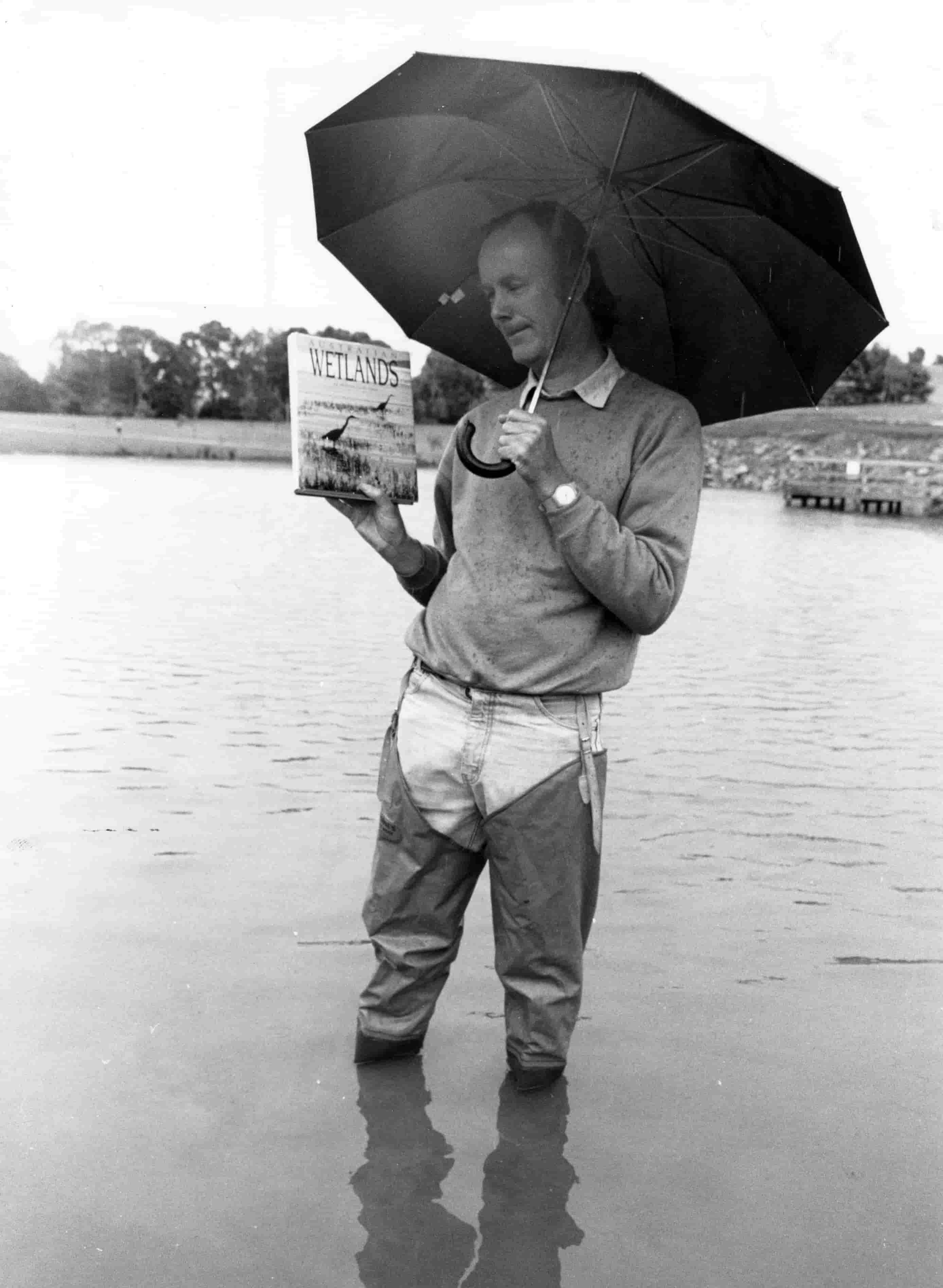
Professor Sam Lake with his book, Australian Wetlands. Image courtesy of the Monash University Archives
Professor Sam Lake’s distinguished career was surely predetermined by his name. As a community ecologist, limnologist and general wetlands expert, he made a tremendous impact on understanding and improving the ecology of freshwater lakes, rivers and streams in Australia.
Throughout his career Professor Lake, who has died aged 83, was honoured with international and national awards for his research and other contributions to aquatic science. As a student, he won a British Commonwealth Scholarship for his honours thesis investigating the heavy metal pollution of the Molonglo River near Canberra. His early promise was realised when he went on to play a lead role in shaping Australia’s understanding of limnology and community ecology.
Sam came to Monash in 1976 as a lecturer in the department of zoology. At that time in Australia, lakes were the principal focus of limnological research. Instead, he turned his attention to the structure and function of intact upland streams and soon became internationally recognized for his important insights into the role of disturbances on invertebrate ecology and stream function.
For the next two decades, he mentored and co-published with an ever-changing consortium of academics, museum curators, postgraduates, undergraduates, research assistants and conscripted friends and relatives, working on invertebrate assemblage structure, function, distribution and responses to disturbance in the Acheron and Lerderderg Rivers in Victoria.
Professor Lake was passionate about getting Australians immersed in his favourite subject. As such, he took the unusual step for an academic, publishing a general interest book, Australian Wetlands, written with fellow biologist Arthur McComb, to raise public awareness about wetlands whilst at the same time making the science understandable.
Upon the establishment of the Cooperative Research Centre for Freshwater Ecology, he became its chief ecologist (1999-2005) and his major contributions on flowing waters were acknowledged as laying the foundations for its success.
Philip Spencer (Sam) Lake, was born in Canberra in 1941, the son of Laurence Spencer Lake and Margaret Key. He once said he “grew up” in a rowboat, watching his grandfather pull the oars which was, he mused, as mesmerising as watching “Torvill and Dean.”
Sam attended Canberra High School and Purley County Grammar School, followed by the ANU where he completed a BSc with first class honours in zoology in 1963. His British Commonwealth Scholarship took him to the University of Southampton, UK, where his PhD on the neurosecretory system of a fairy shrimp received the Thomas Henry Huxley Prize of the Royal Zoological Society of London.
Afterwards, Sam returned to Australia as a lecturer in zoology at the University of Tasmania, where he researched the neurosecretory systems of various crabs and shrimps and lectured in ecology, freshwater ecology and cell ultrastructure— quite a bizarre mixture, as he put it. Steadily, with enthusiastic, and often “unruly”, students and colleagues, he moved on to research freshwater crustacean ecology, the biology of the Bastard Trumpeter, freshwater fish diversity, and heavy metal pollution in the South Esk River and in the streams of western Tasmania.
It was during this time that Sam became very involved in a conservation campaign to try to save the original Lake Pedder and to resist the establishment of a woodchip industry in Tasmania. Whilst he could become agitated about environmental and scientific issues, Professor Lake was surprisingly non-judgemental in exchanges with others in areas where he had the inside intellectual track. He lamented the descent of environmental policy into ‘an age of environmental battles.’
At Monash he worked his way up the academic ladder, becoming a senior lecturer in 1976, reader in 1990 and was appointed to a personal chair in biological sciences in 1997. Two years earlier, he had undergone treatment for cancer and yet the illness hardly interrupted his publishing career. His conversations stimulated ecologists intellectually around the world and he was known for being a generator of great ideas. He talked and thought about science for its own sake and never for personal aggrandizement. His brain, according to colleagues, had an unusual storage capacity for facts. Indeed, his intellect extended beyond science to natural and cultural history, literature, the arts and modern political theory.
Professor Lake had a good understanding of the ecological effects of drought in freshwater ecosystems, having had research projects thwarted by drought, (in particular, the Campaspe Environmental Flow Study). Thus, he published papers dealing directly with the effects of drought, reviewed papers partly covering drought issues and contributed to the book Climate Change: an Australian Guide to the Science and Potential Impacts. He produced 240 scientific papers and his research was known as paragons of science in their respective arenas.
In “retirement”, Sam continued the struggle of furthering the ecological restoration of streams, along with research on the impacts to and responses of stream biota to droughts and other extreme events. He was frequently called upon to serve on state and federal advisory and consultative committees concerned with all aspects of freshwater systems and was a much sought after participant in international symposia.
Professor Lake was the recipient of the Naumann-Thienemann Medal from the International Society for Limnology in 2013, the Gold Medal from the Ecological Society Australia in 2006 and the Award of Excellence from the North American Benthological Society (now the Society for Freshwater Science) in 2002. In 2014 he was appointed an Officer of the Order of Australia (AO). He was President of Australian Society for Limnology in 1980.
Sam was married to the historian, Dr Marilyn Lake (nee Calvert) AO, with whom he had two daughters, Katherine and Jessica. He was appointed Emeritus Professor at Monash in 2010.