
Building trust in Indonesia’s critical minerals sector
Data, democracy and the battery boom: Building trust in Indonesia’s critical minerals sector
14 May 2026
In a sector where misinformation can spread faster than minerals are mined, researchers from the Monash Critical Minerals Initiative are helping communities, regulators, and investors separate fact from fiction.
Mining nickel and cobalt in Indonesia is big business.
As critical minerals essential to electric vehicle supply chains and decarbonisation strategies worldwide, demand for these resources continues to accelerate.
Yet the story above ground is not so simple.
Online narratives about environmental damage, labour practices, and foreign investment circulate rapidly, while reliable data on deforestation, river pollution, and community displacement remain fragmented and hard to access.
Regulators, investors, and local communities are often forced to make decisions without a clear picture of what is happening on the ground.
Faculty members across campus in Indonesia, from the Monash Critical Mineral Initiative, are working to shift that dynamic.
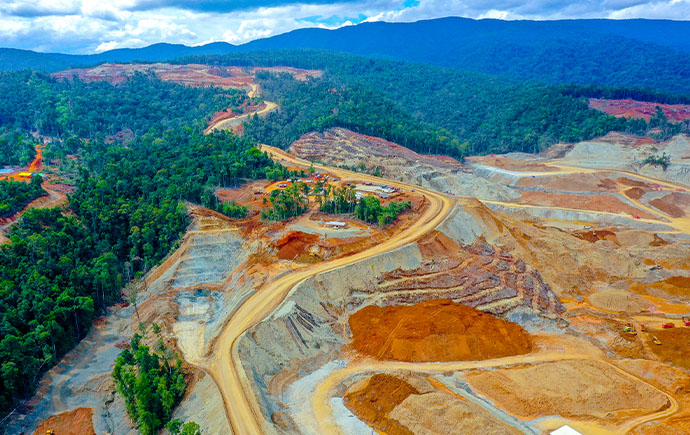
Drone photo view of mining activities
in Indonesia.
Their research integrates satellite monitoring, AI-driven spatial modelling, and digital narrative analysis to clarify competing claims and strengthen governance foundations.
“Information shapes how policies are justified, how projects are implemented, and how attractive the sector appears to foreign investors,“ said Associate Professor Ika Idris.
“Competing narratives - whether about environmental damage, labour conditions, or national sovereignty - directly affect investor confidence, public trust, and regulatory stability.”
Governance in the spotlight
For years, critical minerals strategy has centred on geology, infrastructure, and capital.
Prof Idris argues that governance capacity and information credibility are now equally critical to sector stability and market confidence.
Incomplete monitoring and contested narratives affect multiple stakeholders.
Investors face uncertainty assessing exposure, regulators confront legitimacy pressures, and communities question the effectiveness of oversight frameworks designed to protect environmental and social interests.
“The biggest weaknesses lie in transparency, accountability, and responsiveness,” Prof Idris said.
Concerns frequently relate to mitigation transparency, production reporting, labour arrangements, ownership structures, and oversight of corporate social responsibility initiatives.
“More broadly, there is a governance culture that appears increasingly resistant to criticism,” she said. “Public input, scientific evidence, and community concerns are often sidelined in favour of maintaining the momentum of industrial expansion.”
Building an evidence base
To narrow the evidence gap, researchers are combining data science, spatial intelligence, and governance analysis to produce clearer, independent evidence for decision-makers.
The work integrates research across its Mining Spatial Data Intelligence Research Hub led by Associate Professor Risqi Saputra and Data and Democracy Research Hub led by Associate Professor Ika Idris and Associate Professor Derry Wijaya to address these challenges.
Supported by the Open Society Foundations, Ford Foundation, ASEAN Centre for Energy, and Google, the work combines GIS modelling, AI analysis, and digital monitoring.
Researchers track ecological impacts while mapping disinformation networks linked to mining disputes to convert fragmented information into accessible public evidence and actionable insights.
“These tools make visible what might otherwise remain abstract or hidden,” Prof Idris said.
“However, the limitation is rarely technical - it is political and institutional. Without that translation layer, even the most rigorous data may not influence regulatory decisions or community action.”
From research to practice
Engagement with ministries, provincial governments, BRIN, universities, NGOs, and media organisations is central to the program.
Activities include co-developing dashboards, training stakeholders to interpret satellite data, and strengthening links between evidence and policy discussion.
Findings have informed media literacy initiatives and counter-disinformation strategies, while peer-reviewed research continues to feed regulatory dialogue.
However, adoption remains uneven.
“Government institutions do not consistently integrate independent academic research into policymaking, particularly when findings are politically sensitive,” Prof Idris said.
The long-term ambition is to improve how knowledge circulates across sectors and audiences. “Ultimately, the goal is not only better data, but better circulation of knowledge in ways that improve governance, transparency, and public understanding,” Prof Idris said.