La Gruta Lab research
Collaborations | Student research projects | Publications
About Professor La Gruta
Professor Nicole La Gruta is head of the CD8+ T Cell Immunity and Ageing laboratory in the Department of Biochemistry and Molecular Biology at Monash University. She completed postdoctoral studies at St Jude Children’s Research Hospital, in Memphis, Tennessee, before returning to Melbourne in 2002 as part of Professor Peter Doherty’s laboratory at the University of Melbourne. Nicole was appointed laboratory head at University of Melbourne in 2008. Nicole was recruited to Monash University in 2016 where she undertakes a comprehensive program of research to elucidate the key determinants of robust T cell immunity in the context of virus infection and autoimmune disease. She also has a keen interest in understanding the molecular basis of T cell dysfunction in the elderly. It is hoped that a better understanding of the drivers of optimal and dysfunctional T cell responses will inform the targeted design and application of T cell-based vaccines and therapeutics.
Our research
CD8+ T cell immunity is critical for the effective elimination of viruses and control of tumors. Our research uses advanced cellular and molecular approaches to interrogate the key drivers of effective CD8+ T cell responses. Our comprehensive approach investigates the impact of naïve T cell number and quality, T cell receptor expression, epitope presentation, as well as intrinsic T cell programming, on the effectiveness of the CD8+ T cell immune response after antigen challenge. Understanding how these determinants confer optimal immunity, as well as how they go awry in the elderly or in autoimmune conditions will ultimately allow us to target these factors to enhance or suppress CD8+ T cell immunity in a clinical context.
Current projects
1. Cellular and molecular analysis of ageing in CD8+ T cells
Like many developed countries, the population of Australia is ageing; with 13.8% of the population currently over the age of 65 and predictions this will reach 19.9% by 2031, this increase is predicted to have a considerable effect on the cost to public health services. Aged individuals exhibit increased susceptibility to and severity of a variety of infections (including influenza), alongside waning vaccine efficacy rates, reflecting diminished adaptive responses to newly encountered pathogens. While ageing likely compromises a number of arms of the immune system, studies in mice and humans have demonstrated that intrinsic defects in CTL immunity are likely to contribute substantially to overall immune dysfunction in aged individuals. Thus, my laboratory aims to fully elucidate both age related CTL deficiencies and the mechanisms underlying them. My research involves the characterization of influenza-specific CD8+ T cell populations to define age related phenotypic and functional changes in greater detail (Quinn et al, 2016, Proc Natl Acad Sci USA, 113; 1333) in combination with cutting edge molecular analyses on global CD8+ T cell populations to determine key epigenetic and metabolic signatures of aged CTL function. This work will rigorously define basic immunological, epigenetic, and metabolic mechanisms restricting intrinsic CD8+T cell immunity in aged individuals.
2. The influence of MHC dose and quality on CD8+ T cell development and peripheral homeostasis
The frequency and composition of naïve CD8+ T cells specific for a given epitope, present in individuals prior to antigen exposure, has long been considered to be a critical determinant of the subsequent immune response after infection or vaccination. My research is also focused on how MHC class I molecules (both the amount and the allelic variation) shapes the development and maintenance of epitope-specific CD8+ T cells in the thymus and periphery, respectively. In addition my lab is interested in how negative selection in the thymus (i.e. the process by which around half of all thymocytes that are able to recognize self MHC class I are deleted) edits a mature epitope-specific CD8+ T cell repertoire. Collectively, this research investigates normal physiological processes that have the potential to alter our available ‘arsenal’ of naïve CD8+ T cells, to determine how this will impact the capacity to respond to pathogens/tumors. Understanding such processes ultimately confers the ability to manipulate them to provide clinical benefit.
3. Understanding the structural constraints for effective T cell receptor signaling
The primary role of CD8+ T cells is to eliminate pathogen infected cells and cancers. Central to CD8+ T cell function is the ability of the T cell receptor (TCR) to recognize foreign peptides (p) or tumour peptides presented on MHC Class I (MHCI) molecules. Despite the extraordinary diversity inherent in all components of TCR-pMHCI recognition, structural analyses from both mice and humans has revealed a highly conserved recognition polarity; namely the TCRa chain reproducibly docks over the MHCI a2 helix while the TCRb chain docks over the MHCI a1 helix. It remains unknown whether this conserved modality of TCR recognition of pMHCI is driven by germline encoded recognition motifs within the TCR and MHCI, or due to constraints imposed by the nature of TCR-CD3 signaling. We recently solved the first ternary structures of epitope-specific TCRs from a naïve mouse repertoire in complex with their pMHCI ligand, revealing a completely reversed docking polarity. By expressing these reversed docking TCRs in vitro and in vivo, and in conjunction with state of the art cellular, biochemical and imaging techniques, we are now dissecting the critical requirements for effective TCR recognition of pMHC and the mechanisms by which this translates to full T cell activation and effector function.
Visit Professor La Gruta's Monash research profile to see a full listing of current projects.
Research activities
Analysis of naïve epitope-specific CD8+ T cells
Analysis of T cell receptor usage
Analysis of CD8+ T cell function
Analysis of CD8+ T cell response magnitude
Analysis of CD8+ T cell metabolism
Analysis of CD8+ T cell changes in number, phenotype and function with age
1. T cell receptor/peptide-MHCI interactions and consequences for T cell activation
Using our recently identified TCRs that recognise pMHCI in an entirely novel way, we can shed light on the TCR-pMHCI recognition events that are essential for robust T cell activation.

2. Intrinsic CD8+ T cell dysfunction in the elderly
We investigate the changes that occur in CD8+ T cell subsets, phenotypes, metabolism and function in advanced age in both mice and humans. In particular, we focus on a recently described ‘virtual memory’ population (TVM) that accumulates substantially with age and exhibits significant age-related dysfunction.
Figure 2: Our work aims to identify key epigenetic and metabolic determinants of age-related dysfunction, with the ultimate aim of discovering druggable molecular targets to restore function in the elderly
3. The impact of T cell development on naïve CD8+ T cells
How does T cell development in the thymus shape the repertoire of naive epitope-specific CD8+ T cells found in preimmune individuals?

Figure 3: All T cells develop in the thymus and must pass through 2 key checkpoints, positive and negative selection. Positive selection ensures that T cells can recognize self peptide+MHC (pMHC) molecules and negative selection results in the death of T cells that bind pMHC too strongly (~50% of thymocytes that survive positive selection), thereby ensuring self-tolerance. Thus, only around 3% of the total developing T cell pool differentiates into mature T cells.
Techniques/expertise
Tetramer-based magnetic enrichment
Single cell analysis of paired TCR αβ usage
Retroviral bone marrow transduction for generation of ‘retrogenic’ mice
Analysis of T cell oxygen consumption and glycolysis using the Seahorse XFe96 bioanalyser
Use of mouse models of bacterial and virus infection
T cell enumeration, phenotyping and isolation (using flow cytometric analysis and sorting) T cell functional assays including:
- intracellular cytokine staining
- single cell proliferation assays
- bulk CTV dilution
- in vivo and in vitro cytotoxicity assays
- detection of phosphorylated signaling proteins (e.g. pERK)
Disease models
Influenza A virus infection of mice
LCMV infection of mice
Salmonella infection of mice
Collaborations
We collaborate with many scientists and research organisations around the world. Some of our more significant national and international collaborators are listed below. Click on the map to see the details for each of these collaborators (dive into specific publications and outputs by clicking on the dots).
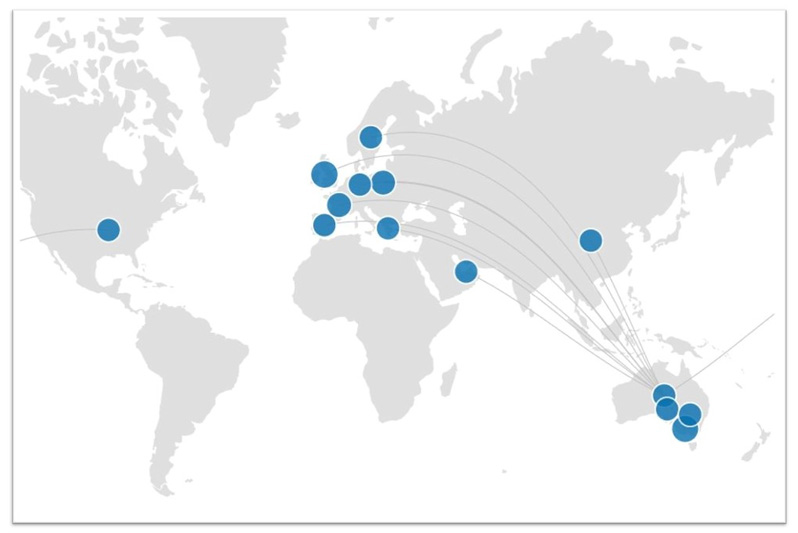
Dr Paul G. Thomas – St Jude Children’s Research Hospital, Memphis, TN, USA
Dr Andreas Handel – University of Georgia, Athens, GA, USA
Prof Jamie Rossjohn – Monash University, Melbourne, Australia
A/Prof Stephanie Gras - Monash University, Melbourne, Australia
Prof Katherine Kedzierska – University of Melbourne, Australia
Prof Tony Purcell – Monash University, Melbourne, Australia
Prof Michael Ryan – Monash University, Melbourne Australia
Dr Zeinab Abdullah – Institute of Experimental Immunology, University of Bonn, Germany
Professor Andrew Cope – King’s College, London, UK
Janssen Pharmaceuticals – Spring House, PA, USA
Student research projects
The La Gruta Lab offers a variety of Honours, Masters and PhD projects for students interested in joining our group. There are also a number of short term research opportunities available.
Please visit Supervisor Connect to explore the projects currently available in the La Gruta Lab.
