Law Lab research
Collaborations | Student research projects | Publications
About Associate Professor Ruby Law
Ruby did her PhD on yeast mitochondrial bioenergetics under the supervision of Prof Philip Nagley and Rodney Devenish at Monash University. She then joined the Autogen led by Profs Ian Mackey and Merrill Rowley to investigate the correlation between glutamic acid decarboxylase in the development of Type II diabetes mellitus before working on the role of cathepsin in liver fluke infection, then as a project leader in the Molecular Parasitology group led by Prof Terry Spithill. In 2002, she joined the Structural Biology Group led by Prof James Whisstock as a senior scientist and administrator within the group. In 2017, she was appointed group leader in the Department of Biology and Molecular Biology. She enjoys being a hands-on researcher tackling challenging targets and mentoring students to develop their careers within and outside research.
Currently, Ruby’s research focusses on the structural and functional biology of molecules related to proteases and inhibitors, and molecules related to immunity. Her expertise lies in molecular biology, immunology, protein chemistry, X-ray crystallography, small-angle x-ray scattering and electron microscopy. She is passionate to expand the knowledge gained in the development of therapeutic molecules that aid the management/treatment of diseases.
Our research
Current projects
- Studies on the mechanism of plasminogen receptor binding in cancer progression
- Studies on the interaction between plasminogen and pattern recognition molecules in innate immunity and wound healing
- Finding new strategies to treat traumatic injuries
Visit Dr Law's Monash research profile to see a full listing of current projects.
Research activities
Our Laboratory studies the structure and function of proteins involved in the fibrinolytic system, memory and neuroplasticity and innate immunity; specifically their roles in human health and diseases.
Fibrinolytic system: This work is funded by NHMRC in collaboration with A/Professor Paul Coughlin and Dr Anita Horvath from the Australian Blood Disease Centre; and Drs Tom Caradoc-Davis and Nathan Cowieson from the Australian Synchrotron. Plasminogen is the zymogen form of plasmin which is the most formidable protease in the plasma. Plasmin is responsible for the removal of blood clots (fibrinolysis) in the circulating system in order to maintain the blood flow. As well as that, plasminogen can also bind to the surface of cells and become activated to plasmin, which breaks down the basement membrane and extra-cellular matrix hence promotes cell migration and, in the case of cancer, cell invasion. We crystallized and determined the crystal structure of plasminogen, and the results were recently published in Cell Reports (2012). The structure reveals how circulating plasminogen resists activation until it binds to a fibrin clot or target cell surface. It also explains how pathogens (such as Streptococcus) hijack this potent plasma protease during invasion. Our current focus is to understand the molecular interactions during plasminogen activation and plasmin inhibitions, especially in disease conditions such as thrombosis and uncontrolled bleeding. We employ various techniques including mutagenesis, characterization of enzyme activities, protein complex formation, X-ray crystallography and small angle X-ray scattering.

Small Molecule Inhibitors to Plasmin Derived from Tranexamic Acid (TXA)
Transmembrane pore formation in perforin: Perforin plays a critical role in the immune homeostasis and surveillance against viral infection and cancer cells and deficiency is associated with impaired cytotoxic T-lymphocyte function. Perforin is a pore-forming MACPF protein (Membrane Attack Complex and Perforin-like) stored as a soluble conformer in the cytoplasmic granules of natural killer cells and cytotoxic T-lymphocytes. Upon conjugation with target cells, perforin oligomerises and adopts a new conformation during pore formation. The perforin trans-membrane pores mediate the delivery of pro-apoptotic granzymes which induce cytolysis. In collaboration with Professor Joe Trapani and Dr Ilia Voskoboinik from Peter MacCallum Cancer Research Institute, we characterized the X-ray crystal structure of the monomeric perforin. At the same time Professor Helen Saibil’s group from Birkbeck College in London determined the perforin monomer and pore structure by cryo-electron microscopy. Together we were able to model how perforin assembles on the surface of the target cell upon formation of transmembrane pores; these results were published in Nature (2010). This publication is a very rewarding outcome following our previous paper (in collaboration with Dr Michelle Dunstone) published in Science (2007) describing for the first time that the MACPF proteins, including those found in the mammalian immunity defense system, adopt the same fold as the bacterial cholesterol dependent cytolysins. Our current objective is to understand at the molecular level how perforin binds to the cell membrane and forms pores on the surface of the target cells.
Structure and regulation of function of human glutamic decarboxylase (GAD): Gamma aminobutyric acid (GABA) produced by GAD is the most abundant neurotransmitter inhibitor in the CNS and is critical for the control of movements, and neuroplasticity during development, learning and recovery from brain damage. Neurological conditions, such as anxiety, autism and post-traumatic stress disorder, are closely related to the imbalance of GABA homeostasis. This project is a continuation and expansion of our previous work on GAD production project for diagnostic and immunological tolerance studies. We published the crystal structures of both GAD65 and GAD67 isoforms in Nature Structure and Molecular Biology (2007). We observed that the mechanism through which GABA produced in mammals is regulated by a dynamic catalytic loop. The two isoforms of GAD cooperate to meet different physiological circumstances; GAD67 is a housekeeping enzyme which maintains the basal level of GABA in the CNS and stably binds to the cofactor pyridoxal 5’ phosphate (as a holo-enzyme), whilst GAD65 switches between the apo and holo-form through a process called autoinactivation. The current project studies firstly, the structural motifs involved in the autoinactivation and secondly, small molecules which can modulate the rate of GAD activity. These studies involve measuring enzyme activity and using X-ray crystallography; with our outstanding research assistant turned PhD student Chris Langendorf being the key contributor to this project. Our aim is to comprehensively understand the process of auto-inactivation and allosteric regulation of GAD, with the long term aim of developing therapeutic treatments for GAD neurological diseases through the modulation of GAD activities
Here a just a few of Dr Ruby Law’s research and discovery highlights:
1. Crystallization of human plasminogen: this work was published in Cell Reports (2012); it reveals how circulating plasminogen resists activation until it binds to the fibrin clots or target cell surface. It also explains how pathogens (such as Streptococcus) hijacks this potent plasma protease and during the invasion.
2. Crystallization of perforin: this work was published in Nature (2010), and it reveals how perforin assembles on the surface of the target cell to form transmembrane pores.
3. Crystallization of the first perforin-like (MACPF) protein: this work was published in Science (2007), and it uncovers the molecular structure and mechanism of pore formation by perforin-like proteins. This work revealed the unexpected finding that perforin-like proteins are homologous to bacterial toxin cholesterol-dependent cytolysin (CDC).
4. Crystallization of both human glutamic decarboxylase (GAD) isoforms: this work was published in Nature Structure and Molecular Biology (2007). It provides central insight into the regulatory mechanism by which gamma-aminobutyric acid (GABA, a neurotransmitter inhibitor) production in mammals is through a dynamic catalytic loop and how the two isoforms cooperate to accommodate for the different physiological requirement in the body.
5. Crystallization of serine protease inhibitor proteins: in particular human Maspin and mouse alpha2-antiplasmin: these works were published in Journal of Biological Chemistry and Blood (2005 and 2008, respectively). Maspin was proposed to be a human tumour suppressor that plays a vital role in inhibiting breast cancer migration. Alpha2-antiplasmin is the primary inhibitor of the fibrinolytic protease plasmin. The structural study reveals that the C-terminus of the molecule mediates this inhibitor to inhibit its target protease very efficiently.
6. Liver fluke costs the agricultural industry millions of dollars each year through loss of livestock production, stock deaths, and costs of treatment and prevention. For many years, detection of liver fluke-infected livestock was not possible, especially in developing countries. Cathepsin B is produced by liver flukes and can be found in the faecal material when animals are infected. Ruby facilitated the development of an expression system to express enzymatically active cathepsin B (2003, Infection and Immunity, first author) and the purified protein was used to develop a diagnostic kit for liver fluke infection in sheep and cattle in South Asia (2009, J Parasitology).
7. During Ruby’s' PhD, she studied the relocation of mitochondrial genes into the nucleus and successfully restored mitochondrial ATP synthase activity with a nuclearly expressed mitochondrial gene (1988, FEBS letts, 1990 EJB, 1990 BBA). This study allowed for the development of strategies to address mutational problems found in diseases caused by mitochondrial gene mutations.
Techniques/expertise
- Structural studies: X-ray crystallography, small angle x-ray scattering, cryo-electron microscopy
- Biotechnology: monoclonal antibody generation, small molecular drug discovery
- Cell biology: flow cytometry, florescence microscopy
- Biochemistry: molecular biology, protein chemistry, enzymology
- Biophysical studies: multi-angle light scattering, surface plasmon resonance, analytic ultracentrifugation
Disease models
- Systemic viral and bacterial infections
- Traumatic injuries
- Cancer
Collaborations
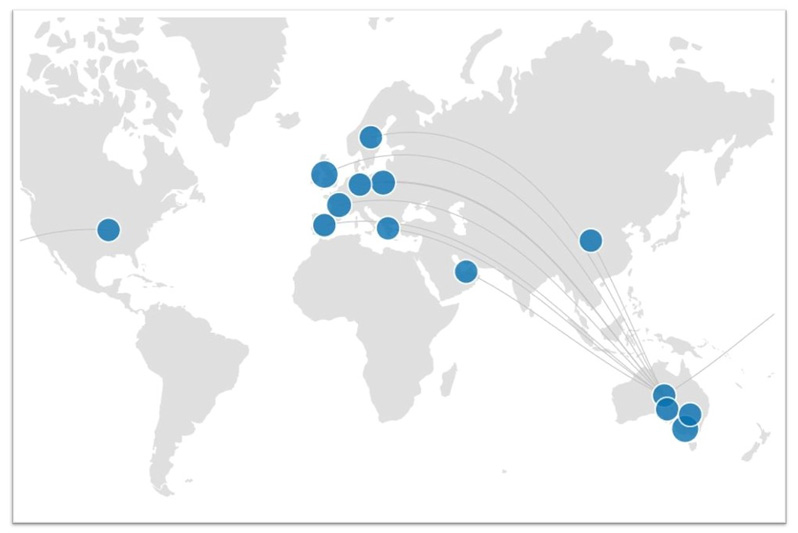
We collaborate with many scientists and research organisations around the world. Some of our more significant national and international collaborators are listed below. Click on the map to see the details for each of these collaborators (dive into specific publications and outputs by clicking on the dots).
STUDENT RESEARCH PROJECTS
The Law Lab offers a variety of Honours, Masters and PhD projects for students interested in joining our group. There are also a number of short-term research opportunities available. You are encouraged to contact Dr Ruby Law regarding potential projects that align with the presented research themes.