Moseley Lab research
Collaborations | Student research projects | Publications
About Assoc. Prof. Greg Moseley
Assoc. Prof. Greg Moseley is head of the Viral Pathogenesis Laboratory. After graduating with BSc (Hons) from the University of York, UK, he undertook research toward a PhD at The University of Sheffield in the UK and the Walter & Eliza Hall Institute in Melbourne on the roles of tetraspanin proteins in immunology and infection. Greg was subsequently awarded a fellowship from The Royal Society (UK) which enabled him to undertake postdoctoral research in immunology at the Austin Research Institute (Melbourne). He later moved to the Department of Biochemistry & Molecular Biology at Monash University to pursue research investigating the mechanisms of subcellular protein trafficking.
At Monash he established an independent research laboratory bringing together his research expertise in virology, protein trafficking and immunology to investigate the molecular mechanisms underlying viral immune evasion and pathogenicity. Greg also undertook fellowship research in CNRS (France) and Gifu University (Japan). In 2013 Greg was awarded the Grimwade Fellowship and relocated his laboratory to the Department of Biochemistry & Molecular Biology at the Bio21 Institute (The University of Melbourne).
In 2017, he was recruited back to Monash to join the Department of Microbiology within the Infection & Immunity theme in the Biomedicine Discovery Institute. His laboratory is building new capacity in the areas of Molecular Virology, Pathogen-Host Interactions, and the Molecular Basis of Infectious Disease. The overarching aim of the research is to define the fundamental processes underlying infection by highly lethal pathogens such as rabies virus, Australian bat lyssavirus, Nipah and Hendra viruses, and Ebola virus, and to use this knowledge to develop new vaccines and therapeutics for currently incurable viral diseases.
Our research
Current projects
- Virus-STAT interactions: Roles in disease and therapeutic targeting
- Elucidating the rabies virus P protein axis
- The molecular basis of Ebola virus pathogenesis
- Structural analysis (cryo-EM, NMR, crystallography) of virus-host interactions
- Viral interactions with the cytoskeleton in the manipulation of host cell biology
- Characterisation of novel viral immune evasion mechanisms
- The roles of intranuclear viral protein interactions in disease
- Mechanisms of viral reprogramming of host cell signalling
- Can rabies cure Alzheimer's?: Using viral tricks to cure neurological diseases
- Super-resolution analysis of the virus-host interface
- Understanding the role of the nucleolus in the infection cycle of dangerous viruses.
- Viral manipulation of the DNA damage response: novel mechanisms for subversion of the host
Visit Assoc. Prof. Moseley's Monash research profile to see a full listing of current projects.
Research activities
Viruses pose one of the grand challenges to human and animal health globally and within Australia. Viral disease progression is critically dependent on the formation of specific interaction networks between viral proteins and host cell factors, which enable viral subversion of important processes such as antiviral immunity and cell survival.
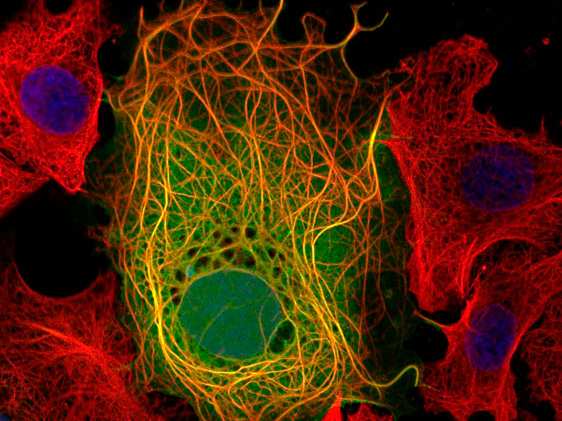
This figure shows a high resolution confocal image of viral protein targeting of microtubules.
This video was generated using 3D super-resolution microscopy to reveal viral targeting of subnuclear structures.
These interactions enable viral reprogramming of host cell biology, including important processes in innate immunity and stress responses.
Research in our laboratory seeks to elucidate these interactions at the molecular level and to understand their functions in diseases caused by highly lethal human viruses, including rhabdoviruses (e.g. rabies virus, Australian bat lyssavirus), paramyxoviruses (e.g. Nipah, Hendra, measles) and filoviruses (e.g. Ebola), as well as a number of agriculturally significant and potentially zoonotic animal viruses.
The overarching aim of our research is to identify novel targets and strategies for the development of new vaccines and therapeutics for currently incurable viral diseases. Our research involves extensive collaborations within Monash University, and with other leading national (e.g. CSIRO-AAHL, The University of Melbourne, The University of Sydney, The University of Queensland) and international institutes (e.g. The Pasteur Institute and CNRS, Paris; Gifu and Hokkaido Universities, Japan; University of Dundee, UK), enabling access to unique resources and technologies including novel and highly pathogenic viruses.
Techniques used
Molecular cell biology, molecular virology, and molecular immunology approaches, including dynamic live cell imaging (e.g. quantitative confocal laser scanning microscopy, fluorescence recovery after photobleaching [FRAP], bimolecular fluorescence complementation), super-resolution light microscopy (including direct stochastic optical reconstruction microscopy [dSTORM]) and electron microscopy, structural biology (including NMR and crystallography), in vivo microtubule interaction assays (including quantitative imaging of the cytoskeleton), functional genomics and proteomics (including nextgeneration sequencing, RT-PCR, quantitative mass-spectroscopy), viral reverse genetics and infection, in vivo viral infection/disease models, immune signalling assays, in vitro protein trafficking/interaction assays, in vitro viral replication assays, cell culture and transfection (including stable and inducible cell lines), siRNA knockdown, flow cytometry, immunoprecipitation, recombinant protein expression and purification.
Collaborations
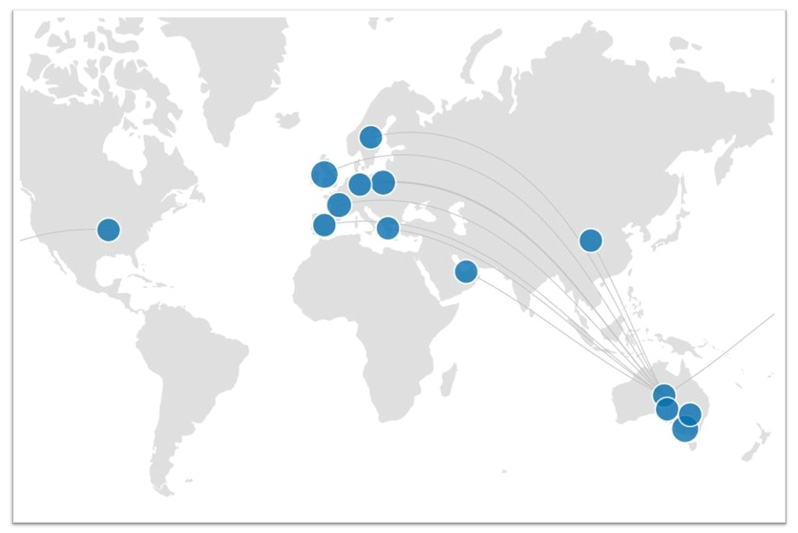
Our research involves extensive collaborations within Monash University, and with other leading national (e.g. CSIRO-AAHL, The University of Melbourne, The University of Sydney, The University of Queensland, Griffith University) and international institutes (e.g. The Pasteur Institute and CNRS, Paris; Gifu and Hokkaido Universities, Japan; University of Dundee, UK), enabling access to unique resources and technologies including novel and highly pathogenic viruses.
Click on the map to see the details for each of these collaborators (then dive into specific publications and outputs by clicking on the dots).
Student research projects
The Moseley Lab offers a variety of Honours, Masters and PhD projects for students interested in joining our group. There are also a number of short term research opportunities available.
Projects in this lab are formulated based on student aspirations and expectations. Please send an email to greg.moseley@monash.edu explaining your desire for research training. If your ambition can be accommodated, we will discuss this with you.
Scholarship support is available to new PhD students. PhD postgraduate scholarships are available for Australian citizens or permanent residents with a H1 Honours degree. We have positions for international students: applicants are advised to check the Graduate studies web pages for information on entry requirements, tuition fee, and scholarships prior to application.