Traven Lab research
Collaborations | Student research projects | Publications
About Professor Ana Traven
Professor Ana Traven is a molecular biologist, who obtained her PhD in 2002 from the University of Zagreb (Croatia) for work on the regulation of gene expression. She trained as a postdoctoral fellow at the St. Vincent’s Institute in Melbourne, where she worked on posttranscriptional gene regulation using baker’s yeast Saccharomyces cerevisiae as a model eukaryotic system. In 2009 Ana started her own laboratory at Monash University, and transitioned her research into the area of medical mycology, focusing on the major yeast pathogen Candida albicans. Her work has had significant impact on deciphering innate immune interactions in fungal pathogenesis, and the relevance of metabolic mechanisms in virulence-related biology, immune interactions and antifungal drug susceptibility. Work from the lab has been published in leading international journals, attracting recommendation by Faculty1000 and interest from the press. The lab has also worked closely with engineers, chemists and material scientist on cross-disciplinary projects to characterise antifungal compounds and biomaterials. In recognition of her research contributions, in 2018 Ana was awarded the prestigious Georgina Sweet Award for Women in Quantitative Biomedical Science.
Our research
Current projects
- Innate immune interactions of fungal pathogens
- Molecular cell biology of fungal pathogens
- Approaches to diagnosis and treatment of fungal infections
Visit Prof Traven’s Monash research profile to see a full listing of current projects.
Research activities
Microbial pathogens are responsible for millions of deaths globally, with raising concerns over resistance to available therapies (so-called AMR or antimicrobial drug resistance). Fungal pathogens are a key class of microbes which have become prevalent killers. Fungi cause an estimated 1.5 million deaths world-wide particularly of immunocompromised and severely ill people, such as cancer patients and those in intensive care units. The recent emergence of Candida auris, a fungal superbug resistant to treatment, has caused health care alerts and wide-spread concern. Fungal infections are difficult to treat, with only a handful of antifungal drugs available and high mortality rates for systemic infections, and there is an urgent need to design more effective approaches to diagnosis and treatment.
The Traven lab focuses on Candida albicans, a common inhabitant of the human microbiome, but also a serious opportunistic pathogen. C. albicans can cause several types of infections, including oral candidiasis and life-threatening disseminated disease. In parallel, and building on the expertise and approaches that have developed to study fungal diseases, we have also initiated work on the superbug C. auris.
Our research areas are:
1. Innate immune interactions of fungal pathogens
We are working towards understanding the interactions of Candida with innate immune cells, which are the first line of defence against fungal overgrowth and are key for antifungal immunity in disease. Our interests lie in the area of immunometabolism. We aim to understand metabolic changes in immune cells and pathogens that control their interactions, and decipher how metabolism could be manipulated to help the patient. Our highlight publications in this area are in Cell Metabolism (Tucey et al 2018) and mBio (Uwamahoro et al 2014). We wrote a recent review on metabolic aspects of host-pathogen interactions for EMBO Reports (Traven and Naderer, 2019).
Macrophages challenged with Candida albicans.
2. Molecular cell biology of fungal pathogens
Another major aspect of our work is to define the molecular mechanisms by which Candida transitions between developmental phases that are connected to virulence (yeast and hyphal cells), and how it can resist stressors that it encounters during infections (such as antifungal drugs or immune cell attack). Our highlight publications in this area are in Cell Reports (Koch et al 2018) and PLoS Genetics (Verma-Gaur et al 2015, Uwamahoro et al 2012).
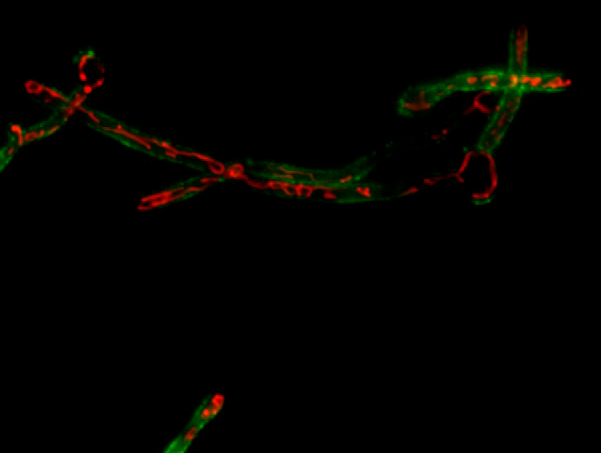
Candida albicans hyphae, the virulent form that invades host tissues.
3. New approaches to diagnosis and treatment of fungal infections
Led by Claudia Simm in our lab, we are developing screening platforms for antimicrobial drug discovery, to find new approaches to defeat deadly Candida disease and AMR infections with fungal superbugs. We are further working with chemists, engineers and material scientists towards development of antifungal biomaterials (with Dr. Bryan Coad at the University of Adelaide, co-supervised student Stephanie Lamont-Friedrich) and diagnostic methods for biofilm infections (with Dr. Simon Corrie, Monash Faculty of Engineering, co-supervised student Vidishiri Kesarwani). In other work, we have collaborated with the CSIRO (Dr. Katherine Locock) and Prof. Laurence Meagher from the Monash Faculty of Engineering to characterise promising antimicrobial compounds to treat biofilm infections with Candida albicans and the bacterium Staphylococcus aureus. Our highlight publication in this area is Qu et al J Antimicrob Chemother 2016.

Polymicrobial biofilm of Candida albicans and Staphylococcus aureus
Techniques/expertise
Our approach is interdisciplinary and uses molecular and cell biology, ex vivo and in vivo models of infection, quantitative live-cell imaging of infected immune cells, and genome-wide approaches of Systems Biology in collaboration with the Monash Research and Technology Platforms.
Disease models
- Challenge of innate immune cells (macrophages, neutrophils) with fungal pathogens.
- Mouse model of systemic candidaemia.
- Worm (C. elegans) model of C. albicans infection.
Collaborations
We collaborate with many scientists and research organisations around the world. Some of our more significant national and international collaborators are listed below. Click on the map to see the details for each of these collaborators (dive into specific publications and outputs by clicking on the dots).
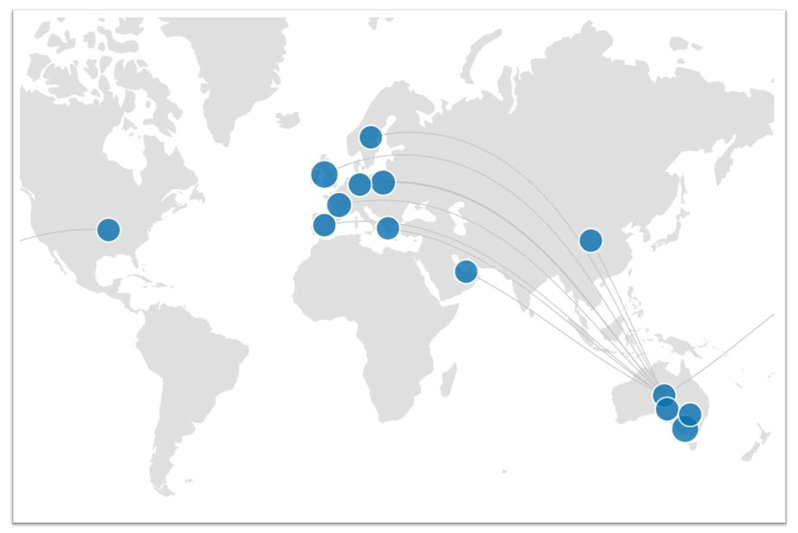
Our lab has collaborated broadly with research leaders in the Biomedicine Discovery Institute at Monash, in other institutions in Australia and internationally. Our goal is to undertake a cross-disciplinary approach to understanding fungal infections.
Our recent collaborators are:
- Dr. Thomas Naderer, ARC Future Fellow, Monash BDI: innate immune interactions of C. albicans
- A/Prof. Traude Beilharz, ARC Future Fellow, Monash BDI: “omics” approaches to understanding host-pathogen interactions in infection
- Dr. Simon Corrie, Monash Engineering & ARC Centre of Excellence in Convergent Bio-Nano Science and Technology: nanoparticle-based diagnostics of fungal infections
- Prof. Laurence Meagher, Monash Faculty of Engineering: new antimicrobial compounds and surfaces
- Prof. Anton Peleg Monash BDI researcher and Head, Infectious Diseases Department of the Alfred Hospital: infection biology
- Dr. Bryan Coad, University of Adelaide: new antifungal biomaterials
- Dr. Mike McDonald, ARC Future Fellow, Monash Faculty of Science: studying bacterial-fungal interactions using experimental evolution
- A/Prof Ivan Ahel, University of Oxford: microbial sirtuin factors
- A/Prof. Rob Wheeler, University of Maine: zebrafish model of fungal-immune cell interactions
- Prof. Judith Berman, Tel Aviv University: mechanisms of antifungal drug resistance
- Prof. Greg Challis, Monash-Warwick Alliance: a chemical biology approach to combat antimicrobial drug resistance
- Prof. Karl Kuchler, Medical University of Vienna: chromatin regulation in C. albicans.
Student research projects
The Traven Lab offers a variety of Honours, Masters and PhD projects for students interested in joining our group. There are also a number of short term research opportunities available.
Please visit Supervisor Connect to explore the projects currently available in our Lab.
