
Adaptive Assistance for Parkinsonian Gait
Project lead
Tina Wu
Chief investigator
Co-supervisors
Chao Chen, Anna Murphy
Participate in this Project
Research topic Human-Robot Interaction, Perception and Learning, Modelling and Control
Industry application Assistive Robotics
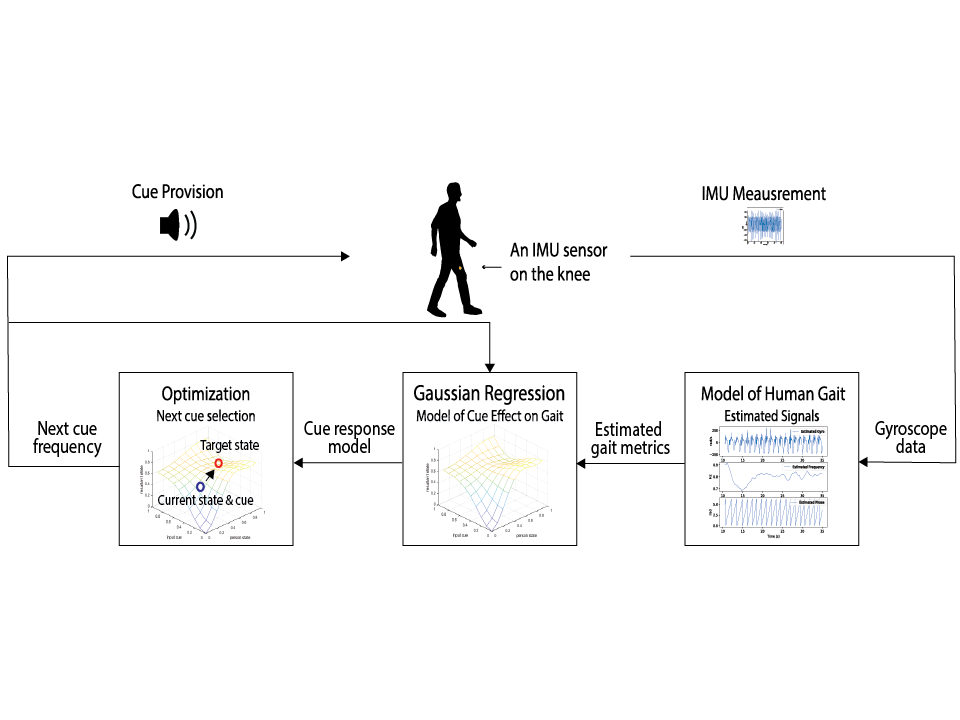
Parkinson’s Disease (PD) causes a decline in motor performance during gait with key symptoms such as shuffling and Freezing of Gait (FoG). The inability to initiate, sustain, and control gait patterns can lead to significant degradation in mobility, loss of self-confidence in social settings, and reduction in quality of life. Part of the current PD treatment involves physiotherapy with the goal of preserving the patient’s motor abilities and gaining new skills for managing FoG. Specifically, an effective technique for FoG recovery that patients can self-administer is through the use of external cues. With the development of wearable devices, the cues can be used beyond the clinical settings, assisting patients in their daily lives. The cues can be provided in visual, auditory, and vibrotactile forms. Existing research focuses on applying auditory and vibrotactile cues at a fixed, patient-specific pace after the onset of FoG. However, PD is a complex disease and its manifestation involves significant day-to-day, patient-to-patient variability. Existing cueing approaches remain static and cannot address symptom fluctuation, habituation, and cue-dependency, as the same cue is used regardless of the patient’s current state and response.
The project focuses on developing an individualised and adaptive cueing framework, tailoring the cues to work in situations where the static cues are inadequate and improving its effectiveness across the patient population. Specifically, the framework utilizes Gaussian Process models to learn the patient’s past response to cues, then uses the model during optimization to provide feedback to improve the patient’s gait. Successful outcomes of the research will develop an adaptive cue-provision strategy that provides personalized assistance tailored to a patient’s current condition. The cueing strategy would not only benefit patients during therapy sessions, but also at home and in the community, improving their mobility and quality of life.
Publications
Human-in-the-Loop Auditory Cueing Strategy for Gait Modification