
Assessing the impact of anthropogenic disturbances on bee pollination using AI and computer vision
Honeybee pollination is essential for global food security and ecosystem sustainability. Around 90 major crops rely on bee-mediated pollination. Modern agriculture introduces many anthropogenic disturbances that may alter the natural foraging behaviour of insect pollinators, potentially reducing their pollination effectiveness.
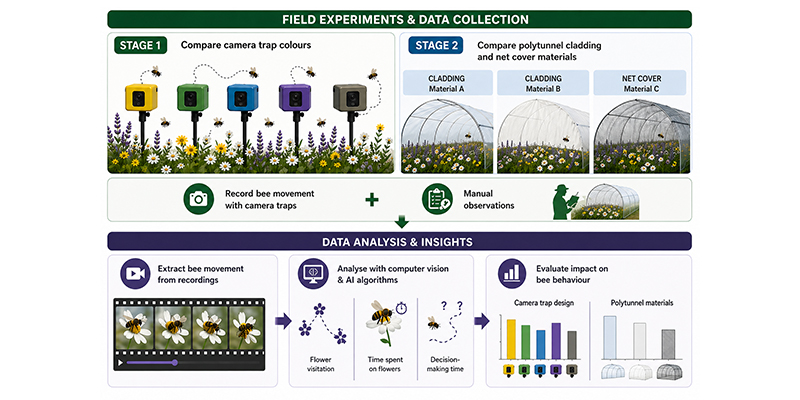
One aspect of anthropogenic interference in honeybee behavior is the introduction of coloured artificial objects that the insect pollinators may mistake for flowers. This is particularly an issue when systems set up to observe insect behaviour, such as camera traps and digital insect monitoring hardware, are themselves altering or interfering with the behaviour under observation. Such effects, especially when using brightly coloured camera and acoustic monitors used by some commercial companies, potentially undermine the quality of the data used by growers to infer crop pollination success or ecologists monitoring pollinators.
This project therefore assesses the impact of differently coloured bee monitors on honeybee flower visitation behaviour. The project’s goal is to understand how the hardware’s surface colour impacts its suitability in natural and agricultural environments. We use AI and computer vision to quantify the effects of these human-introduced distractions on insect movement during flower visits.
Findings will directly inform the design of less-invasive digital monitoring equipment and guide best-practice recommendations for farm infrastructure, helping growers protect pollinator health without compromising crop management. As AI-based insect monitoring becomes standard practice in agriculture and ecology, this evidence will become increasingly important.
Researchers
-

Dr Malika Ratnayake
Research Fellow
-

Scarlett Howard
Senior Research Fellow
-
Leslie Ng
Research Officer
-
Mohaimenul Raiaan
PhD Candidate
-

Professor Alan Dorin
Director, Education (DSAI)