Jiachi Chen
Jiachi Chen has completed his PhD student at the Faculty of Information Technology, Monash University, Australia. Prior to joining Monash University, he spent two years at the Hong Kong Polytechnic University and half a year at Zhejiang University in China both as a research assistant. His research interests include mining software repository and smart contract analysis.
Papers
- Chen, J, Xia, X., Lo, D., Grundy, J., Luo, X., Chen, T. Defining Smart Contract Defects on Ethereum, IEEE Transactions on Software Engineering, 2020, Early Access: 1-17.
- Chen, J, Xia, X., Lo, D., Grundy, J., Luo, X., Chen, T. DefectChecker: Automated Smart Contract Defect Detection by Analyzing EVM Bytecode, IEEE Transactions on Software Engineering, 2021, Early Access: 1-19.
- Chen, J, Xia, X., Lo, D., Grundy, J. Why do Smart Contracts Self-destruct? Investigating the Selfdestruct Function on Ethereum, ACM Transactions on Software Engineering and Methodology, 2022, 31(2), 1-37.
- Chen, J, Xia, X., Lo, D., Grundy, J., Yang, X. Maintenance-Related Concerns for Post-deployed Ethereum Smart Contract Development: Issues, Techniques, and Future Challenges, Empirical Software Engineering, 2021, 26(6): 1-44.
Project Works
TSE-Defects-Definition defines 20 kinds of contract defects. We categorized them into indicating potential security, availability, performance, maintainability and reusability problems. To validate if practitioners consider these contract as harmful, we created an online survey and received 138 responses from 32 different countries. We manually identified our defined contract defects in 587 real world smart contract and publicly released our dataset.
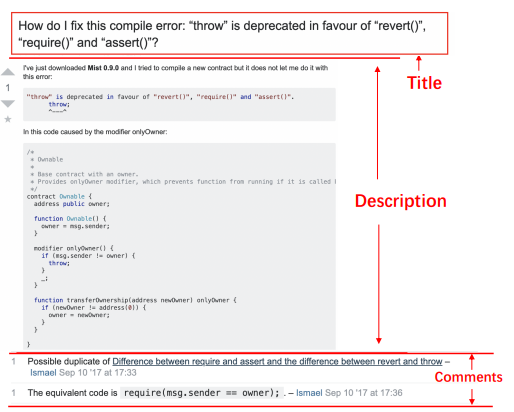
TSE-DefectChecker proposed a symbolic execution-based tool named DefectChecker to detect eight contract defects introdueced on TSE-Defects-Definition [1]. These eight defects can cause unwanted behaviors of smart contracts on the Ethereum blockchain platform.
Read more about 'DefectChecker'.

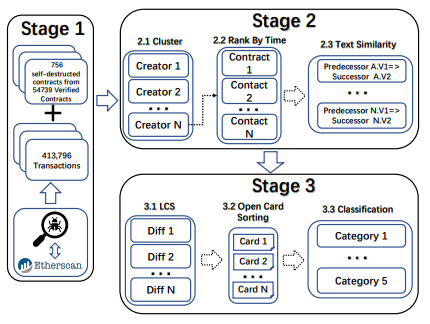
TOSEM-Selfdestruct conducts an empirical study of Selfdestruct function. We use an online survey to collect feedback from developers and summarize the key reasons why they add or not add selfdestruct function. We also propose a method to find the self-destructed contracts (also called predecessor contracts) and their updated version (successor contracts) by computing the code similarity. By analyzing the difference between the predecessor contracts and their successor contracts, we found five reasons that led to the death of the contracts. View the dataset.
EMSE-Maintenance aims to answer (i) What kinds of issues will smart contract developers encounter for corrective, adaptive, perfective, and preventive maintenance after they are deployed to the Ethereum? (ii) What are the current maintenance-related methods used for smart contracts? To obtain the answers to these research questions, we first conducted a systematic literature review to analyze 131 smart contract related research papers published from 2014 to 2020. We also performed an online survey of smart contract developers on Github to validate our findings and received 165 useful responses. View the survery and paper.