
Addressing Age-Related Accessibility Needs of Senior Users Through Model-Driven Engineering
One of the main reasons that cause seniors to face accessibility barriers when trying to use software applications is that their age-related needs (e.g., physical and cognitive limitations) are not properly addressed in the design of software user interfaces (UI). The existing literature proposes model-driven engineering based UI adaptations as a prominent solution to address this shortcoming. But in our exploration into the domain, we identified that the existing work lacks (a) comprehensiveness when it comes to integrating accessibility into software modelling tools, and (b) methods when compared to a well-recognized accessibility standard such as the Web Content Accessibility Guidelines (WCAG). Therefore, we propose a model-driven accessible-adaptive UI development approach that is WCAG compliant.
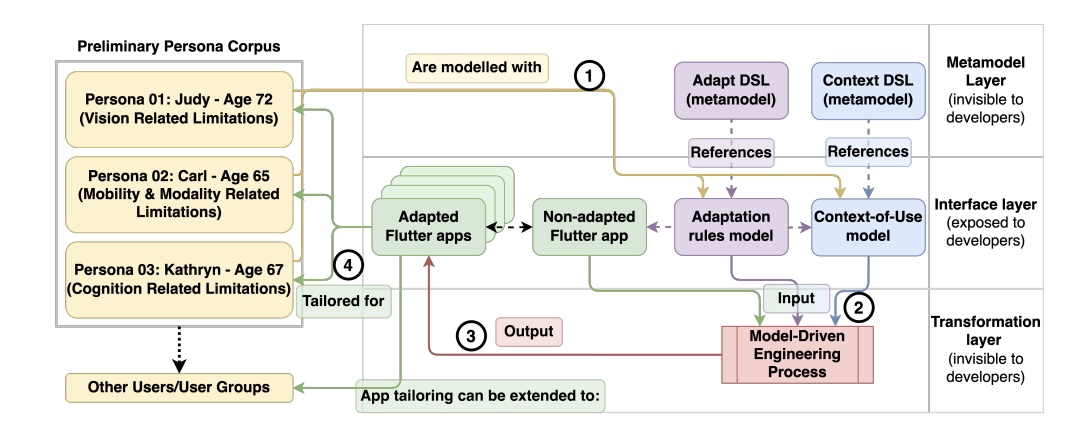
In order to realise our goal, we first elicit a concrete set of age-related UI accessibility-adaptation requirements from a group of senior users through a focus group study. Secondly, we aim to use WCAG as a reference framework to design novel domain-specific languages (DSL) that model the diverse accessibility scenarios of senior users via user context information and UI adaptation rules modelling. Thirdly, we design and develop a model-driven process pipeline to generate WCAG-compliant executable UI from the software models defined with our novel DSLs. Finally, the generated accessible-adaptive UI are evaluated with seniors in another user study for evaluation purposes and to generate end-user feedback to refine software tools and artefacts generated from our research iteratively.
Project Lead
Shavindra Wickramathilaka (PhD Candidate)
Project Team
Prof John Grundy, Dr Kashumi Madampe, Dr Omar Haggag
Publication:
Wickramathilaka, S., Grundy, J.C., Madampe, K., Haggag, O. Adaptive and Accessible User Interfaces for Seniors Through Model-Driven Engineering, Automated Software Engineering, vol. 32, August 2025 -- Final publication available at DOI Author pre-published version PDF