
The Role of Empathy in Software Engineering
We conducted a socio-technical grounded theory study involving 22 semi-structured interviews with software developers and their stakeholders to explore the role of empathy in software engineering, focusing on interactions between these groups.
The limited attention given to empathy in software engineering literature highlights a significant gap in understanding its role in developer-stakeholder interactions and its impact on their effectiveness.
While empathy has been extensively studied in other disciplines, only two studies have specifically examined its effects in software engineering.
Addressing this gap, our study builds on existing work by offering a more in-depth empirical investigation through direct engagement with practitioners. This approach enables us to examine how empathy manifests in real-world software development contexts and how it shapes developer-stakeholder relationships, contributing to a more comprehensive understanding of its influence.
Outcomes:
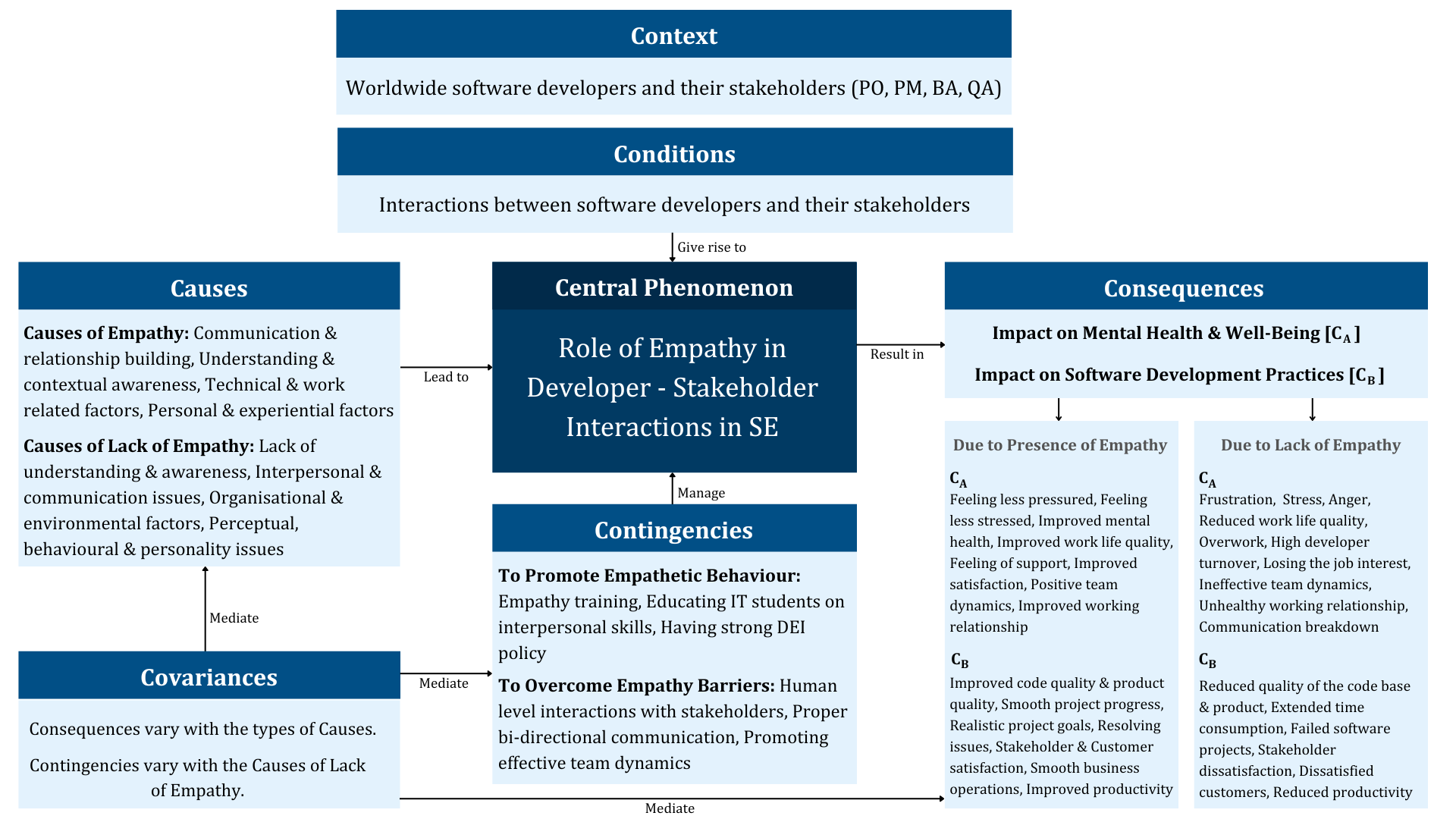
We developed a comprehensive theory of empathy in software engineering, framed by the 6Cs model. Our findings address the context, conditions, causes, and consequences of empathy, as well as its absence. We also identified strategies (contingencies) for enhancing empathy and explored the relationships (covariances) between these categories.
Our findings highlight that empathy is a key factor influencing both the personal well-being of software practitioners and the success of software development processes.
Our theory on the role of empathy in interactions between developers and stakeholders in software engineering provides insights into:
- the context, which provides key background information about the participants, including their work locations, team dynamics, and organisational settings;
- the conditions, which describe the factors necessary for empathy to manifest as a central phenomenon;
- the causes, which identify the drivers of empathy as well as its absence;
- the consequences, which outline the outcomes of both the presence and absence of empathy;
- the contingencies, which include strategies to foster empathy or address barriers to it;
- the covariances, which represent the relationships between these categories.
In addition, we discuss other influencing factors, empathy reciprocation, and empathy training.
Based on our findings, we offer actionable guidelines for software practitioners and propose future research directions for the research community to further explore the role of empathy in SE.
Project Lead
Hashini Gunatilake
Project Team
Prof John Grundy, Prof Rashina Hoda, Dr Ingo Mueller
Publication:
Gunatilake, H., Grundy, J.C., Hoda, R., Mueller, I. The Role of Empathy in Software Engineering - A Socio-Technical Grounded Theory, to appear in ACM Transactions on Software Engineering and Methodology (TOSEM) -- Final publication available at DOI Author pre-published version PDF