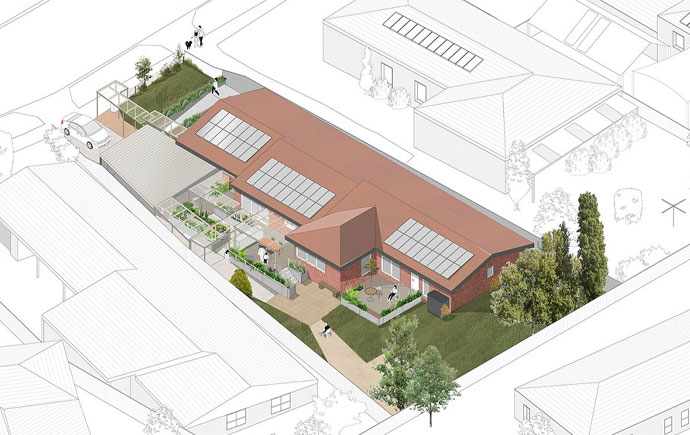
This project proposes a series of planning and construction strategies for the reconfiguration of a 1940s bungalow style property into an appealing care supported share house. The proposal uses the NDIS SDA Design Standard as an opportunity to improve overall amenity for an array of current and future occupants. Key focus areas include engaging home-bound residents with the street through an active frontage; bringing light and wayfinding to a dark/complex plan; connecting private areas to outdoor areas; allowing future adaptation and promoting the conscious use of new and used materials.
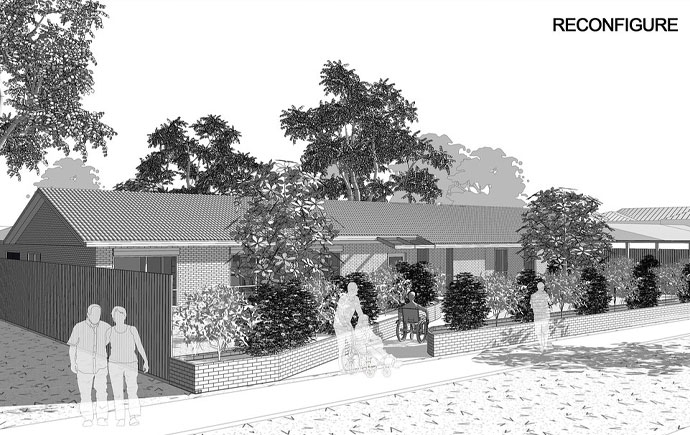
Reconfigured Street View
The key desire of this project is to propose solutions that enrich the lives of occupants, given the insular nature of existing housing stock available for people with disabilities, this project seeks to alter the trajectory of designing for disability away from institutional and isolating feeling buildings to dignified, domestic, connected, and social homes. The street frontage shown here actively connects residents to the street and neighbourhood through utilising level access decking, landscaped ramps and planter boxes to allow for tiered public to private occupation and interaction.
'Animation'
The reconfiguration of Balaclava House transitions the dark, confined, and institutional feeling 6 bedroom structure into a more connected, flexible shared home for 3 residents and a carer. The key planning strategies adopted include consuming narrow corridors for more vast private spaces [not just bedrooms but private retreats], creating a central datum for wayfinding and multiple functions [not just a corridor but an active wide social space] and deconstructing the high fence frontage for reuse into an inviting social space [not just a frontage, but a layered neighbourhood connection].
The existing plan is limiting to its function as an accessible shared home, key limitations include its disconnection from the street by high fences, a stepped entry to the front door, narrow confining interior corridors and rooms, lacking connections to external spaces from bedrooms and a limit of choice for residents to occupy variations in social or private spaces.
Reconfigured Plan
The reconfigured plan utilises a zoned approach to planning, clustering private retreats along the south and an array of options for public occupation and social interaction on the north, south and centre of the layout. The carer’s unit is strategically located toward the front of the house, adjacent to the secondary living space and frontage. This reconfiguration allows for shared living across 4 bedrooms, but has the opportunity to be flexibility split as 2 x 2 bed units, a 3 bed unit + studio, or a 2 bed unit + 2 x studios.
Construction Strategies
The reconfigurations are designed to be a series of easily implemented modifications that can be staged to allow for residents to remain in occupation throughout. Some key minor construction strategies proposed to complete these reconfigurations include installing pre-fabricated wet walls for bathrooms off slab as a practical plumbing solution, extending existing openings for greater outdoor connections, re-using front fence materials for bench seating along the street and utilising simple fencing structural techniques for a modularised pergola system.
Reconfigured Building Section
As demonstrated in the detailed section, the reconfigurations proposed in this project work together across the entire building to get more out of each space and create a more connected, generous, social and appealing home for the benefit of all residents, carers and visitors.
In the spirit of reconciliation Monash University acknowledges the Traditional Custodians of country throughout Australia and their connections to land, sea and community. We pay our respect to their elders past and present and extend that respect to all Aboriginal and Torres Strait Islander peoples today.