Monash Art, Design and Architecture Graduate Exhibition 2025
Monash Art, Design and Architecture Graduate Exhibition 2025
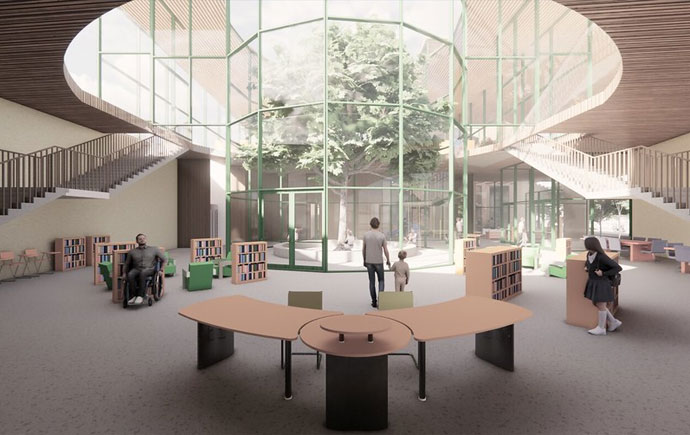
This studio reimagines Moorabbin’s future suburbs as the coexistence of equitable, adaptive, and inclusive systems. rather than static and isolated activity centres, networks-cities propose a multiplicity of dynamic and continuous urban networks.
Hoddle’s 1.6 x 1.6km grid accommodates four Pedestrian Oriented Districts (PODs, the building blocks of networks-cities) with each integrating ecology, public transport, commerce, clean industry, research, and housing, all within interwoven pure and hybrid zoning. These nets generate new typologies, habitable bridges, and redefine an infrastructure that relocates car-dominated environments to the periphery, fostering walkable, vibrant, and connected communities centred on public transport.
Students identified and analysed an 800 × 800m POD, developed a 200 × 200m mosaic (the smallest networks-city community structure), formulated three-dimensional urban design envelopes, and then proposed urban architectural propositions. Their designs test whether urban form, space, order, and aesthetics can exceed bureaucratic templates, and create flexible systems responsive to ecological, economic, political, and cultural progress.
Networks-cities envisions a continuous, progressive urban fabric, grounded in sustainability and reparations, equity, liberty, and fellowship — achieved through connection, continuity, emergence, and inclusion.
Studio Leaders: James Brearley and Steve Whitford