As an Architectural Design student, I am passionate about crafting site-specific, human-centered designs that foster connectivity and enrich daily life. This project revives an underdeveloped site in the Moorabbin Activity Centre through the lens of Networks-City theory, which encourages the linking of social, ecological and infrastructural networks in urban spaces. The proposal envisions community greenhouses, market spaces and a green plaza linking to Moorabbin Reserve. Together, these elements form an integrated network of activity, ecology and community to transform the site into a sustainable urban hub that strengthens local connections and contributes to the broader fabric of the city.
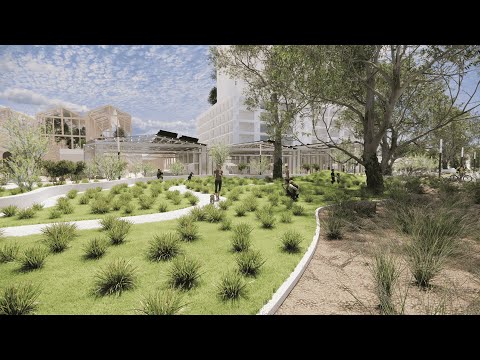
Views Through the Green Plaza
Horscroft Place is reimagined as a pedestrian-only walkway that connects the nearby Moorabbin Reserve to the Moorabbin Train Station; fostering a Pedestrian-Oriented District and establishing a new green corridor through the site.
Within the Networks-City framework, urban structure is defined by horizontal and vertical zoning bands that distribute programs such as commercial, residential and clean industry. These bands shift between pure zones (where functions are distinct and clearly defined) and hybrid zones (where programs overlap to encourage interaction).
Site Planning - Conceptual Diagram
During the site planning process, factors such as pedestrian and vehicular circulation, spatial permeability and the distribution of green spaces were carefully considered to develop a proposal that integrates cohesively with the existing urban fabric.
Ground Floor Plan
A key focus of the design was to respect local Country through the reimagining of the green plaza. The proposal transforms the existing hardscape into organic landscape forms and incorporates indigenous vegetation reflective of the Ecological Vegetation Class of Grassy Woodland and Damp Sands, reinforcing ecological and cultural continuity within the site.
Adaptive Reuse Diagram
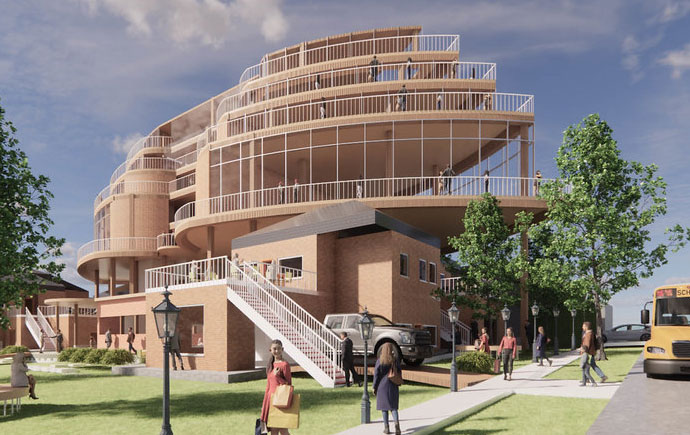
Sustainability was addressed by adaptively reusing the existing warehouse structures, transforming them into vibrant market spaces that preserve the embodied energy of the urban fabric while supporting local economic and social activity.
Section Drawings
The site is designed with future potential for densification through towers while also prioritising activation of the ground plane with community greenhouses and a market that opens onto the central green plaza, creating a vibrant, layered urban environment.
Lelaina Guinan, Views Through the Green Plaza
Lelaina Guinan, POD (Pedestrian-Orientated District) Zoning
Lelaina Guinan, Site Planning - Conceptual Diagram
In the spirit of reconciliation Monash University acknowledges the Traditional Custodians of country throughout Australia and their connections to land, sea and community. We pay our respect to their elders past and present and extend that respect to all Aboriginal and Torres Strait Islander peoples today.