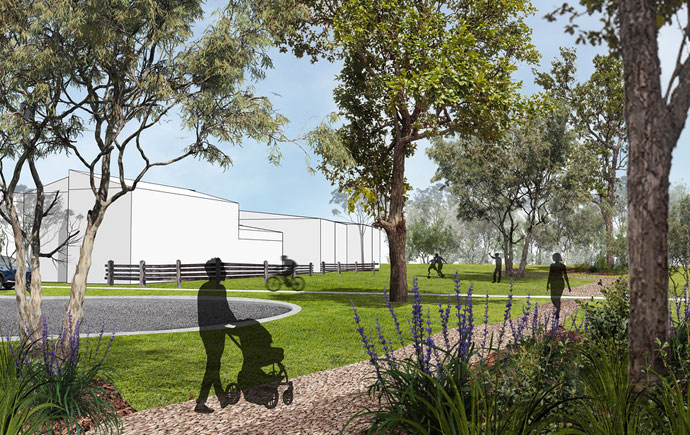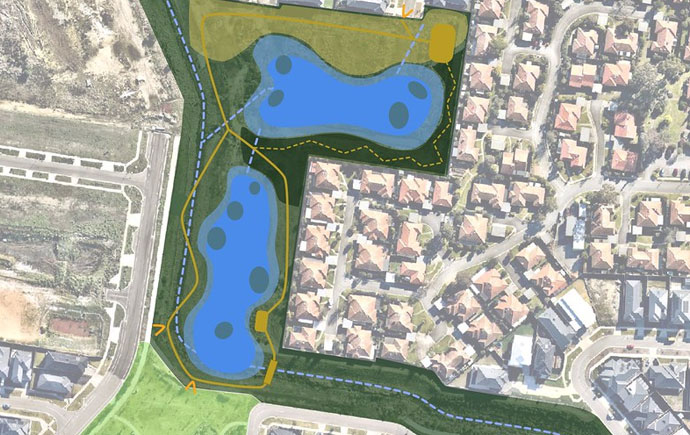
Proposed conditions: Integrating shade, play & housing
Integrating shade, play & housing’, will provide a transformed park with trees and open-air sails for shade, alongside boulders for risky play, to provide a cooler environment that fosters connection. A revegetated powerline easement, together with housing which responds to the natural environment, will extend wildlife habitats into local surroundings while improving housing diversity. The project seeks to dissolve the boundaries between the public realm, private residences, and wildlife habitats, emphasising their fluid and interconnected relationship.
Existing conditions: Disconnected urban fabric, unshaded play & absent ecology
At the heart of this site lies the Station Creek Way Playground, which in its existing condition, lacks shade and features synthetic rubber flooring. Adjacent to the park is a barren powerline easement, flanked by wide roads and low-density housing.
Proposed Conditions Cross-Section
Existing Conditions Cross-Section
Regional Context
The City of Casey is Victoria’s most populous municipality, home to over 365,000 residents across almost 400 square kilometres. Spanning urban, suburban, and rural landscapes, it stretches from the foothills of the Dandenong Ranges to the shores of Western Port Bay. Casey is known for its cultural diversity, rapid population growth, and evolving infrastructure. It includes vibrant communities like Cranbourne, Berwick, and Narre Warren, and is rich in Boonwurrung heritage. The RBGC is situated in the south-west region of the municipality, and is approximately 50km from Melbourne’s CBD. Adjacent to the Gardens are the suburbs of Botanic Ridge and Junction Village.
The Urban Heat Island Effect
Land in the centre of this region, which has been cleared of virtually all native vegetation for urban and agricultural development, is vastly hotter than surrounding well-vegetated areas. The Urban Heat Island Index is a measure of the deviation of urban temperatures relative to a nonurban baseline. The UHI Effect occurs where heat is retained in hard surfaces and radiated out at night. Temperatures in urban areas have been found to be 1-7° hotter than in surrounding areas. The IPCC has estimated that even if global warming is restricted to below 2°C, there could still be a substantial increase in the occurrence of deadly heatwaves in cities when urban heat island effects are considered.
Ruby Thompson, Proposed conditions: Integrating shade, play & housing
In the spirit of reconciliation Monash University acknowledges the Traditional Custodians of country throughout Australia and their connections to land, sea and community. We pay our respect to their elders past and present and extend that respect to all Aboriginal and Torres Strait Islander peoples today.