
Christina Gangemi
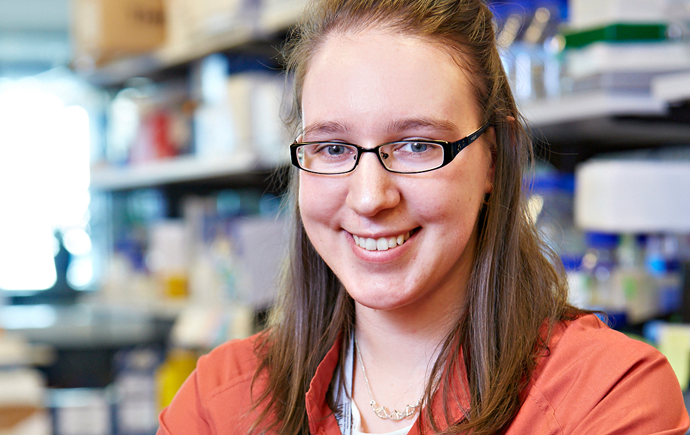
Christina Gangemi
- Year completed 2017
- Current position PhD candidate, Australian Regenerative Medicine Institute
- Degree(s) Bachelor of Science and Bachelor of Arts
Career summary
After graduating from Monash with a Bachelor of Arts and Bachelor of Science (Honours) in 2017, Christina Gangemi worked as a research assistant with the Australian Regenerative Medicine Institute for one year before beginning a PhD in early 2019. She is now working as a PhD candidate and scientist with the Australian Regenerative Medicine Institute, studying the effectiveness of light-induced beta cell regeneration in Type 1 Diabetes.
Career pathway
2019 to current - PhD – Regenerative Medicine, PhD candidate, Australian Regenerative Medicine Institute, Victoria
2017 – Bachelor of Arts / Bachelor of Science (Hons), Monash University
Why did you choose to study a Bachelor of Arts and Bachelor of Science with Monash University?
Before I reached high school, I was already a performer. I did a lot of musical theatre, I was a singer and I played guitar. I also really enjoyed science in high school, particularly biology.
By the time I got to VCE, I knew that I wanted to keep performing, but at the same time I wanted to give myself the chance to get more exposed to science.
My VCE results were better than I expected, so I went to Monash’s Change of Preference Expo where I came across the double degree with Arts and Science.
What have you learnt or gained from your Bachelor of Arts which has helped you in your career?
As a scientist, you have to have excellent analytical and problem-solving skills. At the same time, a huge aspect of the job is being able to communicate your findings not only to other scientists, but to a broad array of people.
Communication is key, and I think it’s something that is not as well recognised as part of the job. Having an Arts degree helped me in this area. I always found that when I was doing a lot of the communication parts of science, like writing and presenting, it came quite easily. In theatre, you learn how to tell a story and you are always presenting to your audience. We did a lot of improvisation in my theatre classes, where we fed off each other to create something off the cuff. In science, you have to be resilient because you can experience a lot of failure and a lot of the time your experiments don’t work. So, having that resilience and always being up for experiencing the unexpected and bouncing back up with new ideas is essential.
How has your career progressed and what are you currently doing?
Securing an internship in my second year was a pivotal moment for me. I got to work in an agriculture biotech company with La Trobe University. This internship allowed me to get practical experience and see what it was like to work in a real lab. I quickly realised that the lab environment was where I wanted to be.
After my internship, I looked for ways that I could be in a lab and continue to get practical experience. I did a few more different internships, and that process landed me at ARMI. Our lab has a focus on using light to regenerate tissues. We engineer proteins to be controlled by light and then we can use this to try and regenerate tissues in different disease contexts - in my case it is diabetes.
With my project, I am designing optical versions of proteins that are important for cell survival and proliferation. The ultimate aim is to regenerate the cells in the pancreas that produce insulin. These cells are important, and they are destroyed by the immune system in Type 1 diabetes. We’re trying to find a way to reverse that process by promoting their proliferation. We hope that light can be a more specific, controlled and targeted method over pharmacological approaches.
How has your Arts degree helped shape your career?
I wouldn’t be the scientist I am today without my Arts degree and without that performance background. The communication aspect of being a scientist is so important.
A lot of science students might be great at the bench or good at getting that data, but at the same time you also have to be good at communication and working with other people. When you study theatre, you have to work in groups a lot. Being able to work with people of different backgrounds, different experiences in different contexts was important for me. I love seeing how theatre and science intersect, and being able to explore that through my degree was exciting and rewarding.
What is your message to future or current students about the benefits of an Arts degree?
Go for it. It will make you so much more rounded as an individual and it will give you those extra vital skills.
University is such a rich time to explore because you are not set on a career yet and you have still got that opportunity to find your passions. A double degree allows you to gain insight into different fields if you are interested in two things.
Interviewed by Tallis Miles, journalism intern, Monash Arts, 2020