
Eleena Chang

Eleena Chang
- Year completed 2023
- Current position Native English Teacher, Munhyang High School, South Korea
- Degree(s) Bachelor of Commerce and Bachelor of Arts
- Specialisation Korean studies
Career Summary
Eleena is a passionate educator, communicator, and cross-cultural connector currently working as a Native English Teacher in South Korea. A graduate of Monash University with a double degree in Arts and Commerce, Eleena discovered a deep love for Korean language and culture through a nurturing and collaborative academic environment. Inspired by her professors and peers, she pursued Korean language studies with intensity, later completing a CELTA qualification to teach English abroad.
Her career journey has been shaped by a desire to explore, connect, and help others grow, whether through immersive language teaching, mentoring, or leadership roles in hospitality and community organisations. Eleena’s ability to communicate fluently in Korean and her deep understanding of Korean society have enabled her to build genuine connections with students and colleagues. Driven by empathy, cultural curiosity, and a global mindset, Eleena brings warmth, resilience, and purpose to everything she does.
Career Pathway
Apr 2024 - Present: Native English Teacher, Munhyang High School, South Korea
Dec 2023 - Feb 2024: Project Officer, Australia-Korea Business Council
Feb 2023 - Dec 2023: Research and Teaching Assistant, Korean Studies, Monash University
Oct 2022 - Apr 2023: Intern, Australia-Korea Business Council
Jun 2022 - Jul 2022: Intern, Monash Virtual and Augmented Reality Services,
Sep 2020 - Apr 2024: Team Leader, Pepper Lunch
Nov 2017 - May 2023: Online Team Member, Woolworths Supermarkets
May 2015 - Aug 2016: Waitress, Nando’s Australia
-
Career Journey questions
Why did you choose to study the Bachelor of Arts and Bachelor of Commerce double degree at Monash?
I was unsure about what I wanted to do in the future, so I wanted a degree that I could apply to multiple industries. I really enjoyed learning Korean in the Korean Studies department as everyone was very friendly and supportive. Everyone worked together and the learning environment was hands down the best learning environment I had experienced.
How did you get your current position?
I wanted to take a break from studying after graduation and I also wanted to travel. I went to an event where professors from the Korean Studies departments shared their experiences in learning Korean. I knew then that I also wanted to do the same, so I could become fluent like them. I researched the EPIK program and completed an intensive CELTA program to teach English. I have now been working in Korea for over a year as a Native English Teacher to middle school and high school students in Jeollanam-do, South Korea. It is one of the best experiences of my life and I'm super grateful for this opportunity.
How did the Monash Arts community support your growth and ambitions during your studies?
Two of my professors would check in on me when I first applied for my course and they provided support during this process. My peers in the same department also supported me during the ups and downs of university life and through the application process to becoming a Native English teacher in South Korea.
How did your Monash Arts degree contribute to where you are today in your career or personal life?
I can use the Korean I learned to communicate with my co-workers and understand what my students are saying in Korean. After graduating, I have realised that the grammar patterns we learned at university were much more applicable than any other textbook used to learn Korean. Although I have much more to learn, I am grateful for the textbooks we used as it made it easier for me to use those grammar patterns in real life compared to people I had met here who used different textbooks.
Meeting everyone in my Korean Studies Department helped me open up to more cultures and experiences that I did not get from the business department. Therefore, I could share more stories about Australia in South Korea. The languages departments were very friendly and everyone was much closer and almost more familial than any other department I had been in.
Were you actively involved in any activities that enhanced your university experience, such as, student organisations or clubs, internships or study abroad?
I became a circle leader and teaching assistant for the Korean Studies Department. This helped me reach out to more people and learn how to better teach people. I wish I had the opportunity to study abroad in Korea, but due to COVID and my available units, it was not possible. If I had had the opportunity, I think it would have further increased my interest and understanding of Korean society, language and culture.
From your perspective, why is Arts, Humanities, and Social Sciences an area of study crucial for today’s society?
Arts, Humanities, and Social Sciences are areas of study crucial for today’s society as the world continues to globalise. It is crucial to understand different cultures and be more open and accepting of changes as the world will never stop changing. Even the rural schools I teach at are trying to expose their students to more diverse cultures as they understand how important that is today. This is a big step for Korea as a homogenous country to open itself up like this. It is that important. Learning about Korean society opened me up to new experiences I would never have experienced back home. Each and every society and culture has something unique to them that everyone should learn to embrace, so it is important to learn about these things as the world around us continues to evolve and change.
What does a typical day look like in your current role?
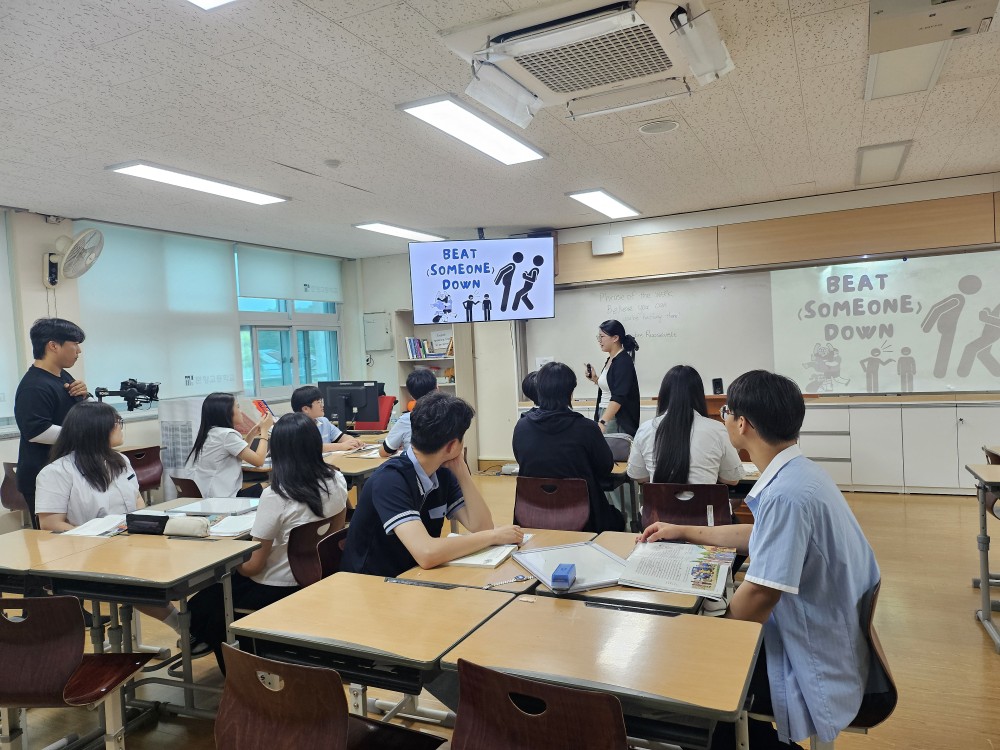
My day usually starts around 8am when I drive to work, and the school day runs from 9am to 5pm. Depending on the day, I teach around two to three classes across both high school and middle school through the EPIK program.
When I’m not teaching, I spend time preparing lessons and sometimes run conversational English classes for co-workers. The teaching style also varies between schools, with middle school focusing more on conversational English and high school focusing more on reading, listening and critical thinking skills.
I currently teach electives including World Culture and Advanced English and over time our classes have become much more interactive and discussion-based.
What have been the most rewarding aspects of your role, and what key challenges have you faced as a Native English Teacher in South Korea?
The most rewarding part of my role has been seeing students become more confident communicating in English. At the start of the year, many students are hesitant to speak because they are worried about making mistakes, but over time they become much more comfortable and expressive.
One of the biggest challenges has been the language barrier, particularly when students are dealing with personal or emotional difficulties. Although I can speak some Korean, I still need to encourage students to communicate in English during class while also trying to support them as best I can.
What advice would you give to students interested in working or living overseas, for example what level of Korean language proficiency was expected for your teaching English role?
You do not need Korean language proficiency to apply for the EPIK program, although having some understanding of the language and culture is definitely helpful. The main requirements are a university degree and a teaching qualification such as TESOL or CELTA.
Living overseas teaches you a lot about adaptability, communication and cultural understanding. My biggest advice would be to stay open-minded, take opportunities when they arise, and not be afraid to step outside your comfort zone.
Some advice I really wanted to share with students is to just try. If you never try something, you will never know where it could lead. Before applying to EPIK, I had read mixed reviews online about school placements and cultural differences, but I decided to take the risk after hearing about the positive experiences of people around me, and I absolutely love working here. Without taking that opportunity, I never would have experienced this side of Korea beyond what most tourists normally see.
What advice would you give to current students on how to make the most of their time at Monash, both academically and socially?
Meet as many new people as you can. Share your culture and work together through the thick and thin of university life. The friends I made at university will forever be the friends I continue with throughout my life. We shared the same interests at university and we still do to this day. Also, especially if you learn Korean, push yourself to learn the vocabulary. No matter the language, no matter how much grammar you master, without the vocabulary to use it, it is difficult to communicate. Coming to Korea, I have seen first-hand that there are some changes to words, as languages also evolve, but I still wish I had studied them more when I was at university.
As a teacher, I would be happy for any student giving anything a try. We understand that students will struggle and will need help, so don't be afraid to ask. It is better to ask and receive an answer than to not ask and forget and/or regret. Lastly, being at Monash University pushed me to take more initiative and to learn to speak up and out, both in my studies and socially. I never thought of myself as someone with many friends until I went to Monash and came to Korea. Because of this characteristic, I have made some lifelong friendships here and met some of the most amazing people who have had the most interesting life stories.