
Julia Pham
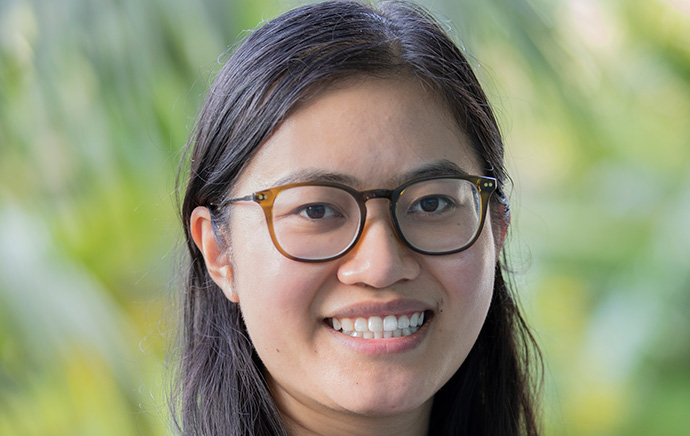
Julia Pham
- Current position Senior Policy Adviser, Department of Jobs, Skills, Industry and Regions
- Degree(s) Bachelor of Arts and Bachelor of Commerce and Master of Public Policy
Career summary
Julia is a passionate policy professional dedicated to shaping cities, economies, and infrastructure in ways that truly impact people’s lives. With a career spanning government, consulting, and think tanks, she specialises in turning complex economic and policy challenges into practical solutions.
Julia’s journey started with a deep curiosity about how societies function—why some cities thrive while others struggle, and how transport and infrastructure shape everyday life. This led her to study Economics and International Studies before specialising in Transport and Urban Policy with a Master of Public Policy. Through internships at think tanks and government agencies, then roles as an economist at AECOM and a consultant at KPMG Australia, Julia gained hands-on experience influencing major projects and policies.
Now a Senior Policy Adviser in the Victorian Government, she plays a key role in shaping policies that drive economic growth and better urban planning. Whether working on multi-billion-dollar infrastructure projects or tackling real-world policy challenges, Julia thrives at the intersection of strategy, data, and public impact. Her journey is proof that curiosity, critical thinking, and hands-on experience can open doors to a career that not only excites but also makes a lasting difference.
Career Pathway
2023 – present – Senior Policy Adviser, Priority Projects Unit – Economic Policy, Projects and Coordination Group, Department of Jobs, Skills, Industry and Regions
2022 – 2023: Manager, Planning & Infrastructure Economics, KPMG Australia
2020 – 2022: Senior Consultant, Planning & Infrastructure Economics, KPMG Australia
2019 – 2020: Consultant, Planning & Infrastructure Economics, KPMG Australia
2018 – 2019: Graduate Economist, Infrastructure Advisory, AECOM
2018: Research Intern, Analysis & Policy Observatory (APO)
2017: Economics Intern, Transport for Victoria, Department of Economic Development, Jobs, Transport
2017: Summer Intern, Transport & Cities, Grattan Institute
Why did you choose to study a Bachelor of Arts and Bachelor of Commerce (majoring in International Studies and Economics) and a Master of Public Policy (majoring in Transport and Urban Policy)?
After finishing my VCE, I knew I was interested in a mix of humanities disciplines such as Economics, Geography, and Politics, which led me to pursue an Arts/Commerce double degree.
Throughout university, I gradually realised that I really enjoyed working in transport and urban policy, and so my first job out of Uni was as an economist at an engineering firm. That experience made me decide to continue in this field, so I went on to do a Master of Public Policy with a focus on transport and urban infrastructure policy.
How did you get your current position?
I’m currently a policy adviser in the Victorian Government, specifically within the Department of Jobs, Skills, Industry and Regions.
Looking back, I took a fairly traditional route to get here—I studied Economics and International Studies at university, both of which have strong intersections with the public policy profession. As an only child and the first in my family to attend university, I was often lost about what I could do with my degree. I explored different options – thought I was going to be an accountant at one point – and made friends following a range of pathways, and it was through those connections that I was introduced to different opportunities.
One of my friends was applying for an internship at a think tank and suggested I apply as well. That experience gave me the chance to explore public policy both academically and professionally, and from there, I completed an internship with the Department of Transport, worked as a public policy consultant, and eventually moved into government.
From your perspective, why is Arts, Humanities, and Social Sciences an area of study crucial for today’s society?
I think an Arts degree—or humanities and social sciences more generally—helps you develop a deep understanding of systems and ecosystems. It teaches you how to analyse complex issues and tease out an understanding where the answer isn’t always obvious. The critical thinking skills it provides are incredibly valuable.
In my work, I have collaborated with engineers who bring a different, more quantitatively-focused skill set, but have tended to be less capable in communicating ideas effectively and navigating complex professional and interpersonal situations (sorry to the engineers I worked with!).
I’ve found an Arts education fosters comfort with uncertainty and nuance, which is crucial both professionally and at a societal level. It helps us see how certain situations are connected to historical, political, and social contexts, which builds empathy, enhances intercultural awareness and allows us to engage with diverse perspectives and people. It also helps us consider the ripple effects of our decisions and navigate the grey areas of real-world challenges.
How did the Monash Arts community support your growth and ambitions during your studies?
As someone who was the first in my family to go to university and was pretty lost during the first half of my studies, I leaned heavily on the support network created by friends I’d made in various social clubs. I remember randomly applying for an internship without really knowing what the day-to-day job would be like, but having friends as a support network made all the difference, and it was reassuring to be on this journey with people who were also figuring things out alongside me. Some friends also had family members were working in the fields we were studying, which was eye-opening and helped me see different career pathways.
The Monash Arts community also provided so many opportunities—there’s a lot of funding and support to explore whatever you like. Programs like Model UN and study abroad were life-changing and formative experiences. Through the New Colombo Plan Scholarship, I had the opportunity to go to Vietnam and learn first-hand about the personal impacts of intergenerational trauma. Coming from that background myself, it was incredibly meaningful to visit the refugee camp where my dad had once stayed.
Looking back, I also realised how fortunate I was to learn from such excellent academics. It wasn't until later in my studies that I truly appreciated just how good the faculty at Monash was – people like Dr Stephen King and Dr Nathalie Nguyen are huge in their fields and I’m lucky to have been their student.
How did your Monash Arts degree contribute to where you are today in your career or personal life?
Practically, the biggest thing my Monash Arts degree did was make me a better writer. Many would be surprised by how valuable this skill is, especially in fields where people are quantitatively focused. Being able to write well is crucial for communicating your ideas – the story you tell about your analysis can influence the impact it will have and whether people will support it.
The degree also helped me understand the historical, cultural, and political contexts which shape my work in policy. When developing policy, it’s important to understand how systems and various influences shape people’s behaviour and perspectives, and which ultimately shapes the effectiveness of any policy.
The multidisciplinary approach of combining social sciences was also extremely valuable for me. The degree doesn’t push you down a specific pathway, but that’s the beauty of it—it opens up options. When I chose my degree at 18 years old I wasn’t entirely sure where it would take me, but it gave me the flexibility to find what I like and pursue it.
What advice would you give to new students on how to make the most of their time at Monash, both academically and socially?
Academically, I suggest students take a broad range of subjects. My major was in International Studies and Economics, and I took a wide variety of courses, from environmental economics and sports economics to subjects on urban development and intergenerational trauma. This broad foundation has helped me engage with people from different disciplines at work and be a better collaborator. Being exposed to different fields also gives you a more nuanced perspective of your own work and shows you how everything is interconnected.
I also recommend joining clubs or societies, whether they’re related to your studies or not. This is a great way to make friends and build a support network. I still catch up with friends I met through the Economics Students Society of Australia, where I wrote articles for their magazine and website. I also participated in Model UN, which allowed me to travel to New York and learn about international politics and negotiation, all thanks to funding from Monash. These experiences were really important for both my personal and professional growth.
Lastly, if you can, get some work experience during your degree. Whether as an undergraduate or postgraduate, working in different fields allows you to explore options and figure out what you want to do without the pressure of a permanent job. For me, my experience at a think tank helped me decide that I wanted to work in a policy role that had more engagement with decision-makers and the community. That experience led me to an internship in government, where I gained valuable insights and practical experience.
Were you actively involved in any activities that enhanced your university experience, such as, student organisations or clubs, internships or study abroad?
The university activities I was part of reflected my evolving interests. I was part of the Monash International Affairs Society, where I attended a lot of Model UN conferences, both interstate and overseas. I also wrote articles for the Economics Students Society of Australia ‘s website and print magazine, and was a member of the Monash Oxfam club as well.
During university I was lucky enough to do internships at the Grattan Institute, Department of Economic Development, Jobs, Transport and the Analysis and Policy Observatory, which helped hone my career aspirations and tailor my university subjects accordingly. I also did a study abroad experience where we went to south-east Asia to learn about the Vietnam war and study the impacts of intergenerational trauma.
Published March 2025