
Natasha Marinopoulos
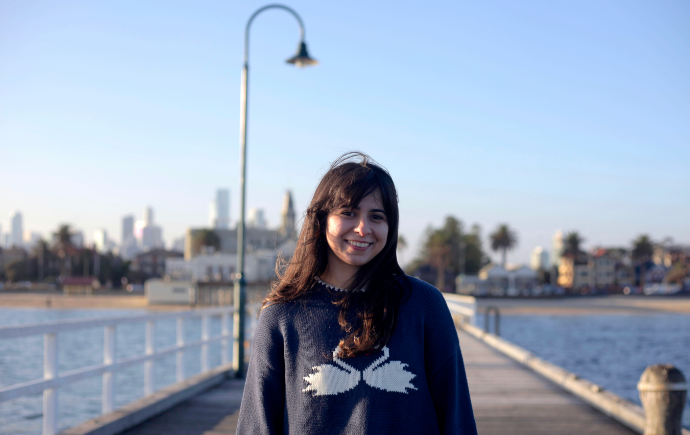
Natasha Marinopoulos
- Year completed 2024
- Current position Education and Public Programs Coordinator at the Hellenic Museum
- Degree(s) Bachelor of Arts
- Major(s) Archaeology and ancient history
Natasha Marinopoulos has always been driven by an innate curiosity about human history, but her path to the museum sector wasn't a straight line. By leaning into the structural flexibility of a Monash Arts degree, exploring unexpected electives, and taking on immersive community volunteering, Natasha transformed a lifelong passion for history into a dynamic, multi-faceted career in public education and curation. Today, she shapes how audiences of all ages—from school children to aged care residents—connect with history.
Career Pathway
- Education and Public Programs Coordinator, Hellenic Museum (Present)
- Master of Museum Studies, Deakin University (2023)
- Museum Volunteer, Jewish Museum of Australia & Hellenic Museum (2022-2025)
- Bachelor of Arts (Honours), Monash University (2017-2021)
- Dance Teacher (2017–2024)
What first drew you to study a Bachelor of Arts and pursue your degree at Monash?
An Arts degree at Monash was a no-brainer for me. All the way through high school, I knew I absolutely loved history, literature, and psychology. History was my baseline and I didn’t entirely know what I wanted to do with it yet, but I knew I had to study it.
I ultimately chose Monash because I fell in love with the sheer flexibility of the course. Compared to other structures that felt very rigid with set units, Monash allowed me to essentially study whatever I wanted and design my own path. Plus, when I attended the open days, I just loved the vibe of the campus. It had this incredible community feel that instantly felt right.
Looking back, what was the most rewarding part of your experience at Monash?
Without a doubt, it was completing my Honours year. It was honestly the most rewarding part of my entire educational experience—even more so than my later postgraduate studies.
It pushed me to do something I genuinely didn't think I was capable of at the start of the year: researching and writing an original, long-form thesis. My thesis was titled Past, Present, and Future: The Agency of Ancestry at Pylos on Bronze Age Greek, focusing on archaeology. Having the guidance of my supervisor, Dr. Jessie Birkett-Rees, was incredible. She taught me so much. It sounds cheesy, but even now, anytime I face a massive task at work or a big hurdle in life, I think to myself, "You made it through your Honours year and wrote a thesis from scratch. You can do anything." It completely reframed my mindset.
What are the top three skills you developed during your degree that continue to shape your work?
First and foremost is writing and editing. Whenever people make snarky comments about the utility of an Arts degree, my immediate thought is that it taught me how to write at a remarkably high volume. It forces you to communicate clearly, concisely, and ruthlessly edit your own work. That is a foundational baseline skill I use in every single walk of my life now.
The second is self-motivation and forward planning. Writing a thesis means you have to plan your life down to the week, set your own deadlines, and constantly push yourself to meet them.
Lastly, targeted historical research skills. Because my current role is heavily anchored in ancient Greek history, the specific methodologies and deep research frameworks I mastered during my Arts degree are things I draw upon daily.
Was there a particular unit or professor that specifically influenced your professional direction?
In my third year, I took a unit called From Alexander to Kleopatra: The rise and fall of the Hellenistic world. He completely changed how I viewed historical storytelling. He presented history as this incredibly dramatic, gossipy, scandalous, Game of Thrones-esque narrative. It was juicy, human, and fascinating.
That unit heavily shapes how I work today. When I am leading gallery tours, writing scripts, or designing public programs, I draw upon storytelling techniques Andrew used. It taught me that history shouldn't just be delivered as dry facts from a dusty book—it has to be about human connection.
You took a gap year to volunteer extensively after your Honours year. How crucial was that for entering the industry?
I cannot encourage students enough to volunteer; it is truly the best way to get your foot in the door. I took a gap year in 2022 and volunteered across both the Jewish Museum of Australia and the Hellenic Museum because I wanted to physically be in those spaces and see if the industry was the right fit for me.
Museum teams are often quite small, so even if you start out simply sitting at the front desk selling tickets, you are constantly chatting with staff, building relationships, and learning how people got to where they are. Everyone in the sector is incredibly friendly and willing to share advice. Ultimately, my volunteering directly led to opportunities and my current job at the Hellenic Museum.
Can you tell us about your current role and what a typical week looks like?
I have a wonderful role where I get to do a bit of everything, which is an amazing position to be in because I am constantly learning. On a Tuesday morning, I might be running an interactive tour and workshop for a visiting school group. By the afternoon, I’m researching best-practice methodologies and writing scripts for upcoming educational programs.
I assist with the curatorial side too, editing copy for exhibition catalogues or writing object labels. I've even had to learn how to handle a drill and a hammer to help dismantle and install physical exhibitions!
My absolute favorite part of the job is our mobile outreach. I coordinate an aged care program where we take the museum on the road to Greek aged care facilities across Melbourne. We design arts-based programs that tap into their cultural heritage (both recent and ancient) and seeing how much joy it brings them is incredibly rewarding.
What advice would you give to current students or recent graduates?
Be brave, follow your curiosity, and take full advantage of Monash's flexibility. I originally went to university thinking I would study history purely for fun and become a psychologist. But I randomly picked up an archaeology elective just to fill a spare unit slot because it slightly piqued my interest. Within the first lecture, I realised, "Oh, this is it. This is what I actually want to do." If you had asked me in Year 12, I would have told you ancient history was boring!
At Monash, moving between majors, minors, and even degrees is incredibly seamless. I am a naturally risk-averse person, but the structure allowed me to experiment safely until I found my exact niche. And if you ever feel stuck, go speak to the Arts Student Services team—they are the most empathetic, helpful humans and guided me every time I wanted to reshape my path. Don't box yourself in. Allow your path to be non-linear.