
Sarah Ricketts
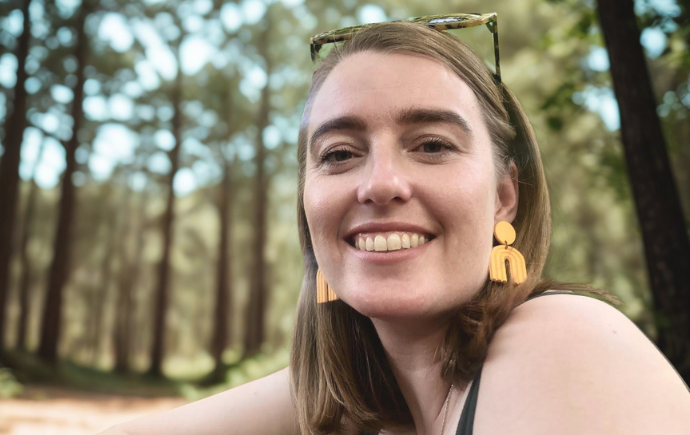
Sarah Ricketts
- Year completed 2017
- Current position Associate Consultant in Cultural Heritage & Archaeology at SLR Consulting Ltd / Freelance Archaeological Specialist
- Degree(s) Master of Arts
- Major(s) Archaeology and ancient history
For Sarah Ricketts, archaeology wasn't just a career choice, it was a childhood dream that became a reality. What began as a passionate interest in ancient heritage transformed into a global, dual-track career across commercial heritage consultancy and field research in Egypt. By taking on a postgraduate opportunity at Monash, Sarah joined a vibrant, interconnected global network of alumni whose shared ties continue to anchor her work across the desert sands of North Africa, the Middle East, Europe and the UK.
Career Pathway
- Associate Consultant – Cultural Heritage & Archaeology, SLR Consulting Ltd (Present)
- Freelance Egyptian Archaeological Specialist & Research Assistant, The Amarna Project (2018–Present)
- Senior Consultant – Cultural Heritage & Archaeology- WSP in the UK (2023-2025)
- Senior Archaeologist – Iceni Projects (2020-2023)
- Archaeological Supervisor – Institute for Field Research, Ethiopia (IFR) (2019)
- Project Volunteer – The British Museum (2019)
- Senior Heritage Advisor – Ecology & Heritage Partners (2019-2020)
- Senior Project Manager/Heritage Advisor – Dr Vincent Clark & Associates (2014-2018)
- Master of Arts (Ancient Cultures), Monash University (2017)
- Researcher & Assistant Archaeologist – Heritage New Zealand (Pohere Taonga) (2012-2014)
- Bachelor of Arts (Hons) (Anthropology), University of Auckland (2008-2011)
In Conversation with Sarah
What first drew you to pursue a Master of Arts in Ancient Cultures at Monash?
It’s quite a story! I’ve been fascinated by archaeology ever since I was young, I was that kid in the museum reading every single artefact label in detail. I completed my undergraduate studies at the University of Auckland and was working in my first professional job when I was introduced to Dr. Colin Hope, a professor of Ancient Cultures at Monash.
He invited me to excavate with him in Egypt as an independent archaeologist. Egyptology had been my primary interest throughout my undergrad, so being out in the field with him was incredible. While we were there, he offered to supervise me for a Masters degree on unpublished material from his excavation. For an aspiring archaeologist, that is the definition of what every child interested in history dreams of. Less than a year later, I had moved to Melbourne to study at Monash.
Looking back, what was the most rewarding aspect of your postgraduate experience?
Getting to work directly in the field was a dream come true, but being introduced to international specialists from across the world was equally profound. The Dakhleh Oasis Project had a large Australian contingent, but there were also British, Canadian, Dutch, American, and Polish experts coming together to study material in the Egyptian desert. Living and working together immersed me in totally different perspectives and ideas.
On a personal and professional level, the networks I forged at Monash have been invaluable and forms a global professional network. Today, I work alongside a whole community of Monash graduates. Even in my freelance research role in Egypt, my project director is a Monash graduate who also taught at Monash.
What top skills did you develop during your MA that continue to shape your work as a consultant today?
Number one is adaptability and perseverance. In my field, primary data comes directly from field excavations, often in foreign locations. During my MA, security issues and permit delays meant I couldn't travel to Egypt to collect my primary dataset on schedule. I had to adapt, pivot to part-time study, and carefully manage the roadblock until I could return to complete my research. When you get hit with a curveball on your postgraduate journey, learning how to stay resilient is everything.
Second is rapid research ability. In consultancy, I am constantly thrown into unfamiliar global locations where I need to quickly get up to speed on local histories, archaeological frameworks, and heritage sensitivities.
Lastly, confidence. My supervisor, Dr Ashten Warfe, was an absolute superstar who constantly encouraged me to present at international conferences and build professional networks. That encouragement really grew my confidence as a researcher and led directly to where I am today.
Your Master’s thesis explored prehistory in Northeast Africa. How does that research influence your work today?
I absolutely loved my thesis research, and I still consider myself a prehistoric Northeast African specialist. I apply the technical skills I developed during my MA to arid environments right across the Middle East and Africa—currently including major heritage projects in Saudi Arabia, Egypt and Mauritania.
At the same time, I’ve spent the last eight years working as a freelance archaeologist at the New Kingdom site of Tell el-Amarna in Egypt, directed by Dr. Anna Stevens (who also lectures at Monash). I’ve excavated non-elite cemeteries and researched mudbrick architecture, while still managing to publish initial findings on local prehistory. Everything comes right back to the analytical and material analysis skills I mastered during my research degree.
How did participating in fieldwork and international missions shape you as an archaeologist?
Excavating at the Dakhleh Oasis Project and attending international conferences taught me how to engage with archaeological material in a live Egyptian context, collaborate across teams, and succinctly present research.
Fieldwork teaches you that archaeology isn't just about digging objects out of the ground; it’s about communicating their significance to the public. Heritage belongs to everybody, and translating complex historical data into something the wider public can connect with is a fundamental responsibility of being an archaeologist.
What does a typical week look like across your dual roles in consultancy and research?
I essentially run two parallel careers! My full-time 9-to-5 is in commercial heritage consultancy. In a typical week, I might be drafting fee proposals, attending client meetings, or conducting desktop research, mapping, and impact assessments. I interpret geophysical surveys, geoarchaeological reports, and site histories—and drink a lot of coffee with my team to get through the day! I also carry out physical site visits across the UK and internationally to evaluate development impacts on heritage landscapes.
My parallel career is my research role, where I spend 4 to 6 weeks a year excavating on-site in Egypt. Back home, I work alongside fellow Monash alumni on a monograph publishing artefact collections from the 1970s and 80s, while also acting as the administrative assistant for the overall research project. It keeps me extremely busy, but it's deeply rewarding.
Why do you feel the Arts, Humanities, and Social Sciences are so vital to society today?
From a cultural heritage perspective, so much of our work centers on public benefit and "placemaking"—exploring how history, archaeology, and identity feed into a community's sense of place. When designing new towns, housing, or infrastructure, bringing historical storytelling into the landscape creates a shared sense of identity that is overwhelmingly positive for society.
Conversely, in times of war, political unrest and conflict, we see cultural heritage deliberately targeted because it embodies a people's history and identity. Understanding and protecting our shared past is essential to understanding who we are and where we are going.
What advice would you give to students considering a postgraduate Arts degree at Monash?
Go for it! Make sure you choose a topic you are genuinely, deeply intellectually curious about, as that curiosity is the fuel that keeps you going through the tough late-night writing sessions.
The technical skills you gain (like research methods, self-direction, and discipline) are a fantastic bonus, but following what you love is what makes it work. Beyond the degree itself, the relationships, confidence, and international networks you build at Monash will stay with you throughout your entire career.