
Tiffany Lucas
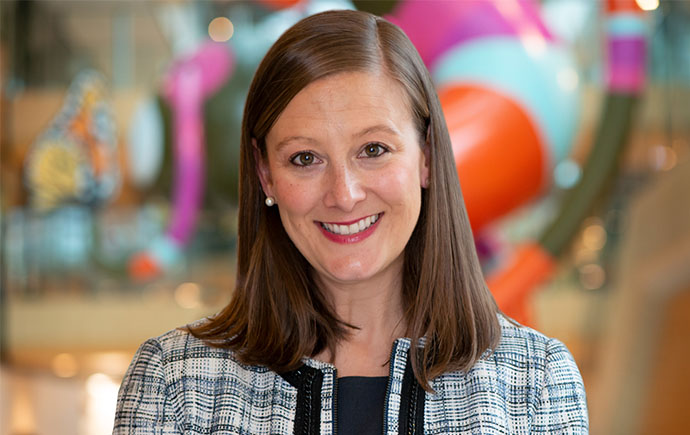
Tiffany Lucas
- Year completed 2016
- Current position Director, TEL Consultants; President RCH Auxiliaries, The Royal Children's Hospital Foundation; Non-Executive Director of The Royal Children’s Hospital Foundation, TEDxMelbourne Ltd, Arts Project Australia and Dancehouse Inc.
- Degree(s) Master of Bioethics
Career summary
Tiffany began her career practising corporate and commercial law at large firms in the US and Australia. While still practising as a lawyer, Tiffany volunteered on the Clinical Ethics Committee for The Royal Children’s Hospital, where she developed an interest in all things bioethics. In 2012, Tiffany channelled that interest into her pursuit of the Master of Bioethics at Monash University, graduating in 2016 with High Distinctions.
Tiffany now sits on the boards of several different organisations including The Royal Children’s Hospital Foundation, Arts Project Australia Inc (an organisation supporting neurodiverse artists), and TEDxMelbourne, where she uses her bioethics background to inform important decision making.
Career pathway
2022 – Present President RCH Auxiliaries, The Royal Children's Hospital Foundation
2022 – Present Non-Executive Director of The Royal Children’s Hospital Foundation, Arts Project Australia Inc, Dancehouse Inc and TEDxMelbourne Ltd
2019 – Auxiliaries Executive Committee, Royal Children’s Hospital Foundation
2017 – Director, TEL Consultants
2016 – Master of Bioethics, Monash University
2013 – Development Director, Melbourne Theatre Company
2011 – Children’s Bioethics Centre Board Member, The Royal Children’s Hospital
2010 – Clinical Ethics Committee Member, The Royal Children's Hospital
2010 – Senior Associate, Arnold Bloch Leibler
2008 – Lawyer, Arnold Bloch Leibler
Why did you decide to study a Master's degree at Monash University, and why the Master of Bioethics in particular?
I decided to study bioethics because I'd gotten involved at The Royal Children’s Hospital (RCH) in a few different facets. I was practising as a corporate and commercial lawyer at that time, and I got involved in the RCH’s Clinical Ethics Committee, which is a group of people who look at ethical situations within the hospital. It's comprised of clinicians, allied health staff, external lawyers, and some community members. It's set up to review ethical situations that have already happened in the hospital and to talk about what would be the best practice next time. It’s like making case law retrospectively, and I found it fascinating.
I became enthralled by this area and had been wanting to do some further study, so I started looking around for programs and Monash clearly has the best bioethics program in Australia and one of the best programs in the world. It was started by Peter Singer, who I think is an amazing ethicist and thought leader. I saw who the professors were and thought, wow, this would be such an amazing program to go through. To get to hear from people who are world-leading thinkers and be in that educational environment was fantastic.
How important is bioethics in today's world?
COVID has completely flipped bioethics on its head. Every single person has suddenly begun sitting around the kitchen table debating bioethics. When in class at Monash, we would contemplate theoretical bioethics questions like “Should you require vaccinations?”, “Could we keep people out of society due to illness?”, “Could we shut down businesses for health issues?”. All those questions that we never thought would transpire in real life, and then they did. I think that bioethics has touched every single person, and everyone now has an opinion on it. It's been amazing to have an educational background in bioethics living in our world in the last couple of years.
I'm on the boards of several different organisations in which we had to make policy about COVID. A lot of them welcome the public into their spaces so there was debate about how we enforce these issues before we had guidance from the government. I really drew on that knowledge and decision making and balancing of priorities and peoples’ rights that we talked about in class at Monash. I think it's super important in today's world.
What were some of the highlights of studying at Monash?
I think just coming together with the other students in the bioethics program was fascinating because, as a Masters program, it draws people from such different backgrounds. Most of the class were doctors and nurses and other allied health professionals, and that was such a different background than what I came from. But there were so many well educated and articulate people. There was also a group of lawyers and government policymakers and a mix of other backgrounds as well. It was a diverse group of people coming together and having interesting conversations. That was the best experience, just hearing other people’s perspectives, all of which were highly educated, highly thought through, but often very different. The quality of the teaching and the quality of the thinkers that were leading the program was also wonderful and engaging.
How has your pursuit in the Master of Bioethics enhanced your career path?
Bioethics is not my primary career, and I mainly pursued it out of interest, but it has really developed my career. I've just recently become the President of Auxiliaries at the RCH and that's all through an auxiliary that we started to support bioethics at the RCH. In October 2022 I will commence on the RCH Foundation Board, and I think being able to bring that bioethics background into the boardroom will be incredibly useful. Having that background really impacted the way that I was able to approach other board capacities during COVID and the thinking I was able to bring.
There is also a wonderful ethics component of the Masters and having that framework and background has been very beneficial to me. I've just finished the Australian Institute of Company Directors course. In that course, we talked about ethics and ran things through ethical lenses all the time, and as a board director you do. So, having that ethics background was incredibly helpful in that as well.
What would you say is the most rewarding aspect of your career?
I think that right now for me, doing so much work with the hospital, it's meeting the families and being part of their journey in a wonderful place that's inevitably filled with a lot of sadness and scariness, but also a lot of joy and amazing people. Being able to be involved in that and help deliver on that is really, really rewarding.
The other thing is, I've been so fortunate to meet and learn from amazing leaders in the medical field, from creative thinkers in the Arts, and from leaders in my board roles. Being around those amazing, visionary people has been so incredible for me.
What advice do you have for those considering pursuing a Master in Bioethics?
Do it. At the RCH we’ve just given a scholarship to someone to undertake bioethics study at Monash. We’ve given her the grant to do that because it really does increase the quality of health care if you are a clinician. It also increases the quality of community thinking, policy making, and decision making. Bioethics issues are going to keep coming up, and throughout our lives there will be complex issues that we have to face as a society. This Masters program gives you a really grounded background and will help you make sound decisions, both in practice and public policy settings. I pursued it out of interest. I didn't even know if it would change or impact my career and it certainly has. I'd recommend it to anyone, and I'd certainly recommend it to clinicians. I've seen the change in the thinking of clinicians and the approach within a hospital setting and I think that it has great benefit and is a growing area of importance. I think that more people are going to be looking for doctors that have that framework as well.
Tiffany Lucas during her Master of Bioethics studies in 2015
Written by Arts intern, Enya Martin, 2022