GPS Research Reveals Caring Responsibilities as Key Barrier to Women's Participation in UN Peace Operations
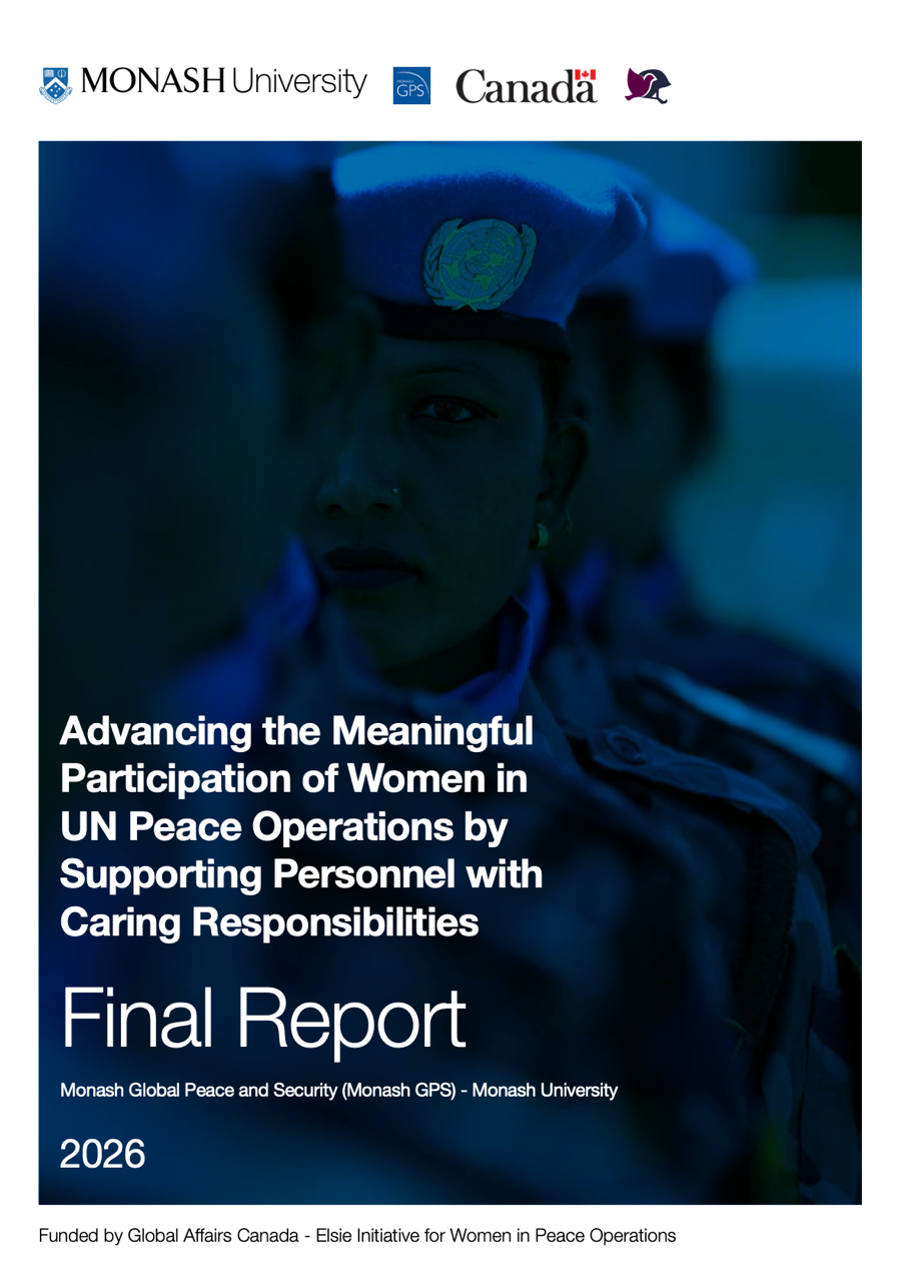
Monash Global Peace and Security (Monash GPS) is pleased to announce the publication of findings from the research project Advancing the Meaningful Participation of Women in UN Peace Operations by Supporting Personnel with Caring Responsibilities, funded by Global Affairs Canada as part of the Elsie Initiative for Women in Peace Operations (2023–2026).
This project is the first of its kind to identify the causes and consequences of marginalising women with caring responsibilities from security sector institutions in Troop and Police Contributing Countries (T/PCCs) and UN peace operations. Drawing from a global survey (296 respondents) and interviews (257 interviewees) with peacekeepers, other uniformed personnel and key stakeholders – totalling 553 research participants and representing 63 countries – the research reveals that caring responsibilities are one of the most persistent, structural barriers to women’s meaningful participation in UN peace operations.
Research was conducted online and across seven country sites: three T/PCCs (the United Kingdom, India and Indonesia); three peace operations (UNMISS in South Sudan, MINUSCA in the Central African Republic, and MONUSCO in the Democratic Republic of the Congo); and UN headquarters in New York. While individual circumstances and contexts vary, research revealed that most women with caring responsibilities, principally caring for children, face a range of practical, organisational, work culture and personal challenges in T/PCC security sector institutions and peace operations. These challenges are compounded by maternal bias and when organisations provide insufficient support. These challenges directly and negatively impact women’s recruitment, retention, training, career progression and deployment opportunities.
The research also reveals that personnel with caring responsibilities bring distinctive and valuable skills to peace operations, and that supporting these personnel enhances capability, benefits well-being and work cultures, retains talent and improves outcomes.
The project outputs include a comprehensive Final Report with evidence-informed recommendations for the United Nations, T/PCCs, armed forces and police, and individual personnel; a Summary Report; an Organisational Toolkit containing 15 practical tools to help organisations translate evidence into action; Policy Briefs; Early Outputs; and a series of op-eds and articles. All outputs are available in multiple languages, including English, French, Spanish, Bahasa Indonesian and Hindi.
These resources can be accessed at https://caringforpeacekeepers.org
Acknowledgements
We gratefully acknowledge Global Affairs Canada for their generous funding and leadership in advancing the meaningful participation of uniformed women in peace operations. Our sincere thanks to the research team — Dr Eleanor Gordon (project lead), Professor Katrina Lee-Koo, Dr Richard Fosu and Lauren Lowe — and to our global consultants and partner organisations: Joana Osei-Tutu and the Kofi Annan International Peacekeeping Training Centre (KAIPTC); Jane Townsley and the International Association of Women Police (IAWP); Dr Irine Gayatri and the National Research and Innovation Agency (BRIN), Indonesia; Tishya Khillare, Anushka Chavan and the Council for Strategic and Defence Research (CSDR), India; Llani Kennealy; and Jennifer Grover. We are deeply grateful to the hundreds of peacekeepers, uniformed personnel and other stakeholders who generously shared their time, experiences and recommendations, and to all those who supported the project through facilitation, advice or review.