
NARI SHAKTI: EMPOWERING INDIA’S WOMEN WARRIORS Anushka Chavan
This article is part of the project: 'Advancing the Meaningful Participation of Women in UN Peace Operations by Supporting Personnel with Caring Responsibilities' (2023-26), funded by Global Affairs Canada as part of the Elsie Initiative for Women in Peace Operations.
Over the last decade, the Indian tri-services and Paramilitary Forces have undertaken paradigm shifts within their organisational and operational structures by incorporating women-centric approaches and devising gender-inclusive policies. For instance, by granting equal childcare and maternity leaves across personnel and officer ranks, and paving way for
Women to attain combat roles as well as high-level posts, the Indian forces (with support from the union government and judiciary) have exhibited a positive pathway towards the advancement of female security personnel.
Granting Permanent Commission to Women
In 2019, the Indian Army altered its rules regarding Permanent Commission (PC) for women, prior to which, female officers were recruited on a Short Service Commission permitting them to serve for only 14 years. Granting PC entailed that female officers would now be eligible for the same promotions, benefits, pensions, and ranks as their male counterparts, and could now be promoted to the ranks of Colonel and above (requiring 16-18 years of service). Moreover, in January 2023 the Army for the first time cleared 108 female officers eligible to command units and troops in their respective branches.
Extension of Maternity and Childcare Benefits Irrespective of Rank
In November 2023, the Defence Minister announced the approval of the provision for extending the rules of maternity, childcare and child adoption leave for all women in the military irrespective of their ranks. With the new provisions in place, women PBOR (Personnel Below Officer Rank) recruited under the ‘ Agnipath Military Recruitment Scheme ,’ would now be at par with their officer counterparts as they would also be entitled for paid maternity leave benefits (180 days), childcare leave (360 days), and adoption leave (180 days). This step towards inclusive participation of all women irrespective of rank, was undertaken to deal with women-specific family and social issues relevant to the Armed Forces, while promoting the harmonious integration of their personal responsibilities and
professional duties.
Provision of Women-Centric Support Schemes in the Paramilitaries
Alongside providing the above maternity and childcare benefits, the central government has been, for years, extending numerous provisions to its female Central Armed Police Forces (CAPF) personnel, such as: separate accommodation and toilet facilities; vehicles fitted with mobile toilets; female doctors and medical facilities with special care to pregnant women; education facilities; creches and day-care centres; and same station posting to married personnel in most cases. The board also requires the presence of one female during the recruitment of women officers. Moreover, female personnel are given equal opportunity in their career progression in terms of promotion/seniority, and skill training to increase ‘self- dependency’ among women recruits. In order to monitor and respond to sexual harassment related-complaints at all levels, Internal Complaint Committees (ICCs) are established and a ‘Programme on Gender Sensitisation in Government Service’ is also conducted. More recently, in 2024, in a bid to strengthen women’s participation, the union government reserved 14-33% constable-level posts for women in various branches of the CAPF. It also allowed for the appointment of pregnant candidates by reserving their candidature and re- examining them six weeks post-confinement, thereby reflecting institutional support for
women’s biological realities and career advancement.
 High-level Appointments of Female Officers
The recent high-level appointments also underscore the significant progress the Armed Forces have made in advancing women's empowerment. These include the appointment of Vice Admiral Arti Sarin as the first female Director General, Armed Forces Medical Services; Lt Gen Sadhna Saxena Nair as the first female Director General, Medical Services (Army); Lt Cmdr Prerna Deosthalee as the first woman officer to command an Indian naval warship; the appointment of Col Sunita BS as the first female Commanding Officer, Armed Forces Transfusion Centre; the appointment of Sqn Ldr Manisha Padhi as India’s first woman military officer appointed as Aide-De-Camp of the Governor of a state; and the appointment of IPS Officer Nina Singh as the first female Director General, Central Industrial Security Force (CISF).
Deploying Female Officers in Combat Roles and Commanding Posts
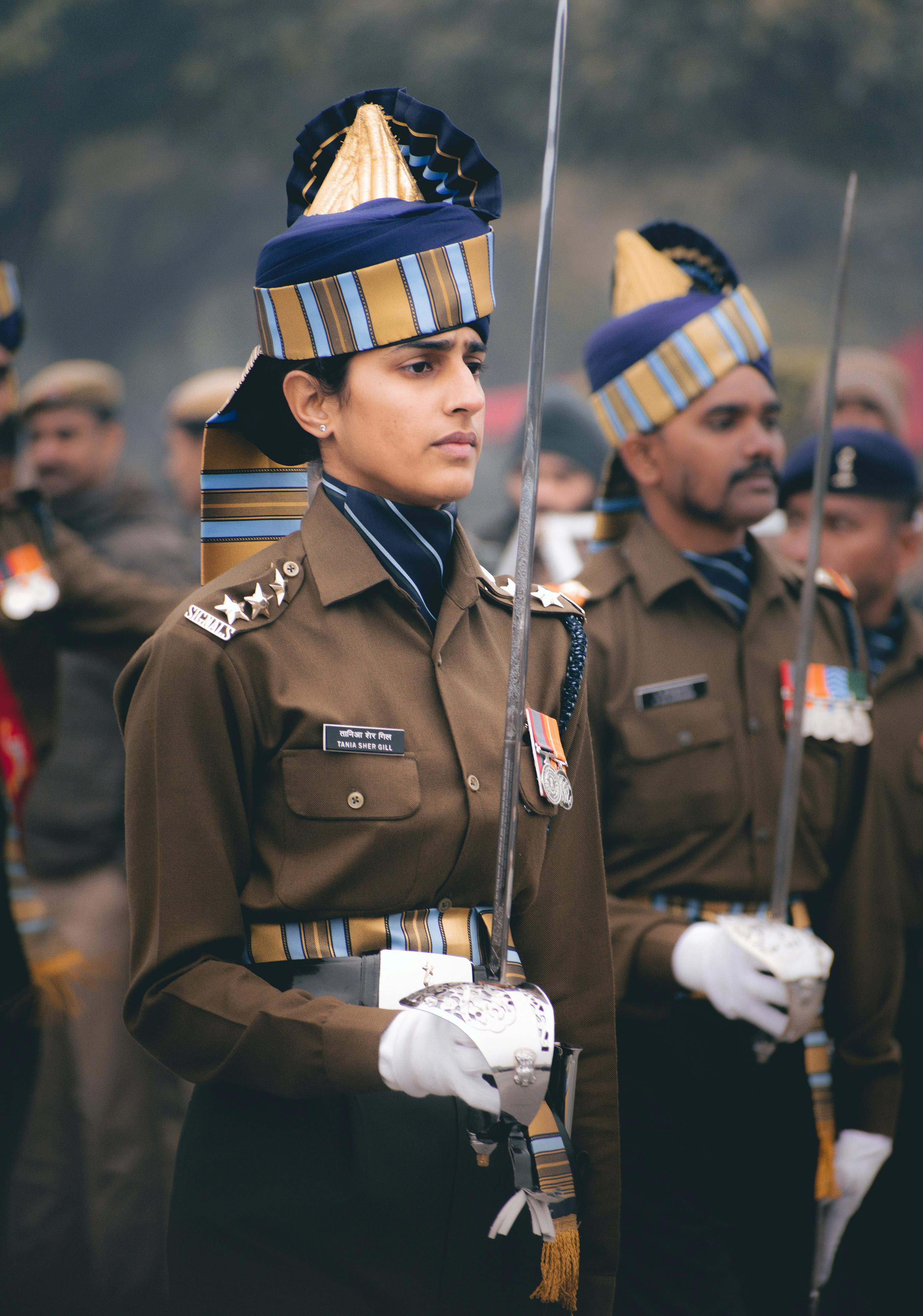
Although female officers in the Indian Army are not permitted to be deployed in combat branches and roles, 10 women officers were commissioned in the regiment of Artillery (a combat support arm) for the first time in 2023. In 2015, the Indian Air Force opened combat roles to women and inducted female fighter pilots in 2019, of whom Sqn Ldr Avani Chaturvedi was the first female fighter pilot to take part in a maiden air exercise. In 2016, Col Sofia Qureshi became the first and only woman to lead an Indian contingent in a multinational exercise, and in 2019, Lt (then) Bhavana Kasturi became the first woman to lead an all-male contingent at the Republic Day Parade. Subsequently, the Indian Navy deployed its first female pilot Sub Lt Shivangi and in 2021 the Corps of Military Police (a
branch of the Indian Army) began inducting female soldiers. Following this, the Indian Army also opened the enrolment of female officers into its Aviation Corps stream with Capt Abhilasha Barak becoming the Army’s first combat aviator in 2024.
In 2023, Gp Capt Shaliza Dhami became the first female officer to command a combat unit, and Capt Shiva Chauhan became the first female officer to be deployed on an operational post on the world’s highest battlefield - the Siachen Glacier. Followed by which Capt Geetika Koul and Capt Fathima Wasim became the first women medical officers to be deployed on the Siachen. Moreover, the Central Reserve Police Force (CRPF) consists of 6 all-women battalions and in 2020 appointed IPS Officer Charu Sinha as the first female Inspector General of one of the most sensitive, terrorist-affected areas of Jammu and Kashmir. Additionally, in 2022, two female officers of the CRPF, Seema Dhundia and Annie Abraham, were promoted to the rank of Inspector General and deployed as unit heads for the first time
ever.
Although further advancements can be made by the Indian Military and paramilitary forces, in terms of frontline deployments for women, significant policy changes have been undertaken over the years. This is particularly with regard to the deployment of female CAPF commandos in Naxal-affected areas, counterinsurgency operations in the North-east and for anti-militancy and search operations in the state of Manipur and UT of Jammu and Kashmir in 2021. The deployment of female BSF soldiers at the Line-of-Control along the Pakistan border for combat and patrol duties; the historic achievement of BSF’s SI Suman Kumari - India’s first woman sniper; and the unyielding defence by the young women of BSF, at forward posts along the Indo-Pak border for three relentless days during Operation Sindoor, broke barriers and redefined the role of women in combat.
In addition to inducting new ships which cater to the gender-specific needs of women, the Indian Navy has opened doors to women opting to get inducted into MARCOS - its Special Forces branch, as well as the Remotely Piloted Aircraft stream. It has also been encouraging the participation of its female officers in multilateral forums and has adopted a gender-neutral language to counter gender stereotypes.
Furthermore, in January 2024, the Defence Minister inaugurated the first all-girls Sainik (military) School with over 800 student enrolments; and most importantly, in a landmark decision taken by the Indian Army, the doors of the prestigious 76-year-old National Defence Academy were finally opened to female cadets - which until 2022 remained a male bastion for recruitment into the three Forces. Such policy shifts being implemented from a gender- inclusive lens prove to be great examples of how the Indian military and paramilitary, are progressively embracing the inclusion and advancement of women in the defence and security fields, thereby revitalising India’s historic and cultural ethos of woman power, that is
- Nari Shakti.
References:
MINISTRY OF DEFENCE - YEAR END REVIEW 2023. (n.d.). Pib.gov.in. Retrieved February 7, 2024, from
https://www.pib.gov.in/PressReleaseIframePage.aspx?PRID=1989502
Raksha Mantri approves provision for Maternity, Child Care & Child Adoption Leaves for women soldiers, sailors & air warriors at par with their officer counterparts. (n.d.). Pib.gov.in. Retrieved February 7, 2024, from
https://pib.gov.in/PressReleaseIframePage.aspx?PRID=1974797