
Encounters with Haenyeo
The Haenyeo Museum on Jeju Island’s east coast is possibly the world’s only museum dedicated specifically to women and the sea.
Introduction: the First Encounter
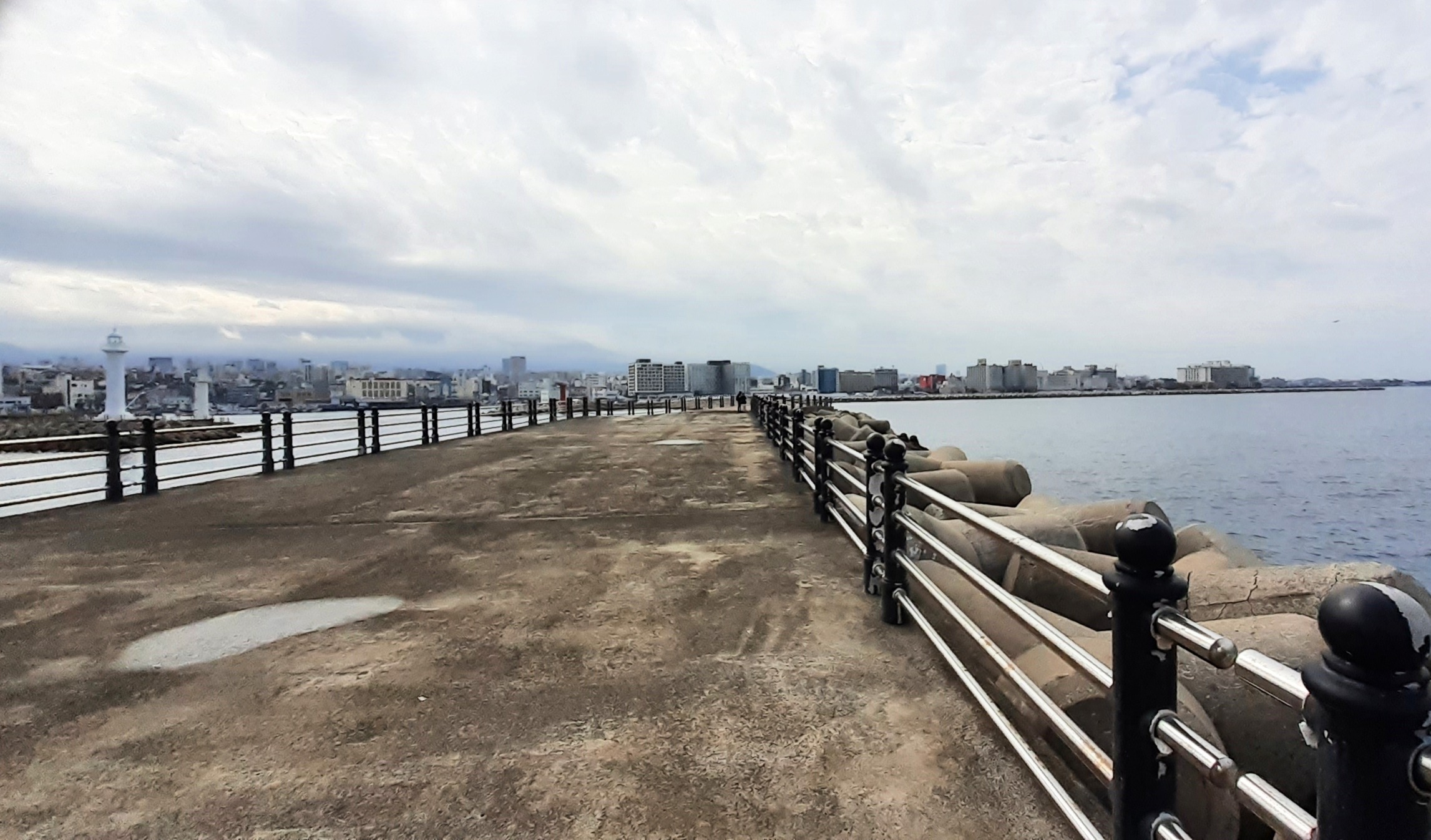
The harbour at Jeju City, seen from the long pier.
In February 2023, on a solitary walk down the wintery, windswept Jeju harbour, I chanced upon a group of four Haenyeo setting off on their daily dive. Haenyeo are the famed women free-divers of Jeju Island, inscribed by UNESCO in 2016 on its list of Intangible Cultural Heritage of Humanity. Often older, they hunt sustainably for abalone, shellfish, sea cucumbers and other maritime produce in a centuries-old tradition.
I was surprised as I had not expected to see them in an industrialised area like the main port of Jeju City. Yet I knew that there were more than 3000 Haenyeo estimated to be active around the island. In addition to their regular work, in other parts of the island they feature in tourist attractions, where eager visitors gather to photograph them going out to work, coming back with their catch, and performing cultural songs.
The women I encountered at Jeju Harbour were simply going about their daily business. I nodded respectfully to them as I passed, and already had my phone out to message my Global Encounters colleague Lily Yulianti-Farid to update her – knowing how excited she would be - when one of the women called out to me and beckoned me over. This was done with calm authority: she knew I would comply. The Haenyeo handed me a pair of sparkly purple crocs and, pointing to the shed at the end of the pier, ordered me to leave them there for her. And with that, she climbed down the rocks and disappeared into the freezing water. This chance encounter, where I was conscripted momentarily into Haenyeo labour, was the highlight of my first trip to Jeju.
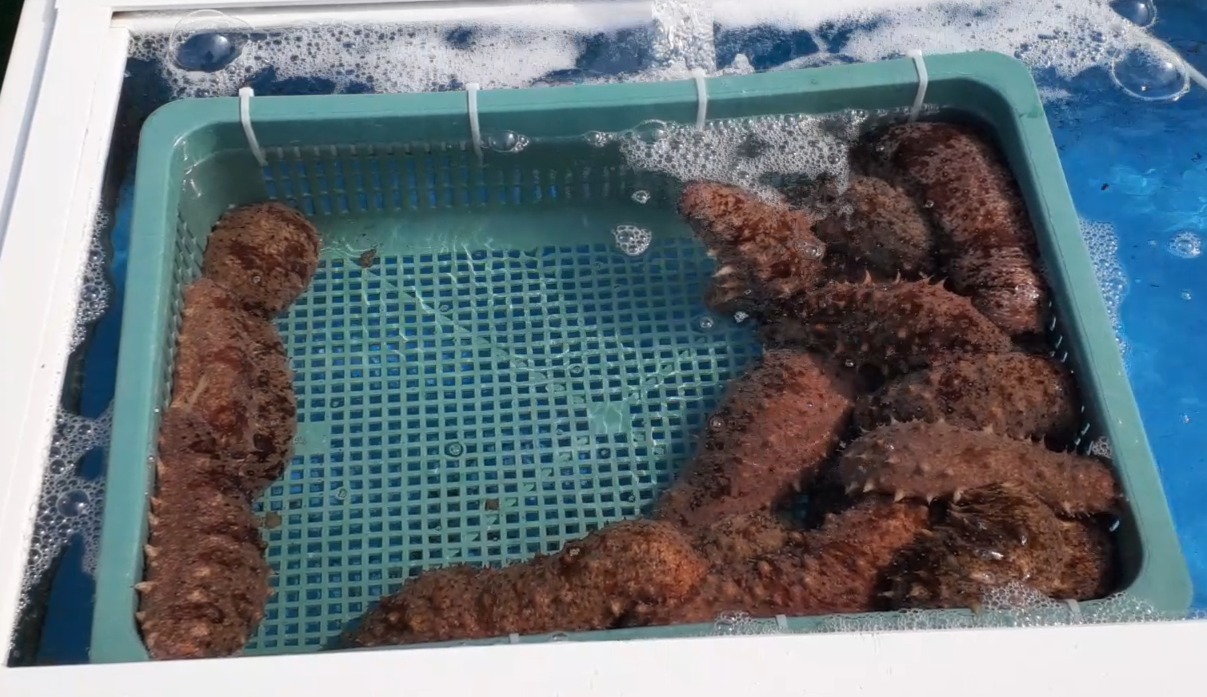
[Note: I did not take photographs of the Haenyeo, as that would have been rude. Instead I photographed some glossy haesam or sea cucumbers in a tank by the Haenyeo shed]:
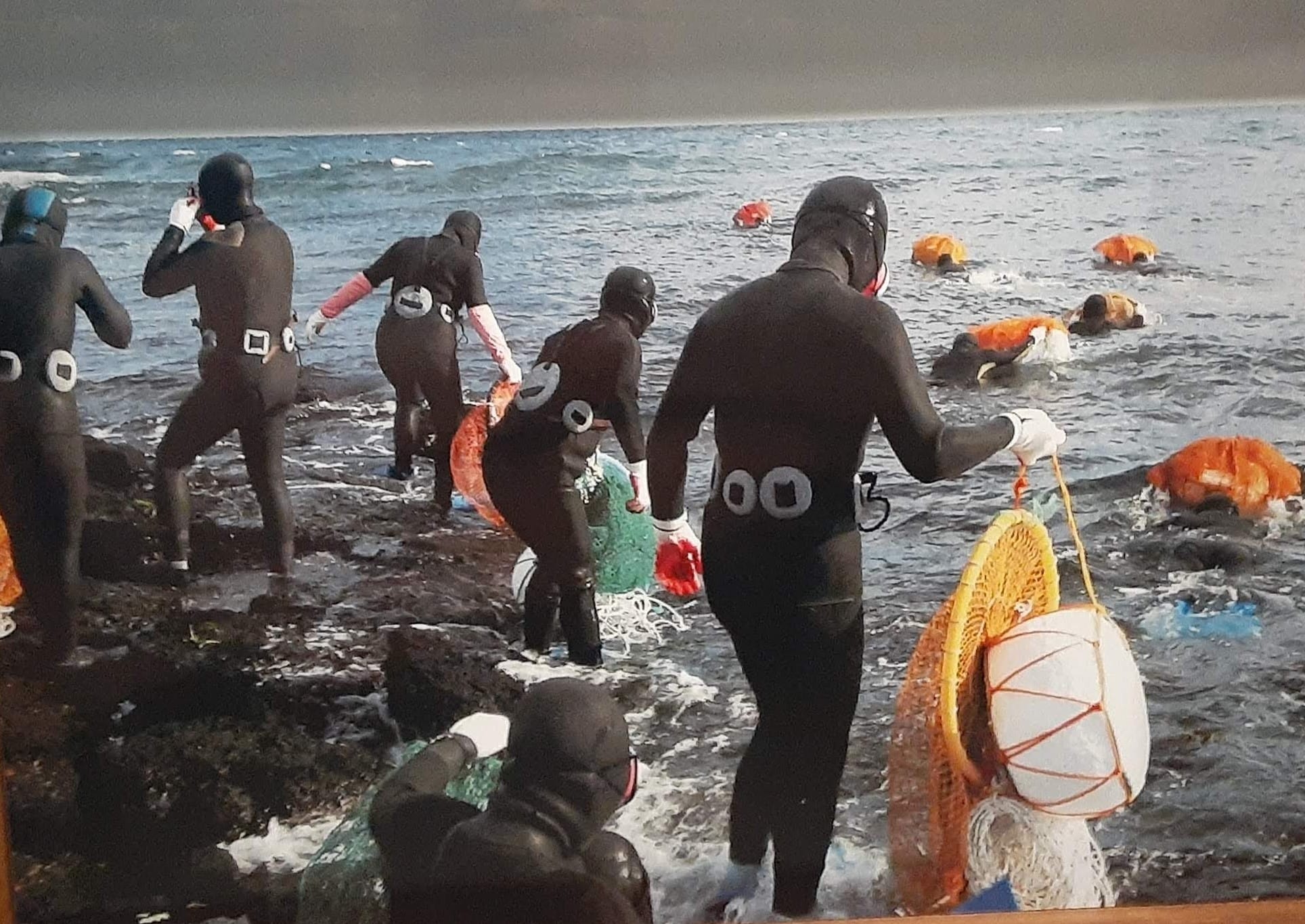
But here is a representative photo of Haenyeo going to work, from the Haenyeo Museum.
Why Jeju?
Although the Global Encounters project is focused on Australian coastal interactions with those who came from the sea, my greatly missed colleague Lily Yulianti-Farid and I spent many, many hours discussing Haenyeo women and their culture. Aside from a shared obsession with Korean dramas, the significance of which should not be underestimated, Haenyeo culture spoke strongly to our individual interests. Lily was a staunch feminist, and had a particular research interest in the role of women in maritime culture. She was doing significant work on unsettling stereotypes and preconceptions that women did not belong on boats or the sea. Lily loved the sea.
My own interest was in the shared characteristics between Haenyeo and the palawa Sealing Women of the northern coasts of lutruwita (Tasmania) who had figured largely in my PhD research on palawa resistance in the Flinders Island exile period of the 1830s and 40s. Both the Haenyeo and Sealing Women were adept at very difficult, dangerous and physical coastal work, largely independent of men, and had developed unique cultural characteristics of solidarity through adversity. Lily was unwell and could not make the trip to Jeju with me in February 2023, and passed away several weeks later. I returned to Jeju in May 2024 to more fully explore the representation of Haenyeo culture. Never before has research been imbued with such sweet sorrow, and each of the following photographs and experiences were taken with my absent colleague in mind.
Encountering Jeju
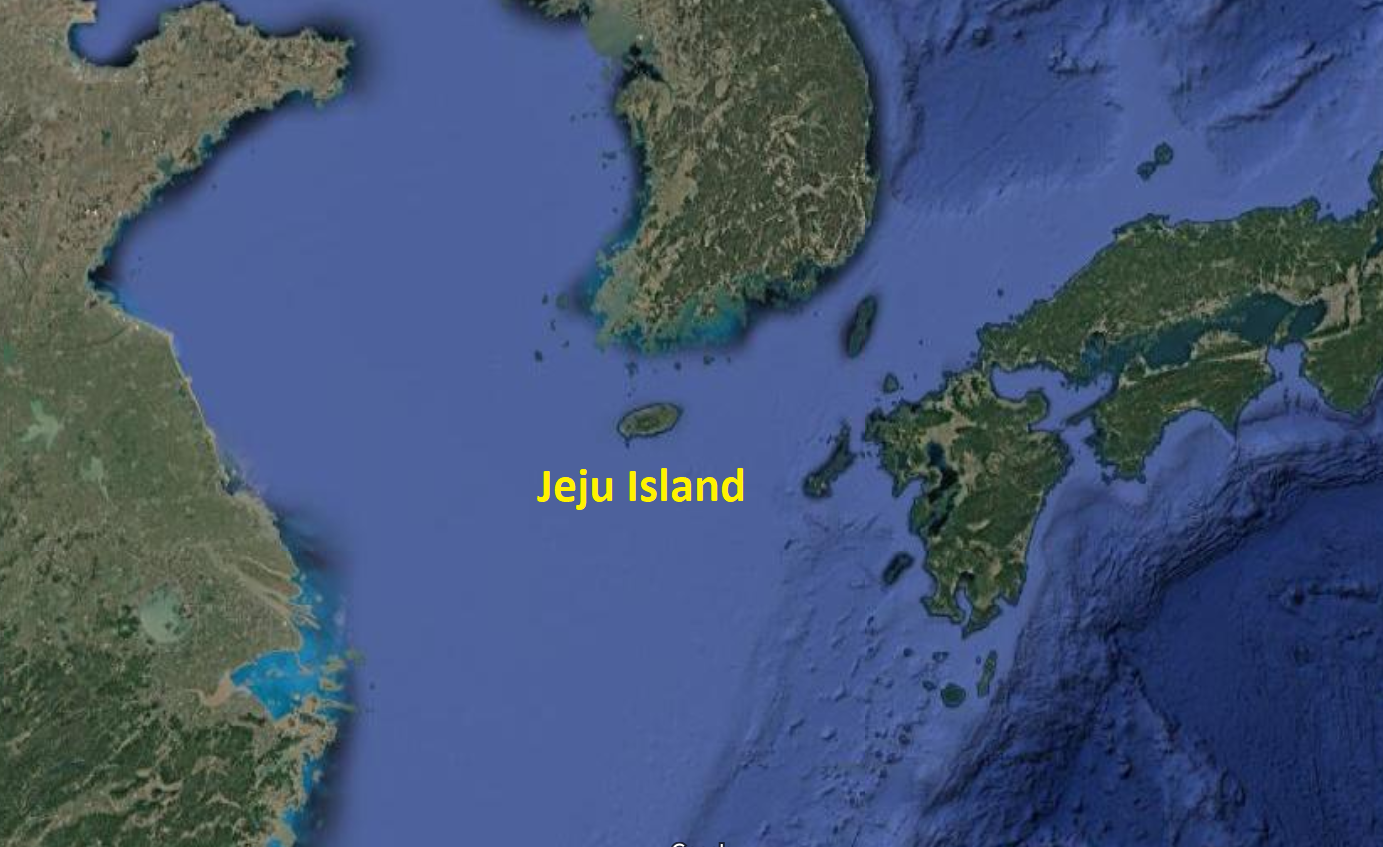
Jeju Island (centre) with the Korean peninsula to the north, Japanese archipelago to the east, and Chinese mainland to the west. Google map.
Jeju Island is situated just over 80km from the southernmost islands of the Korean peninsula. A volcanic island formed after sea level falls associated with the end of the last ice age, around 10,000 years ago. Between 12 and 6000 years ago, its inhabitants created the unique Gosanri-style pottery, which is the oldest in Korea. Jeju was known as the Kingdom of Tamna from 2300BCE, and in 938 it became a tributary state of the Goryeo dynasty. Four hundred years later, Tamna was absorbed into the Joseon kingdom, which more or less maintained control until Japanese occupation from 1910. After WW2, the Jeju Uprising against the division of Korea led to a brutal crackdown in 1948-49, where an estimated 30,000 people, or 10% of the population, were killed. This recent history of colonisation and brutal repression at the behest of non-Korean interests underpins cultural life in Jeju to this day.
Jeju culture is unique, and differs from mainland Korean culture. While Confucian values dominated traditional gender roles on the mainland, maintaining a patriarchal system in public and often private spheres, in Jeju the dominance of shamanism created much more fluid social and domestic spheres. Women always played an active role both inside and outside the home, and especially in the sea. The trauma of Japanese occupation and especially the Jeju Massacre, in which so many men were lost, made Haenyeo work even more essential for survival.
Haenyeo are now something of a cultural phenomenon. They feature in Jeju tourism promotions and in a wide variety of printed materials and maps, often alongside the three other promotional icons – the Dol hareubang (or stone grandfathers), the central volcano Mt Hallasan, and Hallabong tangerines.
The Haenyeo Museum
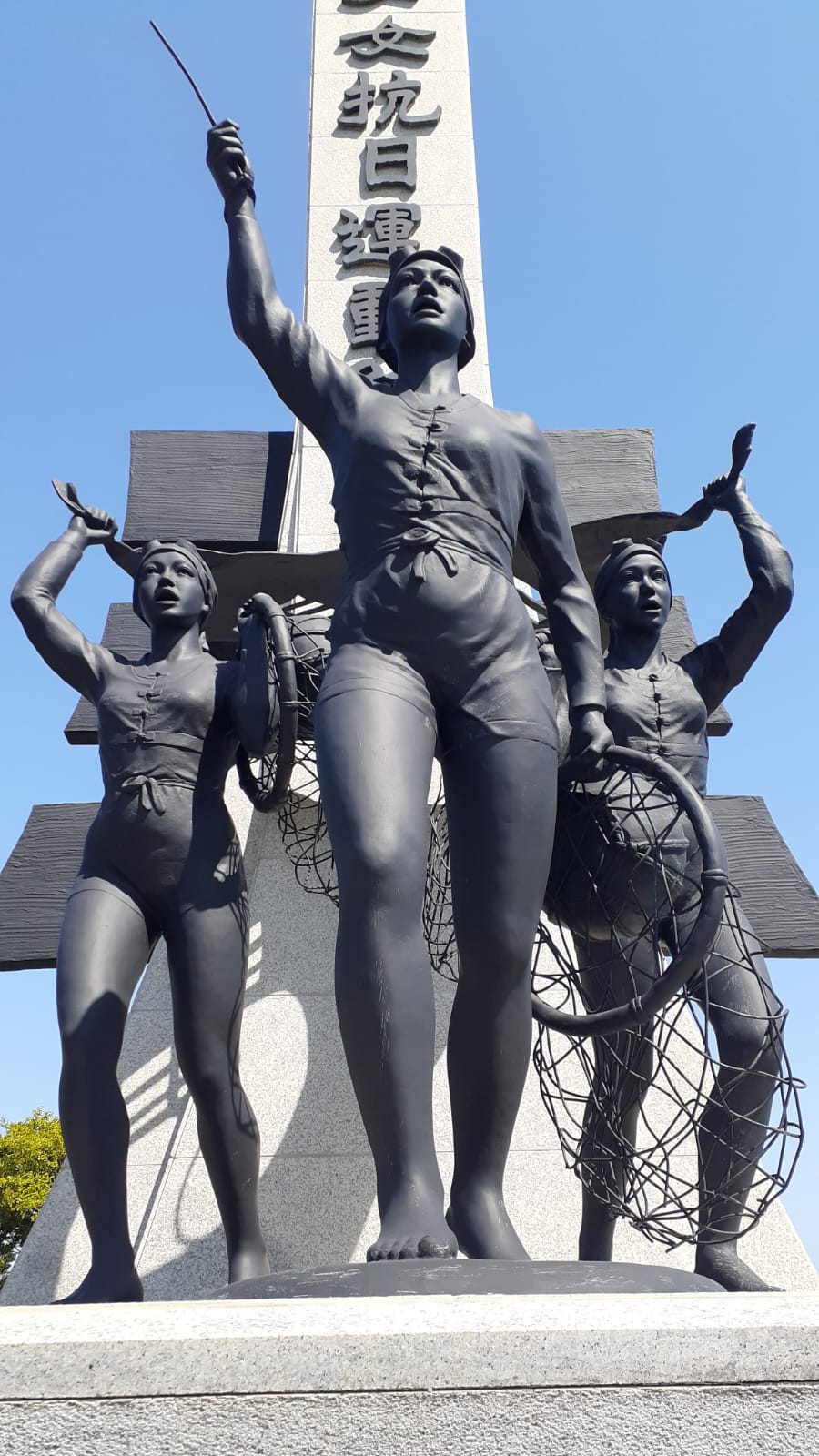
The Jeju Haenyeo Museum is a unique institution situated on the east coast of Jeju at Gujwa-eup, a location which, while on the tourist trail, maintains the atmosphere of a quiet fishing village. Approaching the museum, the visitor passes the magnificent Jeju Hangil (Anti-Japanese) Memorial to Haenyeo. A massive monument focuses on three Haenyeo – Bu Deok-Ryang, Kim Ok-Ryeon and Bu Chun-Hwa - but generally commemorates what is known as the Jeju Haenyeo Uprising.
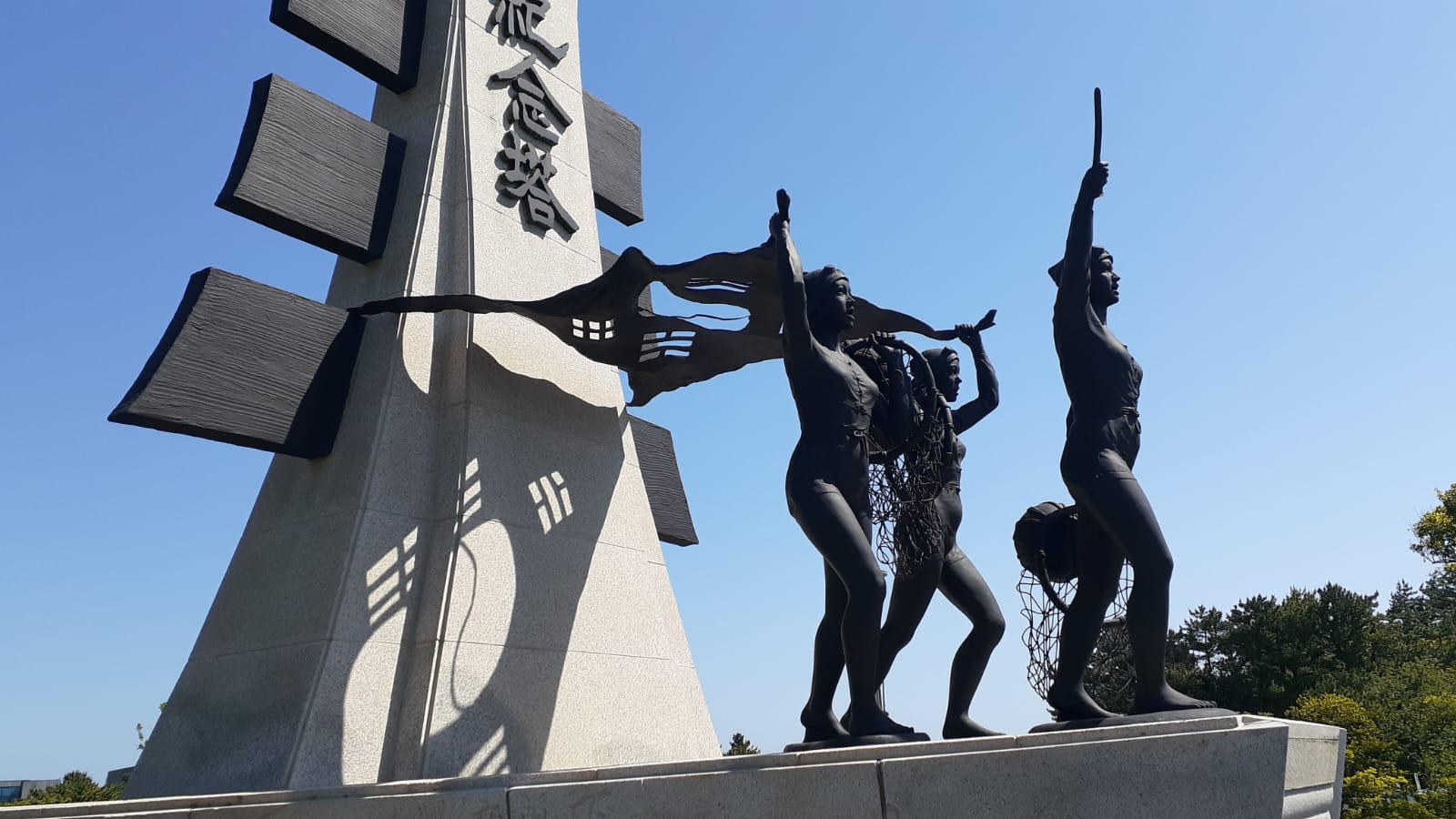
Bu Deok-Ryang, Kim Ok-Ryeon and Bu Chun-Hwa immortalised at the Jeju Hangil Memorial.
In 1932 they led a thousand Haenyeo in a series of protests against deprivations under Japanese rule. They were armed with the traditional tools of the Haenyeo – the bitchang (a steel bar for collecting abalone) and the golgaengi (a hoe for harvesting shells). The women won concessions for their industry in this instance, but shortly afterwards were jailed for supporting independence activists.
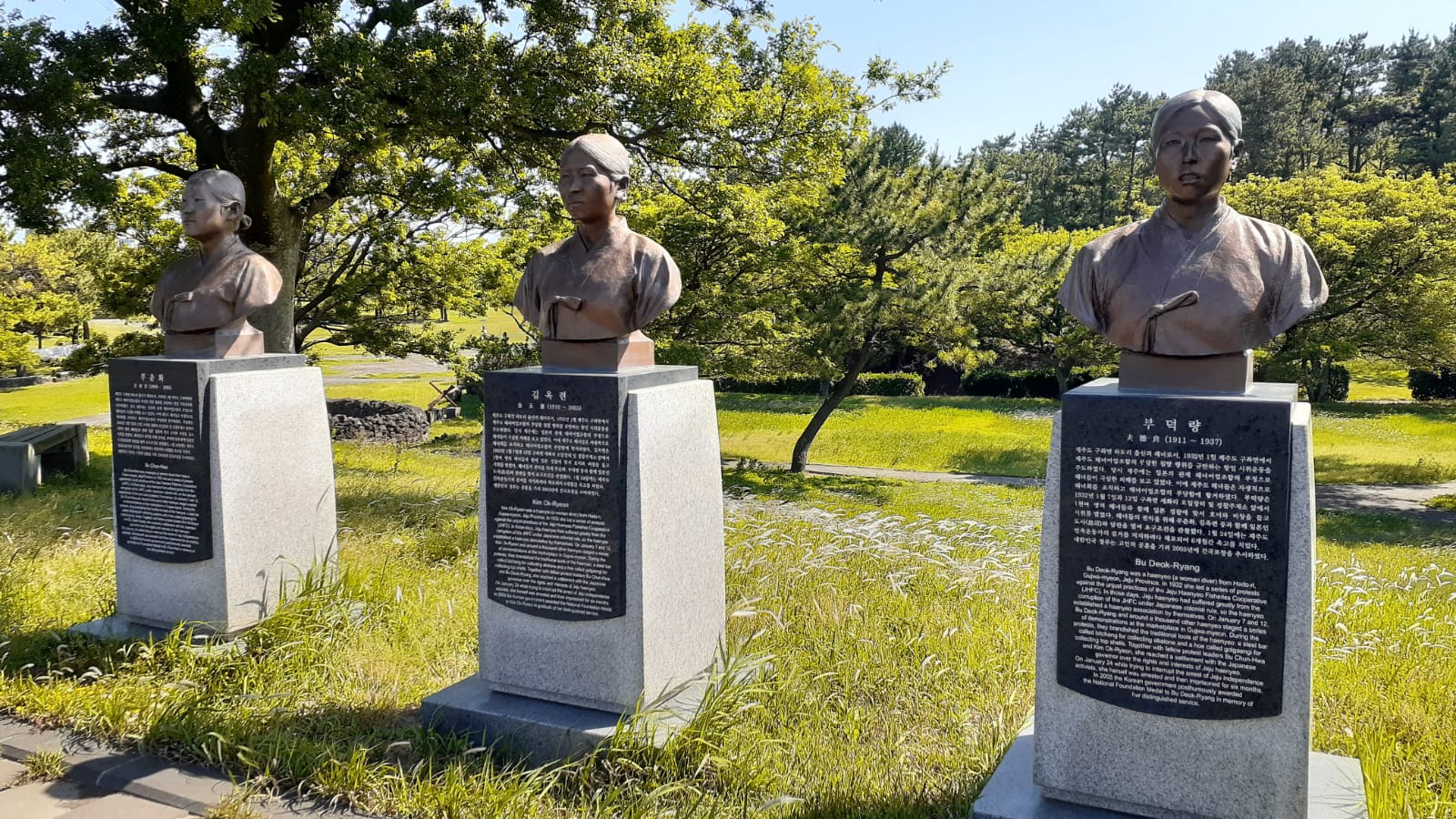
Memorial busts of Bu Deok-Ryang, Kim Ok-Ryeon and Bu Chun-Hwa, at the Jeju Hangil Monument
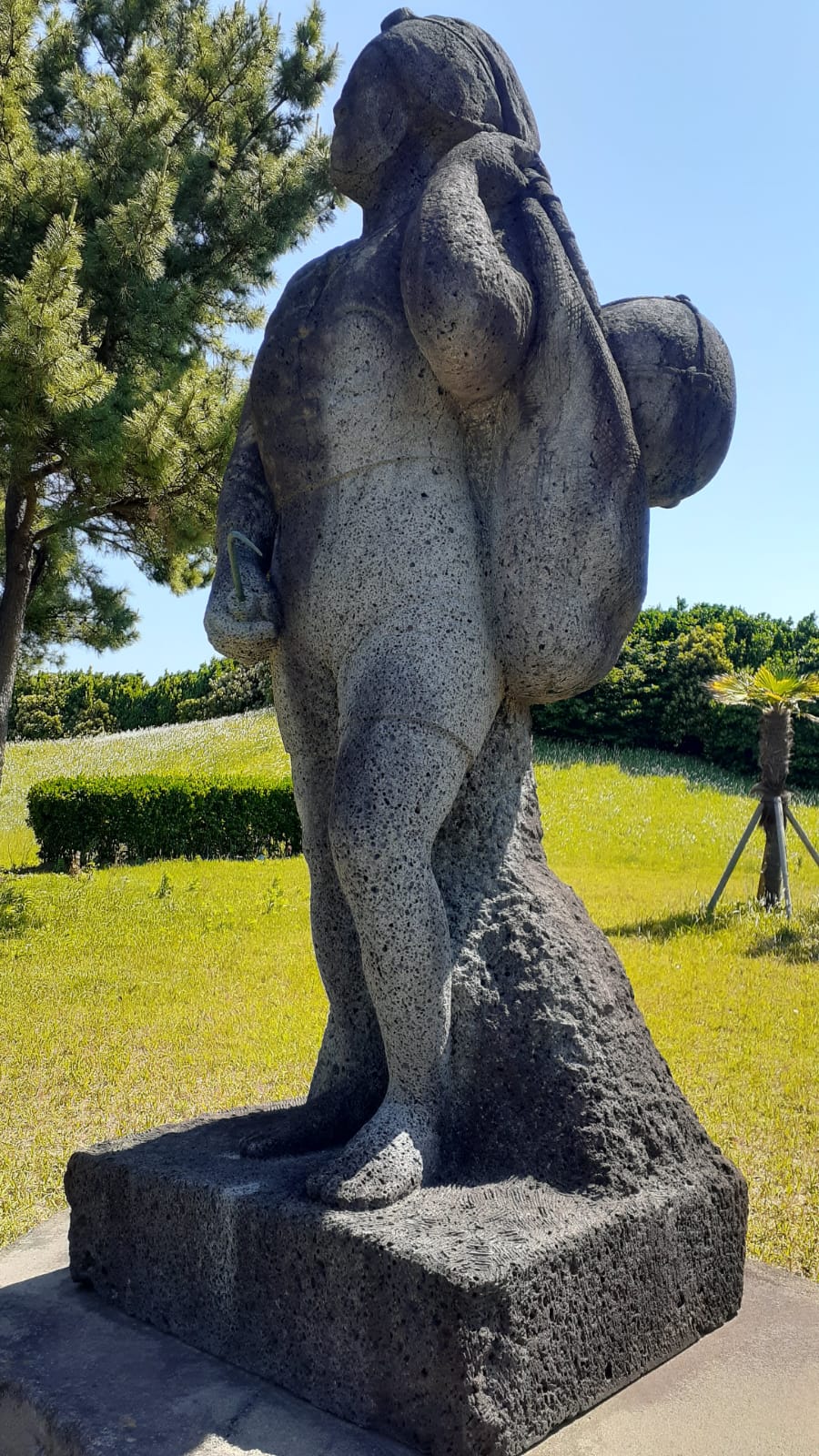
The work of the Haenyeo is central to all representations. It is there in the Hangil Memorial, where the three leading Haenyeo are seen brandishing the tools of their trade. It is the feature of a more modest sculpture off to the side, carved in volcanic stone in a style reminiscent of the ubiquitous Dol hareubang which are one of the key icons of Jeju (along with Haenyeo).
Work is also represented in an outdoor Bulteok, beside the Hangil Memorial.
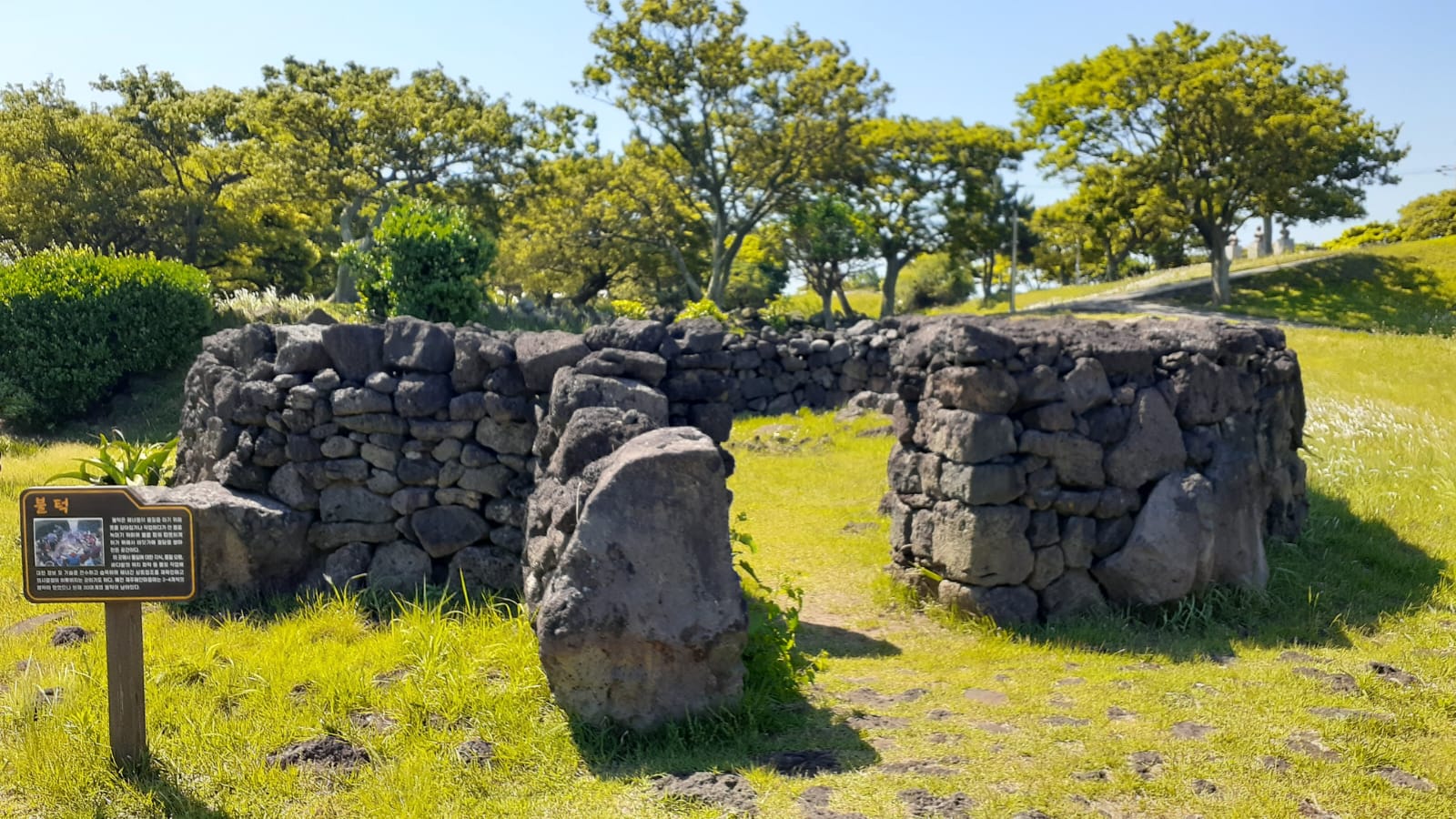
A bulteok, where Haenyeo gather, change clothes, or light a fire to keep warm. It is also where knowledge about techniques, materials and sea fields is shared.
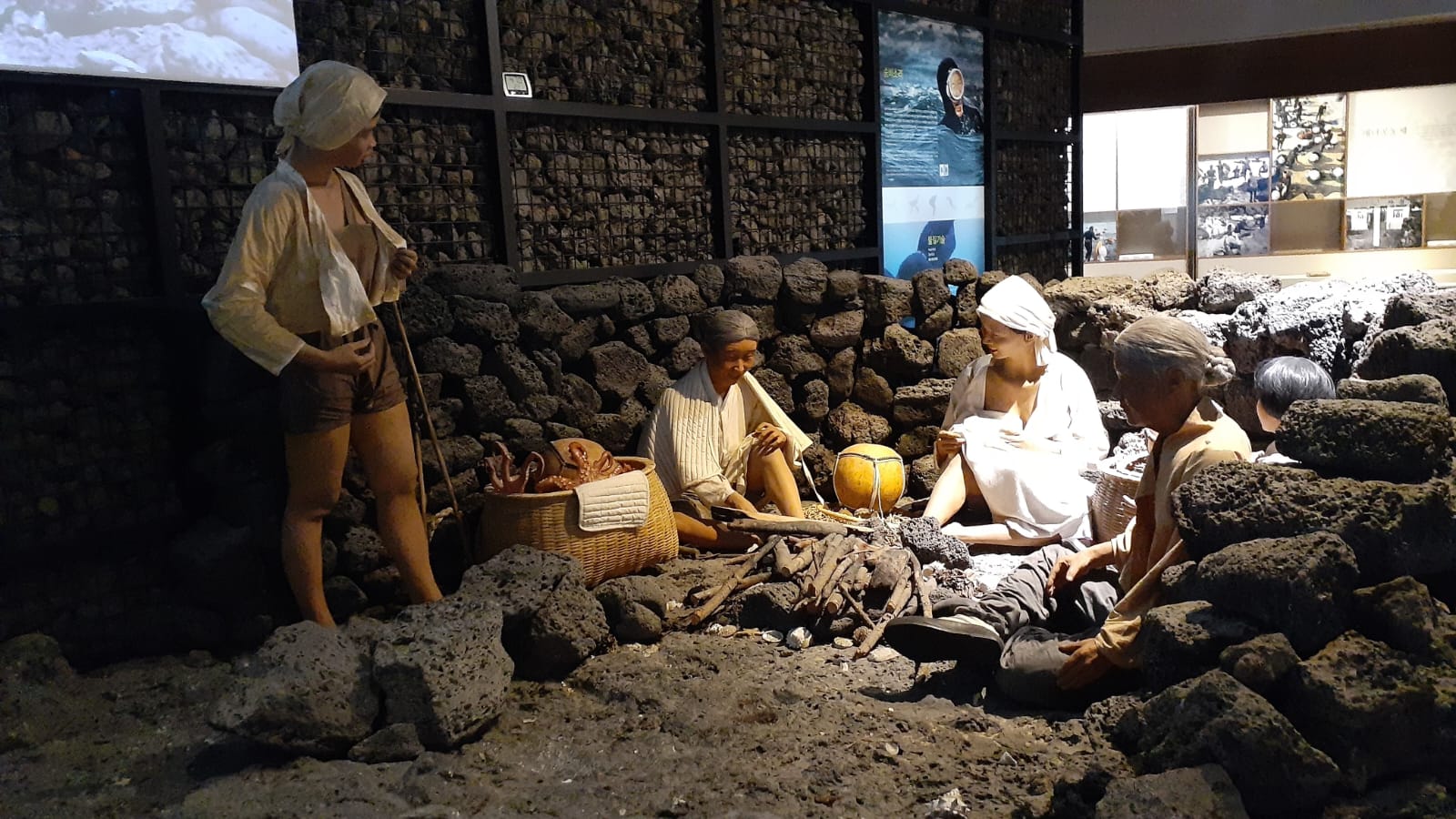
Bulteok as represented inside the museum
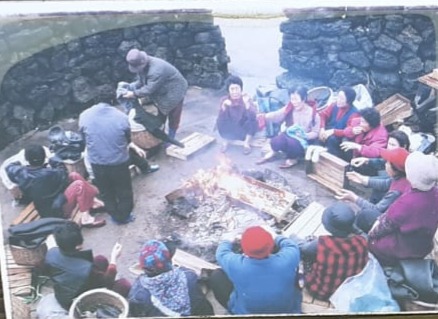
Contemporary Haenyeo in a bulteok, represented on a plaque outside the museum.
And the bulteok itself is echoed in the design of the public toilet installation, just outside the Haenyeo Museum.
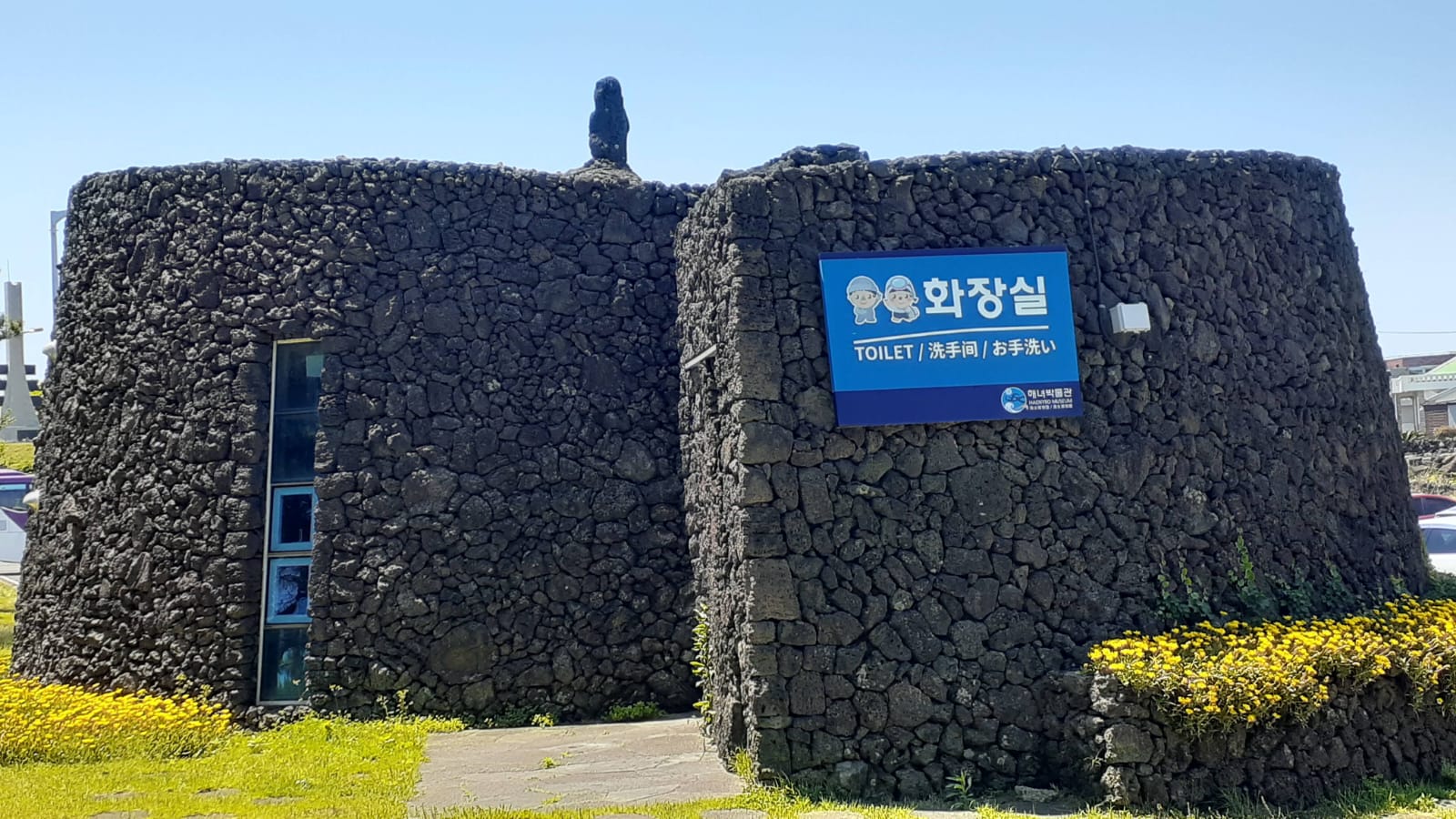
Public convenience built in bulteok style, echoing the architecture of the region using volcanic rock
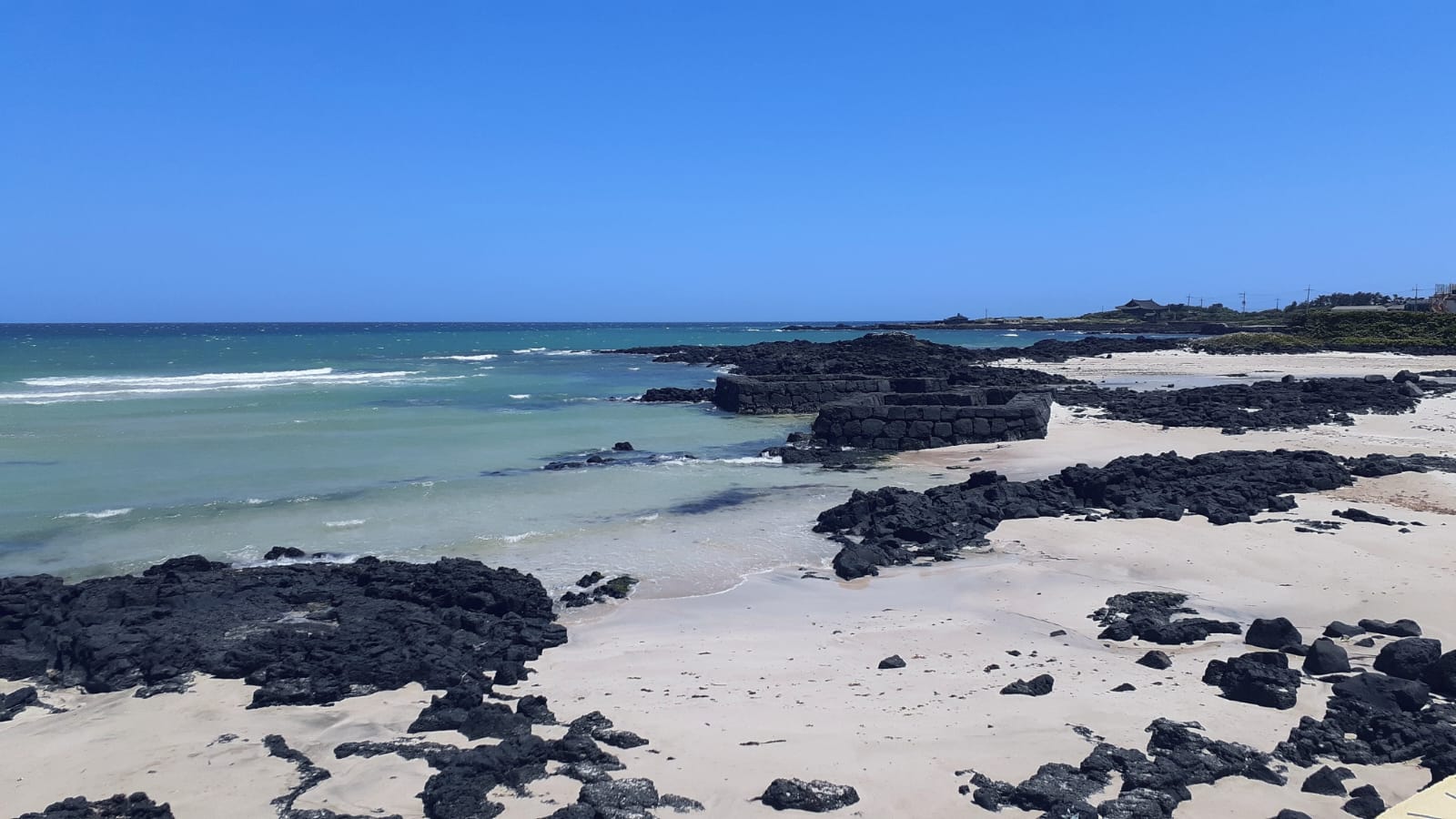
The coast, 100 metres from the museum. Stone structures, possibly fish traps, line the beach. This image views eastward, to Fukuoka and Nagasaki.
Inside the Haenyeo Museum
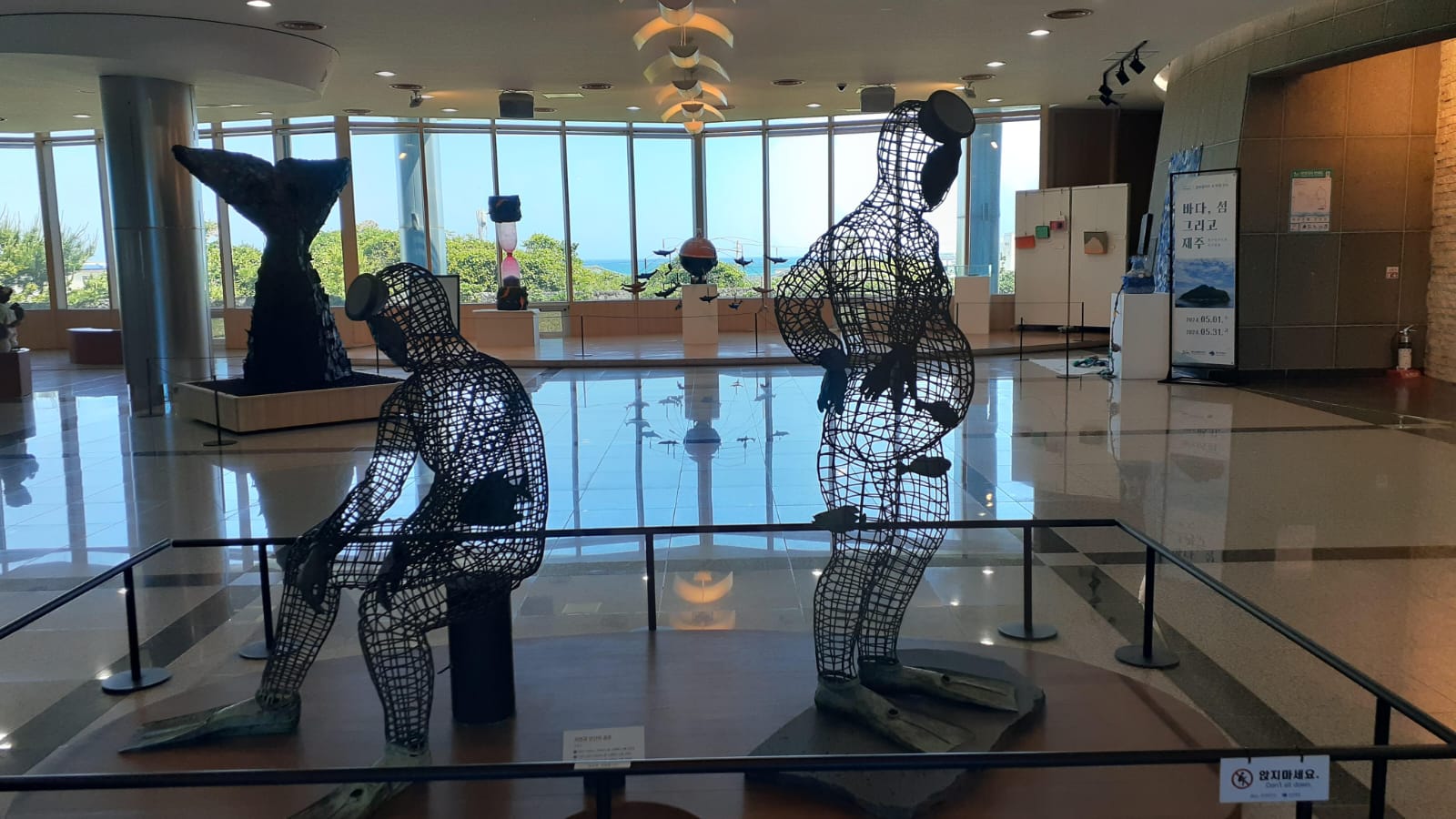
The lobby of the Haenyeo Museum is bright, spacious, and contains artwork in various mediums on the lives and work of Haenyeo. In fact, every single exhibit, photograph, sculpture or item highlights the inextricable link between women, work and the sea. The lobby boasts a panoramic 180° view of the coast, which opens to viewing platforms on all three levels.
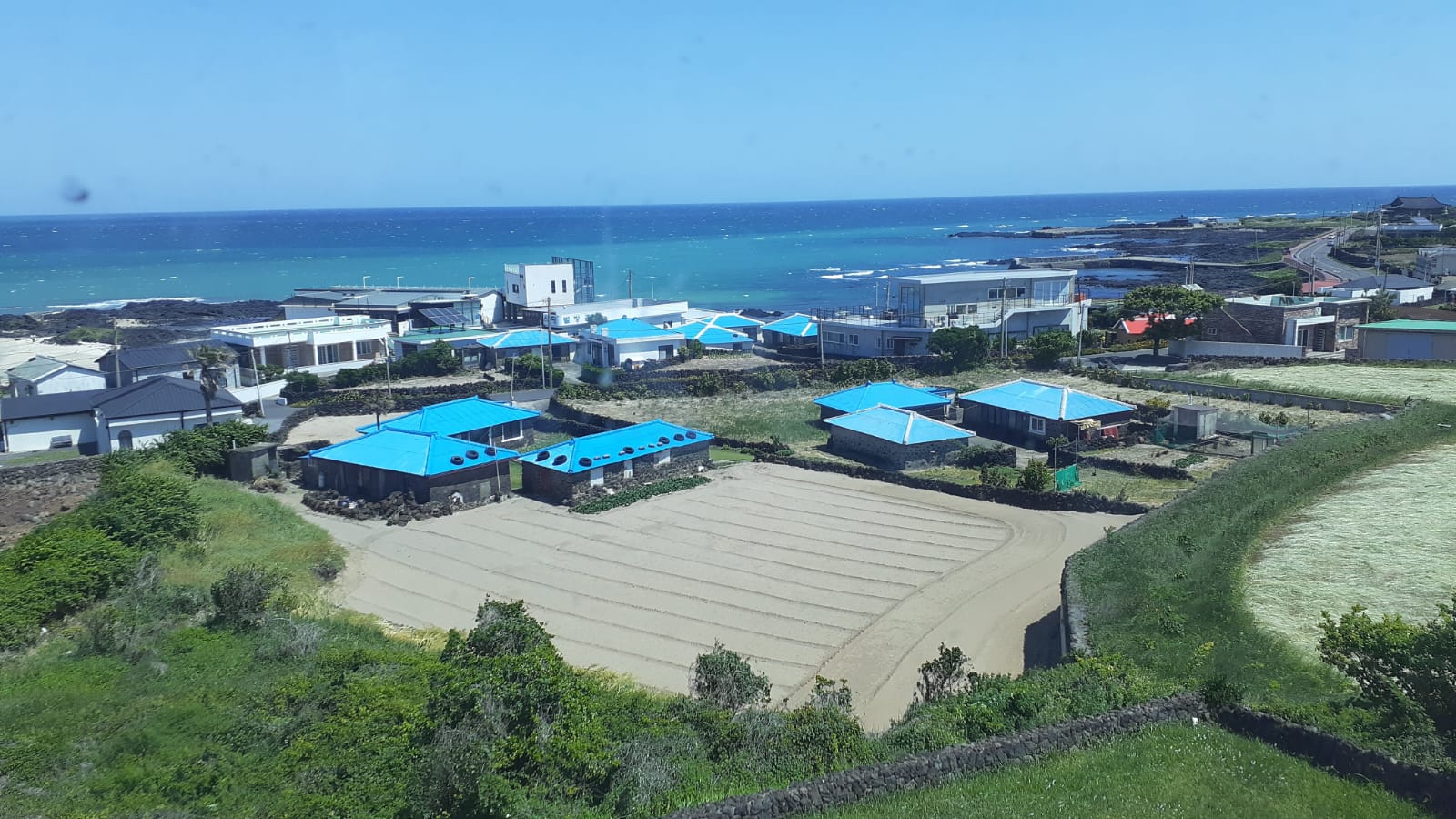
View from the Haenyeo Museum lobby. In the foreground are typical Jeju houses, made of volcanic stone and with waterproof rooves, and the volcanic stone fences seen throughout the island, which protect agricultural lands from the ever-present winds.
The overarching theme of the entire museum is work and culture. Haenyeo tools, clothing, culture, and living conditions are represented in photographs, oral recordings and installations. The hardships encountered by Haenyeo are evident in the displays of their diving gear. Traditionally, Haenyeo carried out their work in light cotton diving outfits, carrying their tools and rocks as weights.
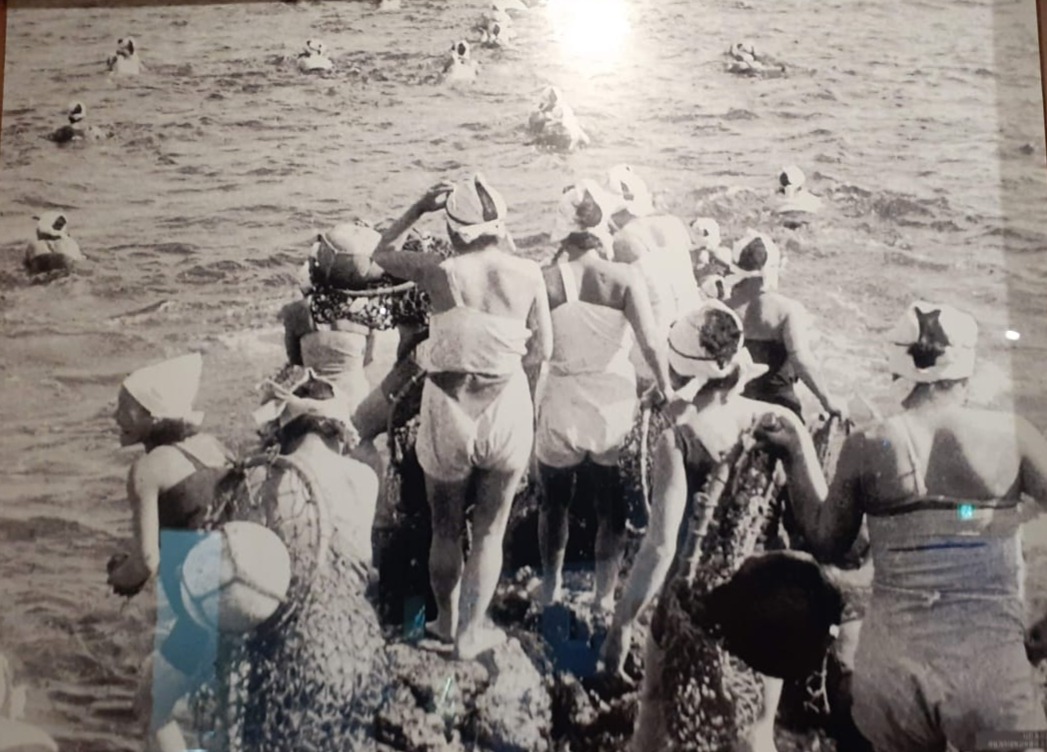
This historical photograph was captioned “Sea Farms”.
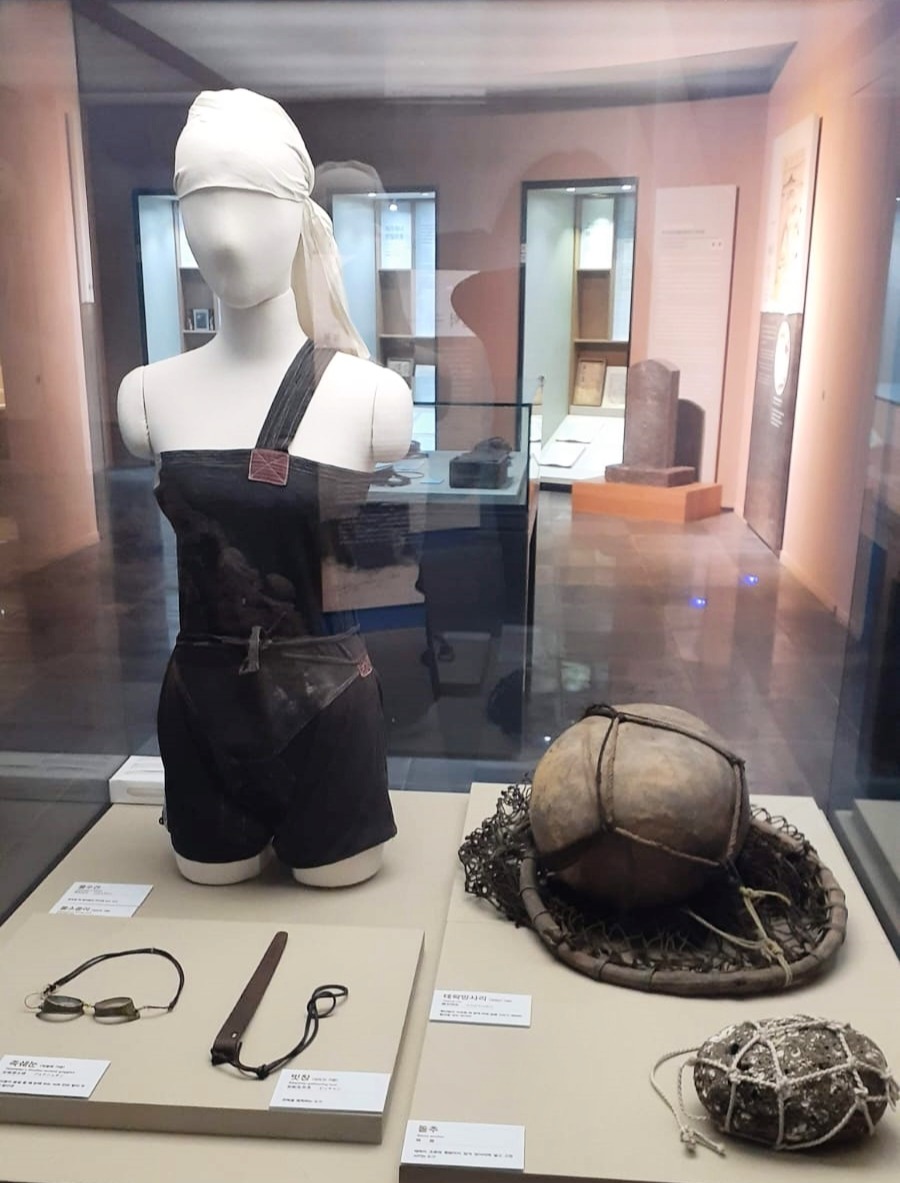
Traditional Haenyeo diving outfit and tools, including flotation device, net, sinker weight and pick.
From the 1960s and 70s, Haenyeo began using modern rubber wet suits, as these became available. They offered greater protection against the cold seas in winter, and flippers and belt weights also streamlined work.
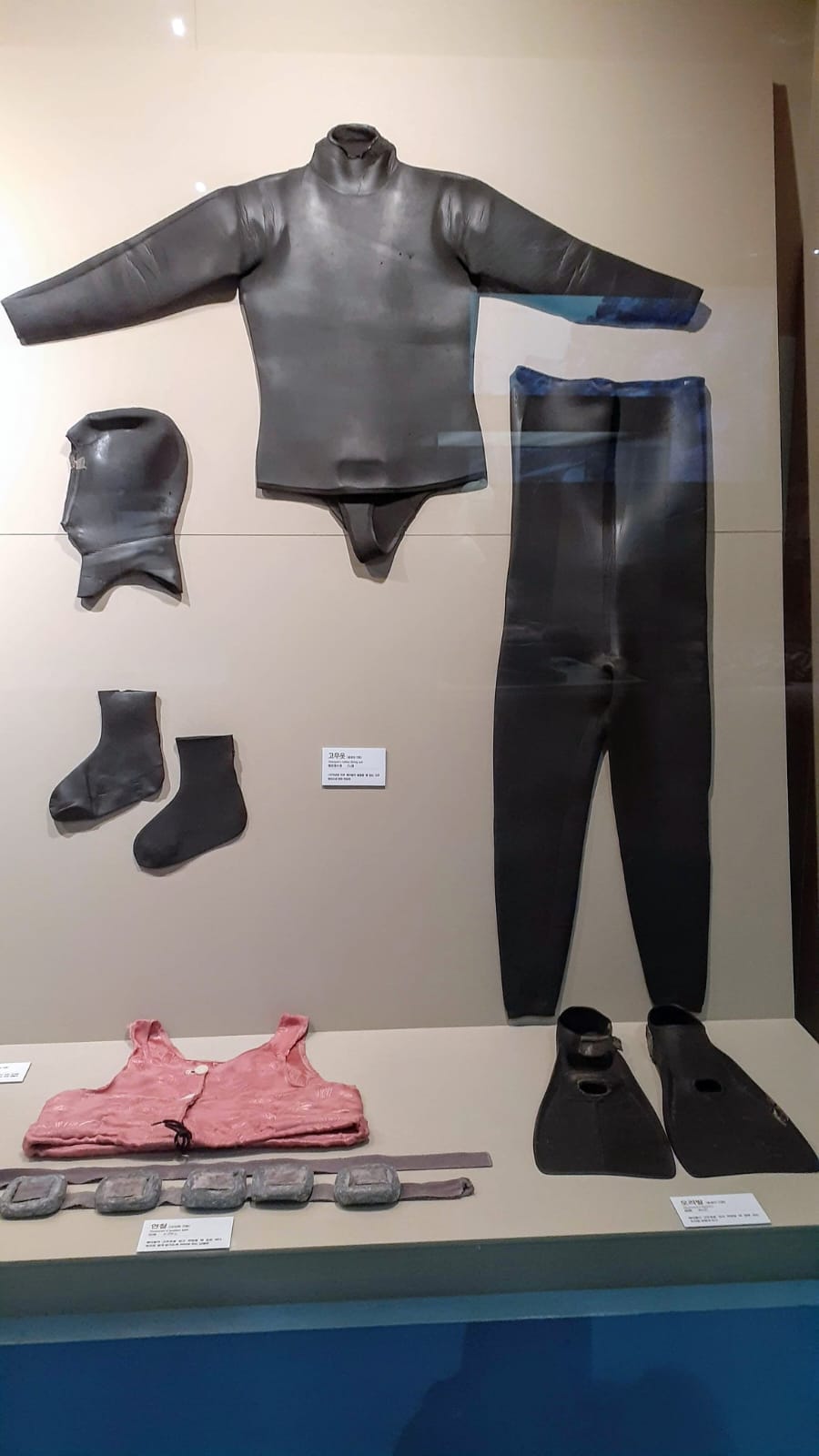
More modern diving outfits offer better occupational protection.
Spiritual Lives
Shamanism has always been an important aspect of life on Jeju, despite the encroachments of Confucianism and, later, Christianity. Haenyeo lives are traditionally indebted to the female dragon god, Yeongdeung God, for their safety while diving and for the sea’s bounty. Rites at seaside Haesingdan Shrines are performed regularly, and in the second month of the lunar calendar (corresponding to the onset of spring), the rite of Yeongdeunggut is held. As literature at the Museum states,
Haenyeo believe that Yeongdeung God provides safety and abundant fish to Haenyeo and fisherman, and that the god visits Jeju Island on the first day of the second lunar month. Yeongdeung God sows seeds, including seaweed, abalone, and conch to make the Haenyeo’s life abundant, then returns to her home after passing through Udo Island on the 15th of the second lunar month.
In the Haenyeo Museum, a series of installations vividly portray the shamanic rites associated with Haenyeo’s spiritual relationship with the sea and Dragon god Yeongdeung.
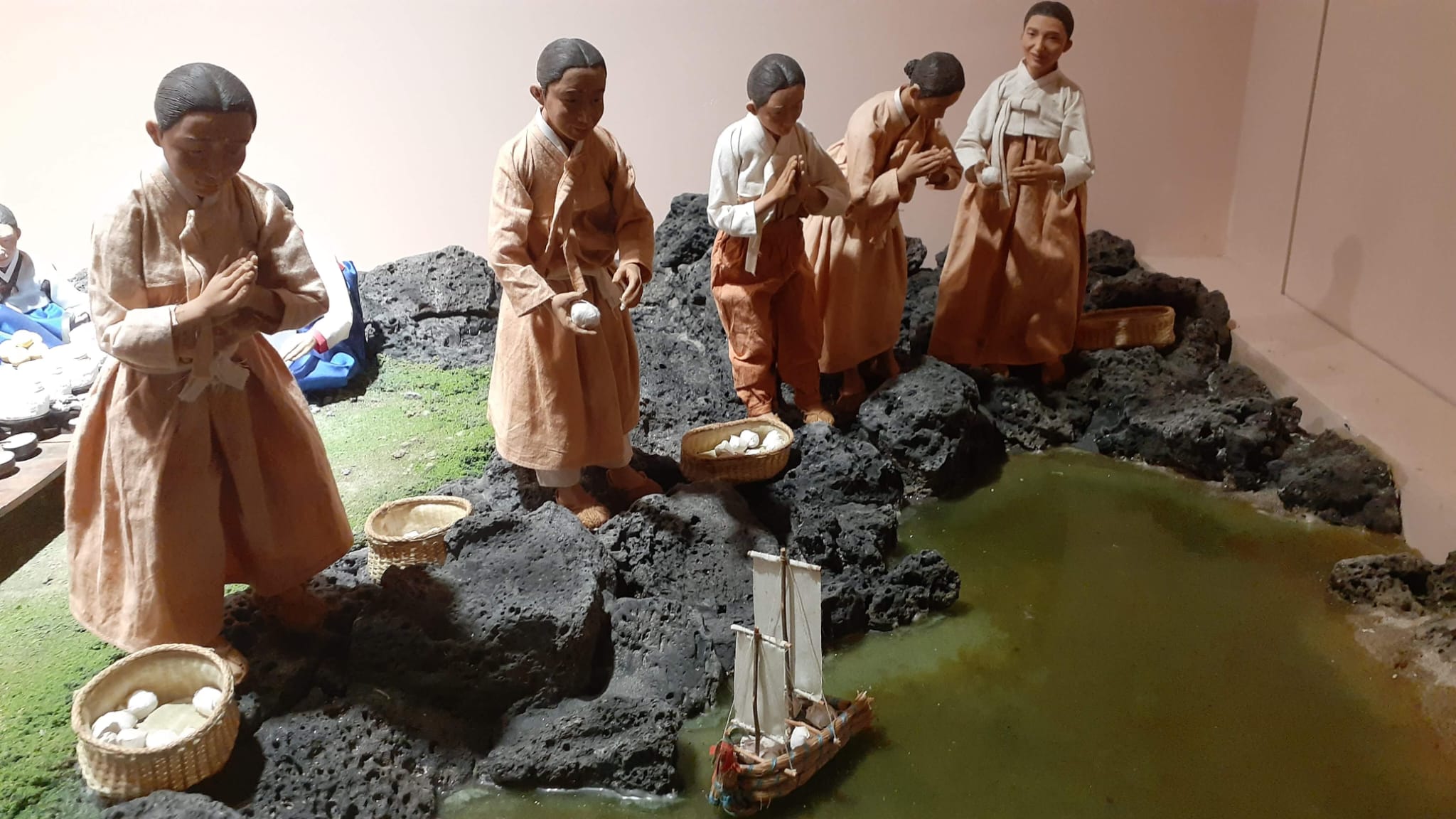
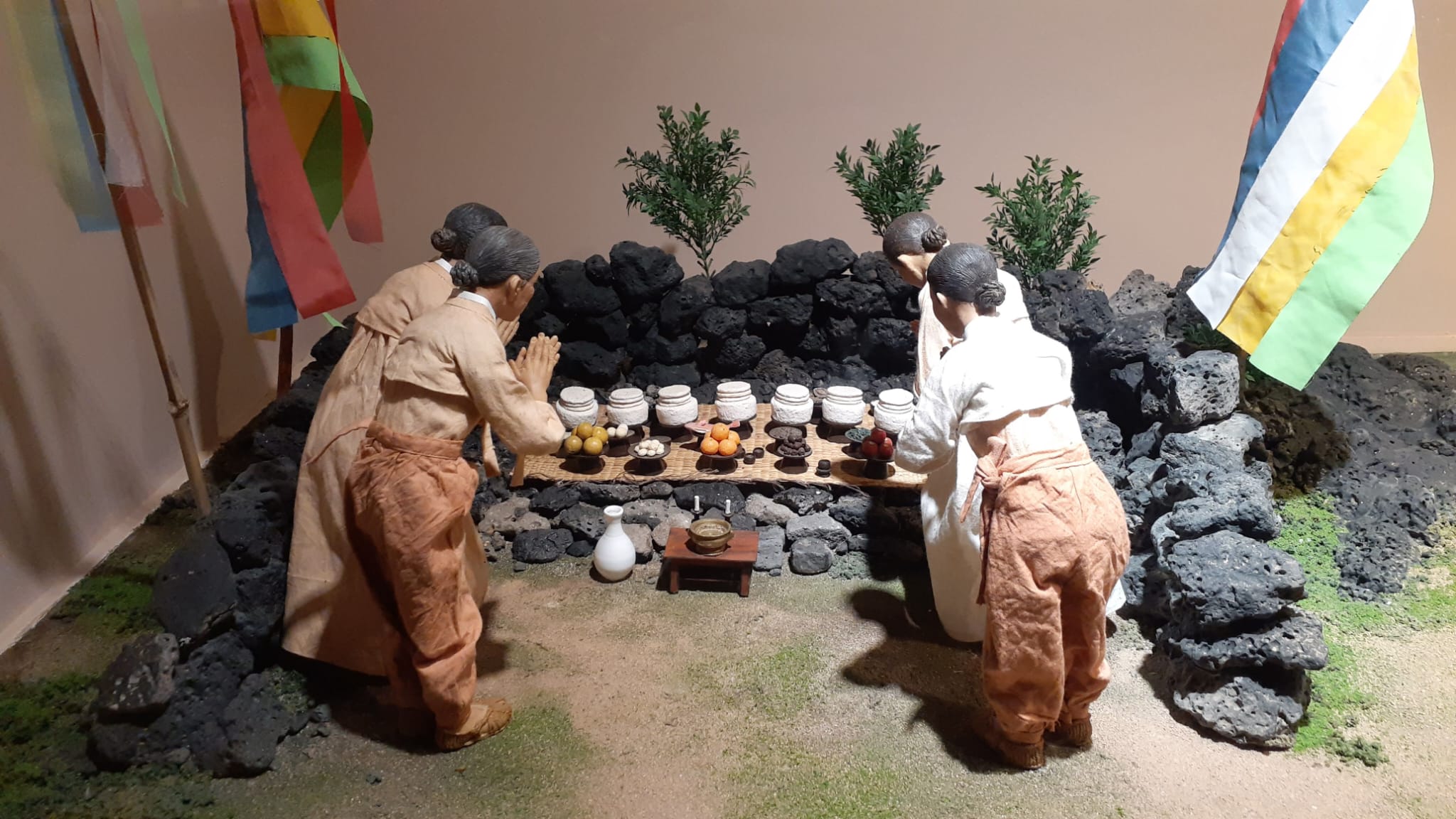
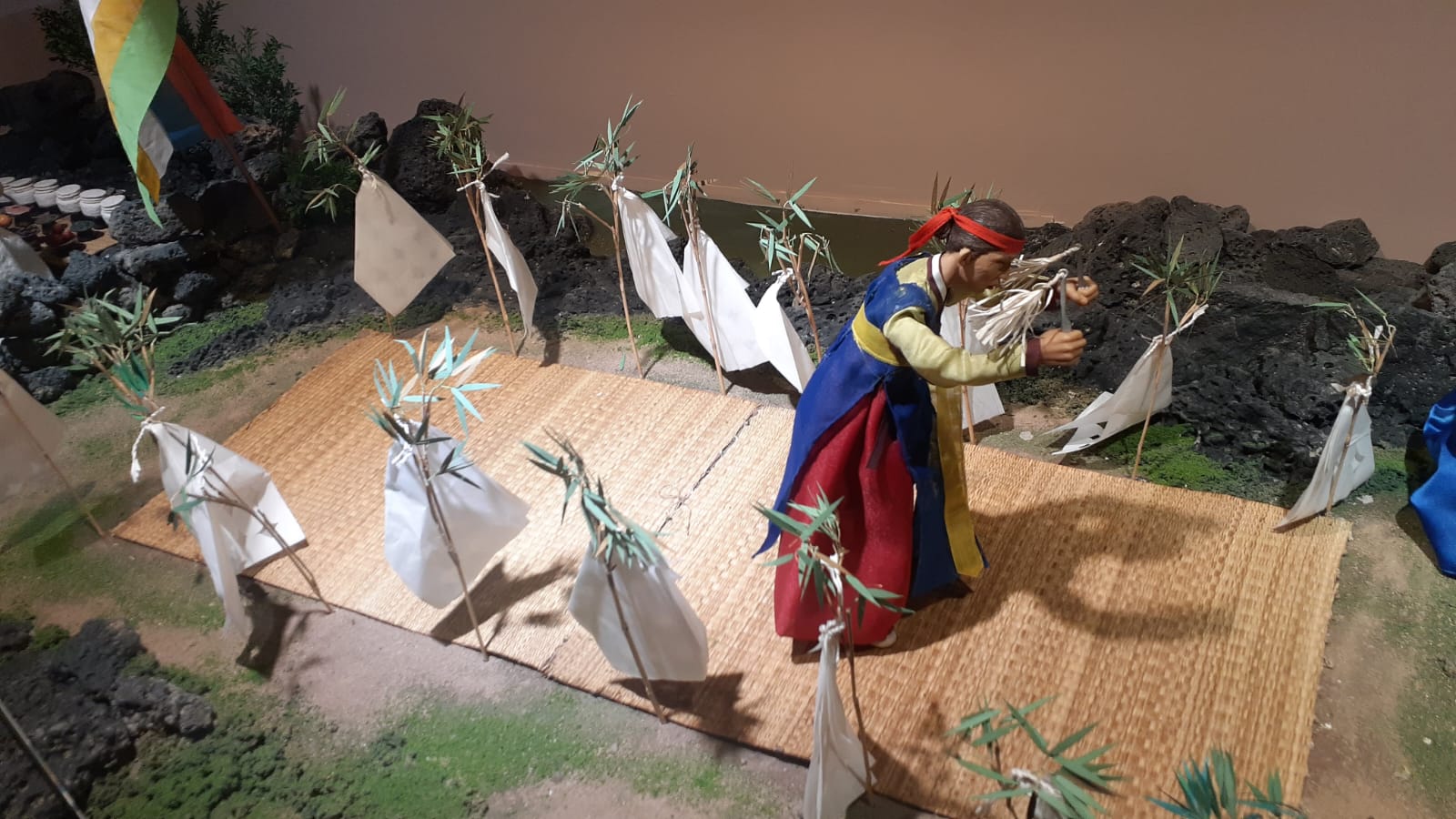
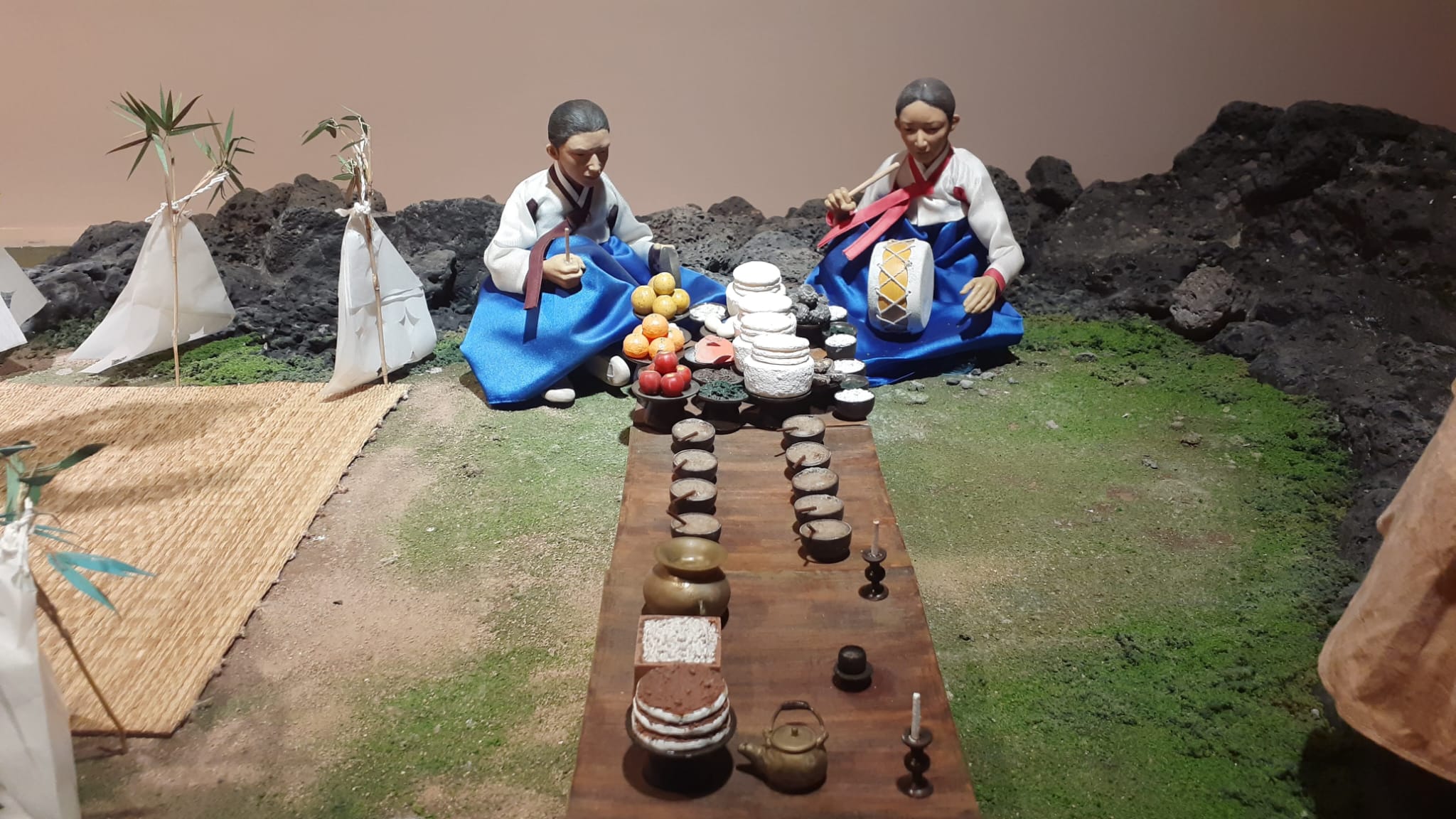
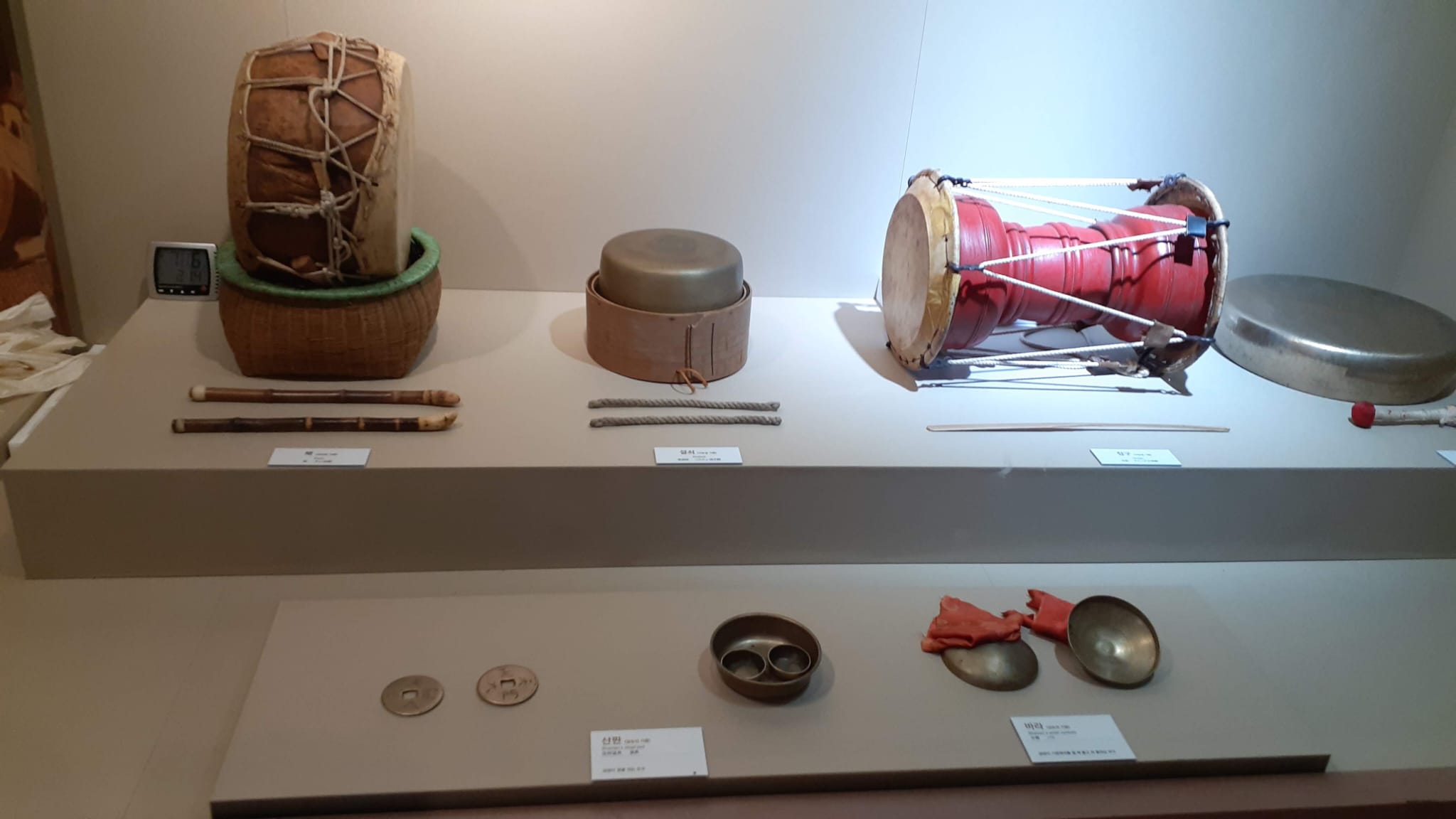
Shamanic tools, including drums and other percussion instruments, used in Yeongdeunggut rites
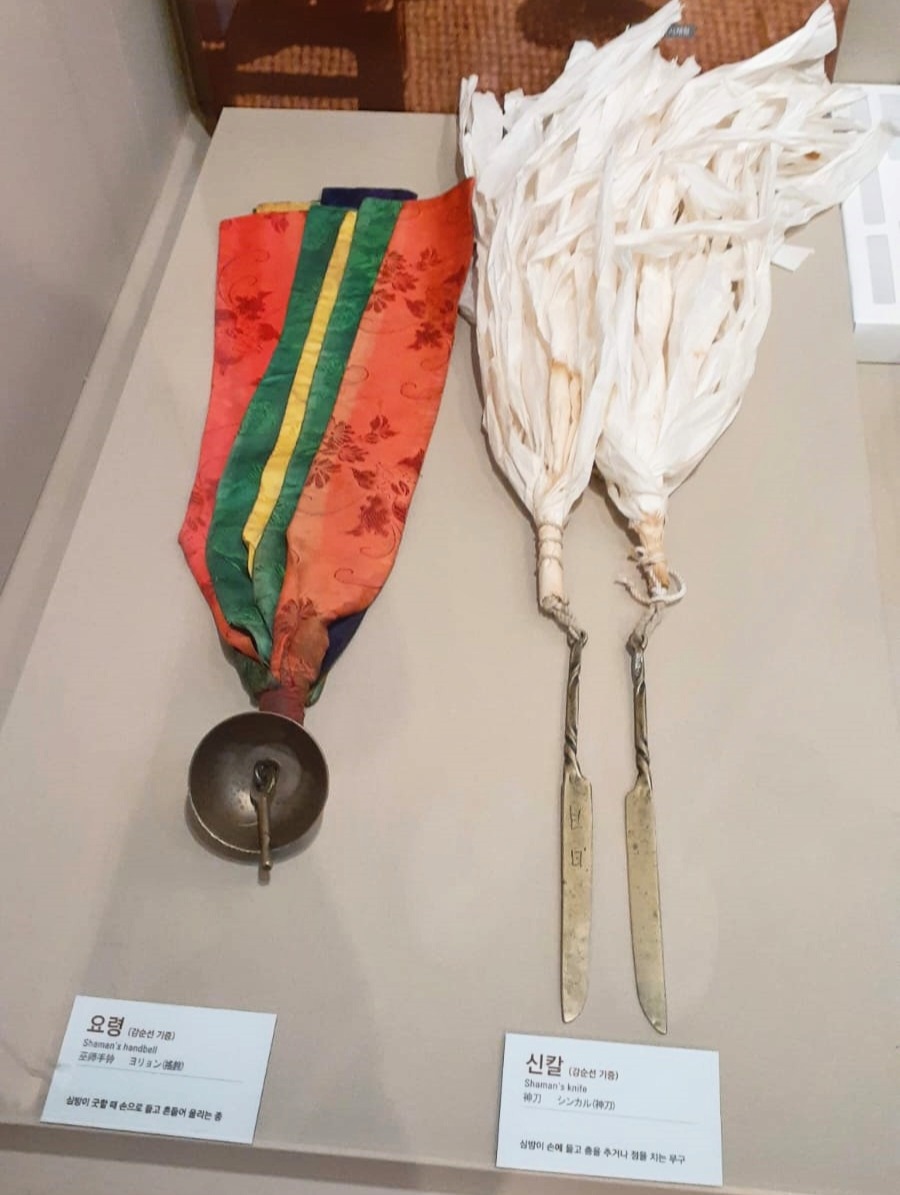
Shaman’s hand bell and knives.
Haenyeo beyond Jeju
Haenyeo skills were highly in demand. To support their families, they travelled vast distances in the region to work, including to the east and western Korean mainland, southern and northern China, Japan, and north as far as Vladivostok (which was once Korea). This reminded me of palawa (Tasmanian) sealing women, a group of whom travelled to the southern Indian Ocean island of St Paul’s to ply their trade, ending up in Mauritius.
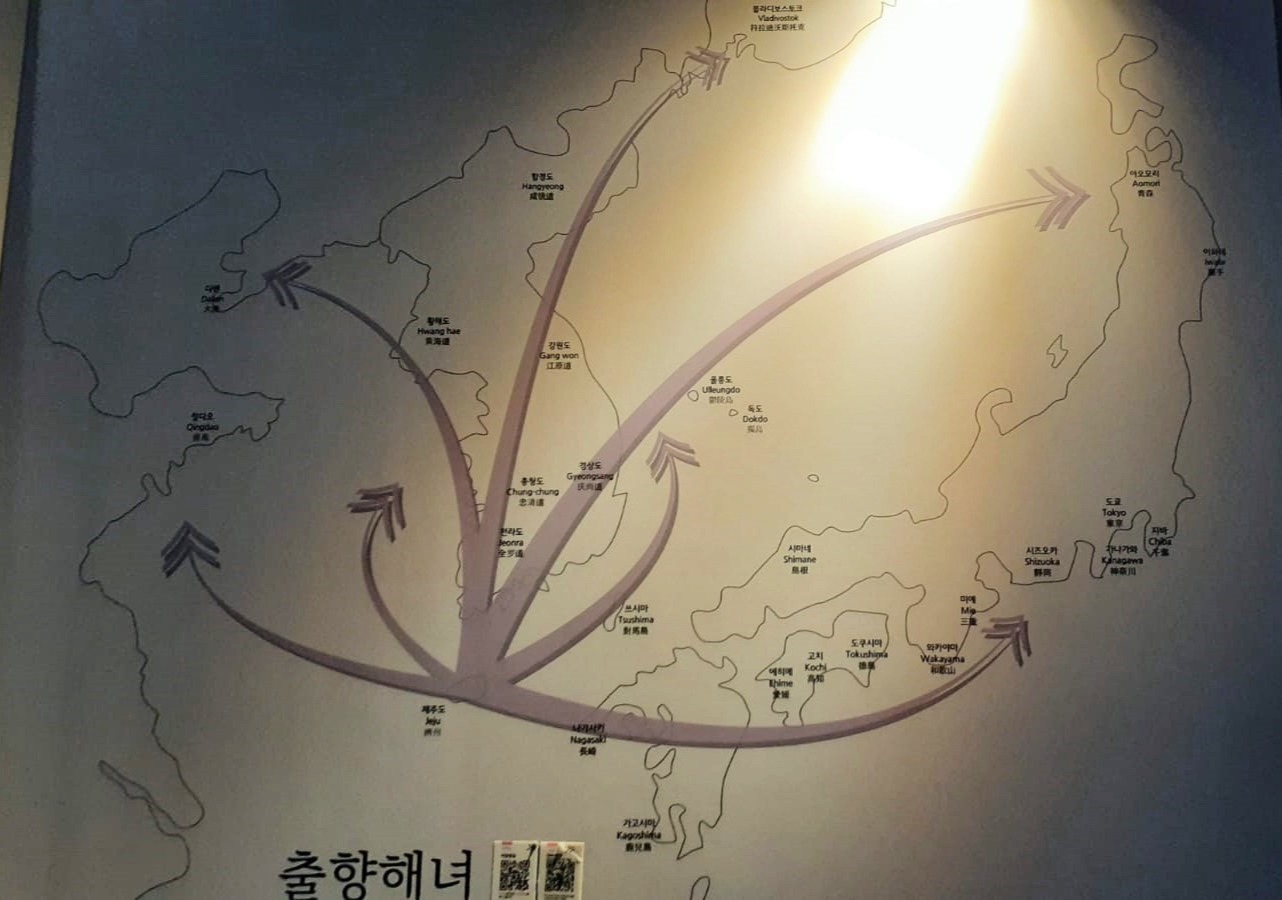
Map exhibit, showing some of the locations which Haenyeo travelled for work. There are no representations of travelling southward to the Philippine archipelago – this remains an open research question.
These long-distance Haenyeo journeys are commemorated at the Museum by the central focus given to the Cheon Nyeon 2, a Teu (or teobae) traditional boat. It is presented full-size. These boats were used on rivers and on open sea, and were vitally important to Haenyeo work, and Jeju islanders’ lives in general. The Cheon Nyeon 2 is significant, as it was sailed in a commemorative journey in 1997 from Jeju to Nagasaki (Japan) to explore and revitalise traditional trade routes.
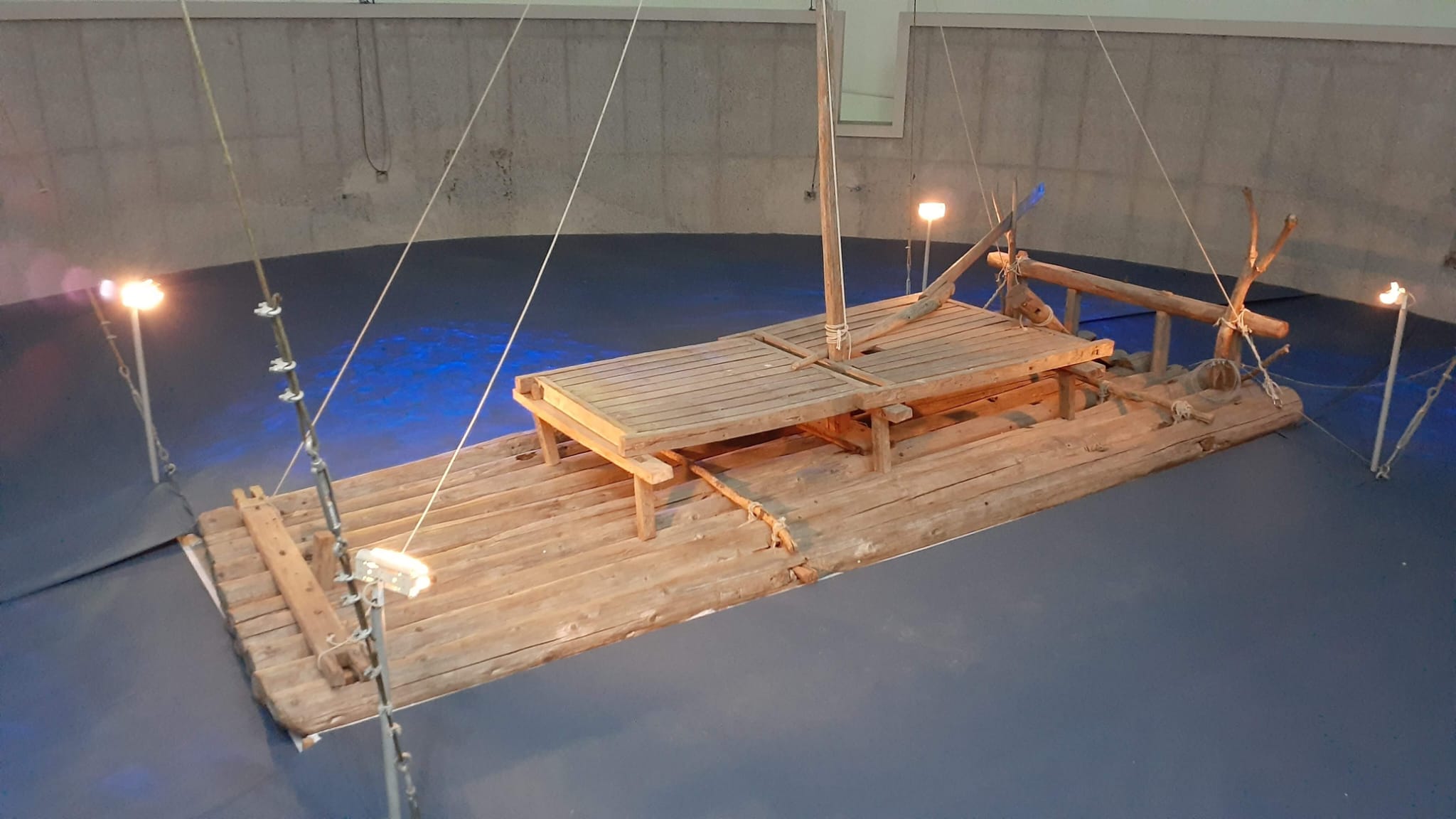
The Cheon Nyeon 2, probably the biggest single exhibit at the Haenyeo Museum
Representations of Haenyeo
There are constant representations of Haenyeo in Korean (now global) TV, film and literature set on Jeju. In these fictional accounts, Haenyeo are typically depicted as hardworking, loyal, and independent; they are usually wary or sceptical of outsiders, but always generous and welcoming at times of need, especially towards young women.
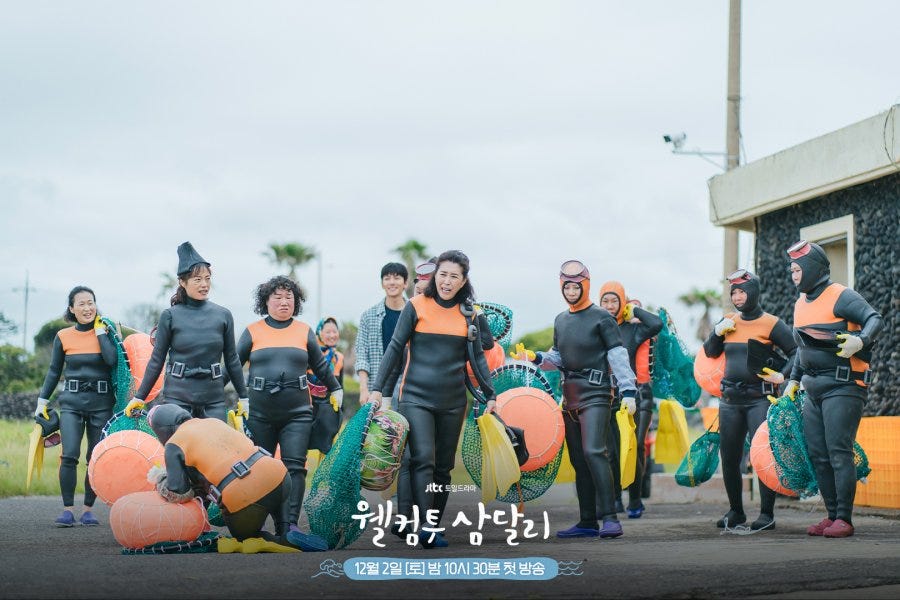
A typical depiction: Haenyeo characters in Welcome to Samdal-ri (Promotional poster, JTBC 2023)
Amongst western audiences, the Haenyeo profile was lifted further in the last decade in artist Kim Hyung-Sun’s iconic Haenyeo – the sea women of Jeju Island photographs which have been exhibited worldwide. https://gestalten.com/blogs/journal/Haenyeo-by-hyung-s-kim
In addition, numerous documentaries and photographic exhibitions have detailed Haenyeo lives. However, these have often occupied a sometimes problematic space in the way they are marketed to western audience. The title of Sue Kim’s celebrated The Last of the Sea Women (2024) is a case in point, drawing attention to the advanced age of many Haenyeo and deploying doomed race tropes to suggest that Haenyeo would soon be extinct. While the documentary speaks to their agency and environmental concerns, almost every media article about the film simply highlighted that these would probably be the last generation of Haenyeo. This is a long way from the self-representation at the Haenyeo Museum of a strong, continuing culture with a long, difficult historical past and an adaptive, resilient attitude to the future.
In search of Haesam
When my late colleague Lily Yulianti-Farid and I first discussed going to Jeju, beyond our interest in Haenyeo – and visiting K-Drama locations – we wanted to chart the harvesting and use of sea cucumbers. We had studied these for some time due to the important role they played in their dried form – trepang – in historical encounters between northern Australian Indigenous peoples and those from Makassar. In Korean, sea cucumbers are known as Haesam, or Ginseng of the Sea. Haesam is highly prized in Korea, China and other places as a health food (being 90% collagen), though this is often dismissed, in quite racist terms, as being sought as an aphrodisiac.
On Jeju island, fresh haesam or sea cucumbers are everywhere. They are noted in the Haenyeo museum as one of the key Haenyeo produce (aside from abalone), and presented in glorious resin:
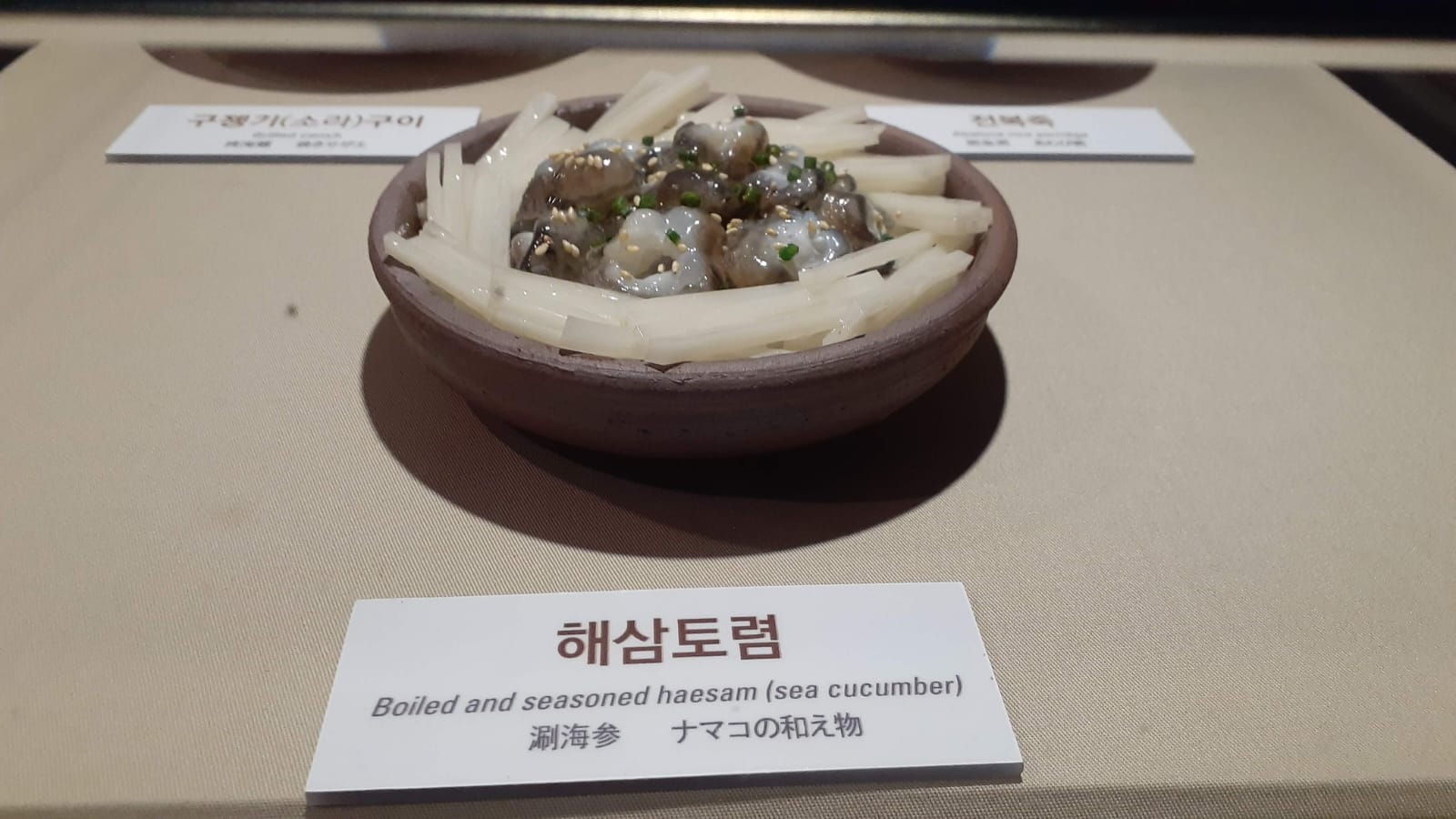
Haesam (sea cucumbers) as consumed on Jeju island – boiled (or raw). From the Haenyeo Museum.
Haesam are also present outside many cafes and restaurants in tanks, still alive, and at markets such as small local ones, and major permanent markets such as the Seogwipo Maeil Olle Market, a 90 minute bus ride from the Haenyeo museum.
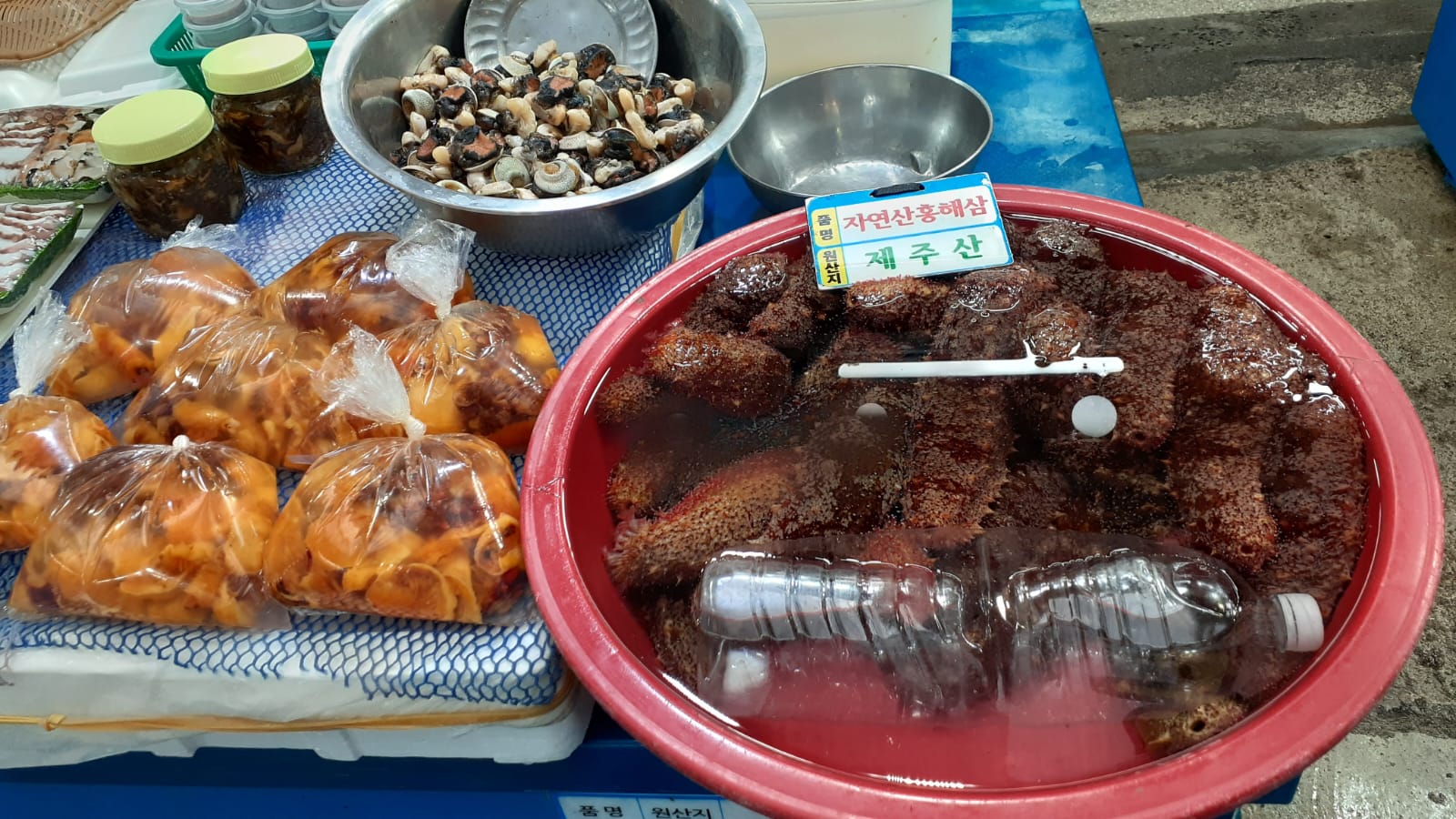
Haesam and other sea products for sale at Seogwipo Market, on the south side of Jeju Island
I also encountered haesam in a tank inside Ojo Haenyeo’s House, a popular eatery run by Haenyeo a few kilometres down the coast from the Museum at Seongsan. At Ojo Haenyeo House, haesam was served simply, exactly as presented (in artificial form) at the museum – fresh, and seasoned with salt and sesame oil. For all my research into sea cucumbers and extolling their virtue as a vehicle for studying historical trade routes, I could not bring myself to try them. Instead, I had the house’s specialty abalone porridge.
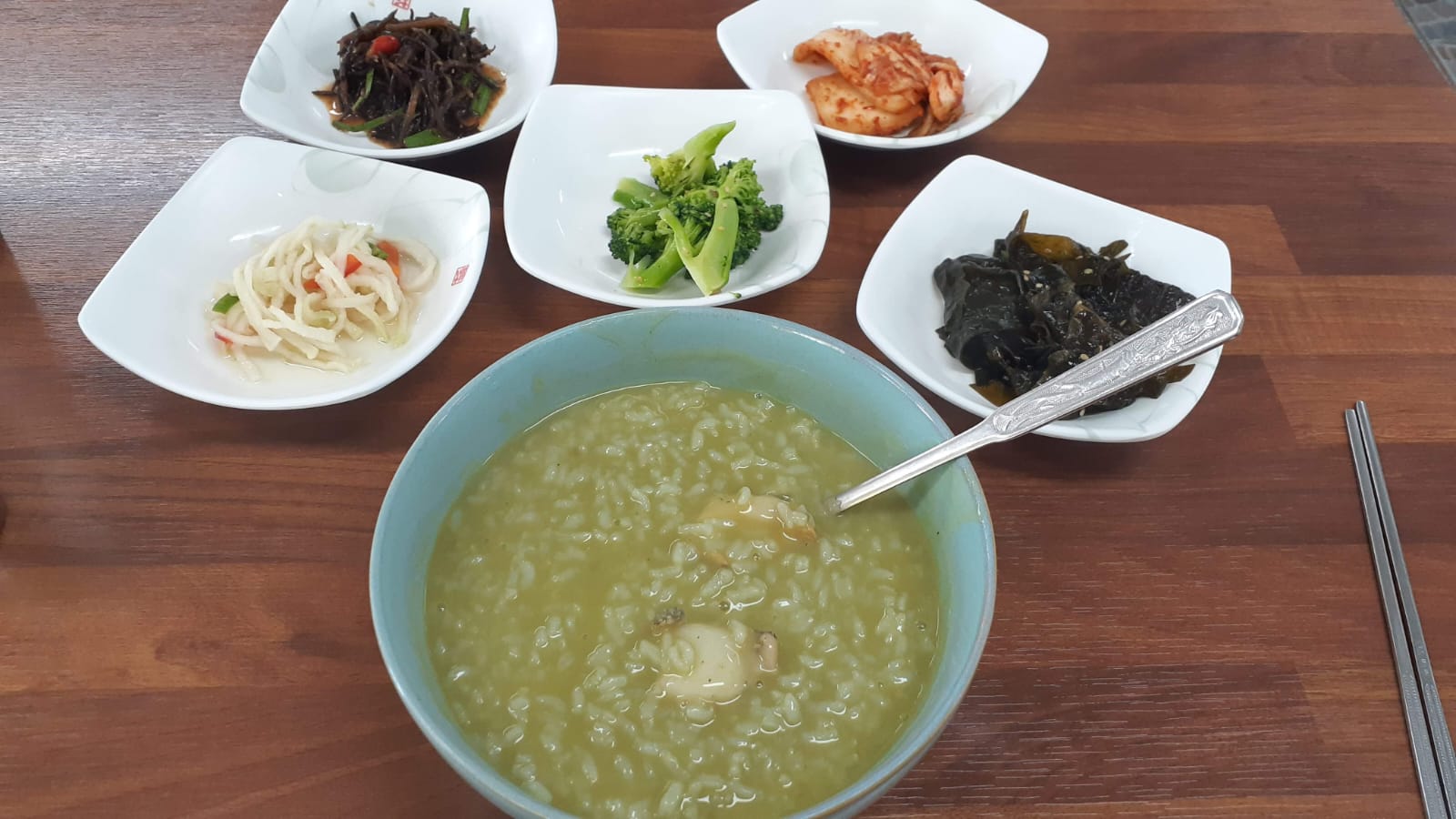
Abalone porridge at Ojo Haenyeo’s House, with banchan (side dishes) which accompany Korean meals
As I sat in a solitary manner, enjoying my juk (porridge), a group of middle-aged women who were undoubedtly Haenyeo came in for their lunch. The two women who had been cooking and serving brought them trolley loads of abalone soup, then stopped and ate with them. It was now mid-afternoon, and it was only myself and them in the place. In some ways they tallied, as a group, with some of the K-drama depictions of Haenyeo: the tough ajummas, united and impenetrable (at least language-wise, to me). They were quite loud, at one point laughing hysterically at a joke made by one which, judging by hand gestures, was quite obscene. They paid me no mind.
Leonie Stevens
10 March 2025
All photos here, unless otherwise noted, were taken by the author.