
The 1623 Project
Between 12 April and 15 May, Global Encounters Monash will publish a blog following the voyage of the Pera and the Arnhem through the Indigenous Nations of Cape York Peninsula, which took place exactly four hundred years ago.
Contents
- The Voyage of the Pera and the Arnhem
- The 1623 Project: What is it?
- 12 April 1623: The Pera and the Arnhem sight land
- 15 April 1623: The Wik make contact
- 17 April 1623: The Pera and the Arnhem make a second landing
- 18 April 1623: Abduction on Yir Yoront Country
- 19 April 1623: 200 Yir Yoront warriors confront the VOC mariners
- 20 April 1623: The Pera and the Arnhem retreat south
- 24 April 1623: A bounty is offered
- 25 April 1623: The VOC leave a record of their presence
- 27 April 1623: The Pera and the Arnhem part ways
- 28 April 1623: Koknar/Koko-bera people use smoke to distract the VOC
- 29 April 1623: Koknar/Koko-bera people refuse to parley
- 3 May 1623: Carstenszoon comes ashore on Yir Yoront Country
- 5 May 1623: The Wik strike against the VOC
- 7 May 1623: 100 Wik warriors thwart a kidnapping
- 8 May 1623: Kidnapping and violence on Winda Winda Country
- 9 May 1623: “Footprints of men and large dogs”
- 10 May 1623: The Winda Winda people refuse to parley
- 11 May 1623: The Pera explores the coast of Tjungundji Country
- 12 May 1623: A skirmish on Tjungundji Country
- 14 May 1623: Fresh water and failure
- 15 May 1623: The Pera departs for Ambon
- References
The Voyage of the Pera and the Arnhem
Exactly four hundred years ago, the traditional lands of the Anggamudi, Anguthimri, Awngthim, Teppathiggi, Thaayorre, Wik, Winda Winda, Yupangathi and other nations of the Cape York Peninsula were visited by two ships owned by the United Dutch East India Company (Verenigde Oost Indische Compagnie or VOC), undertaking a voyage of exploration in search of profit.
These ships, the yacht Pera and the sloop Arnhem, sailed under the command of Jan Carstenszoon and Willem Joosten van Colste, respectively. They departed Ambon on 21 January 1623.
The goal of their journey was twofold. First, they were instructed to secure compacts with the islanders of Quey, Aroe, and Tenimber in the Southern Moluccas, before travelling onwards the unexplored reaches of New Guinea and the Southland. In this they were expected to extend and deepen knowledge of the region first charted by the VOC ship Duyfken in 1606.
According to the orders received by the commanders:
When you get near the northern extremity and the east coast of the Southland, you will diligently inquire whether it yields anywhere sandal-wood, nutmegs, cloves or other spices; likewise whether it has any good harbours and fertile tracts, where it would be possible to establish settlements, which might be expected to yield satisfactory returns. In a word, you will suffer nothing to escape your notice, but carefully scrutinise whatever you find, and give us a full and proper report on your return, by doing which you will render good service to the United Netherlands and reap special honour for yourselves.1
Furthermore, they were ordered that:
In places where you meet with natives, you will either by adroit management or by other means endeavour to get hold of a number of full-grown persons, or better still, of boys and girls, to the end that the latter may be brought up here and be turned to useful purpose in the said quarters when occasion shall serve.2
On 12 April 1623, the Pera and Arnhem, manned by crews consisting of Dutch, French, Germans, “Malays,” Ambonese, and others, sighted the northernmost tip of Cape York Peninsula. Over the subsequent five weeks, until 16 May, they sailed up and down the western coast of the peninsula, before returning to Ambon in advance of the monsoons. The whole time, their crews believed that they were exploring part of New Guinea.
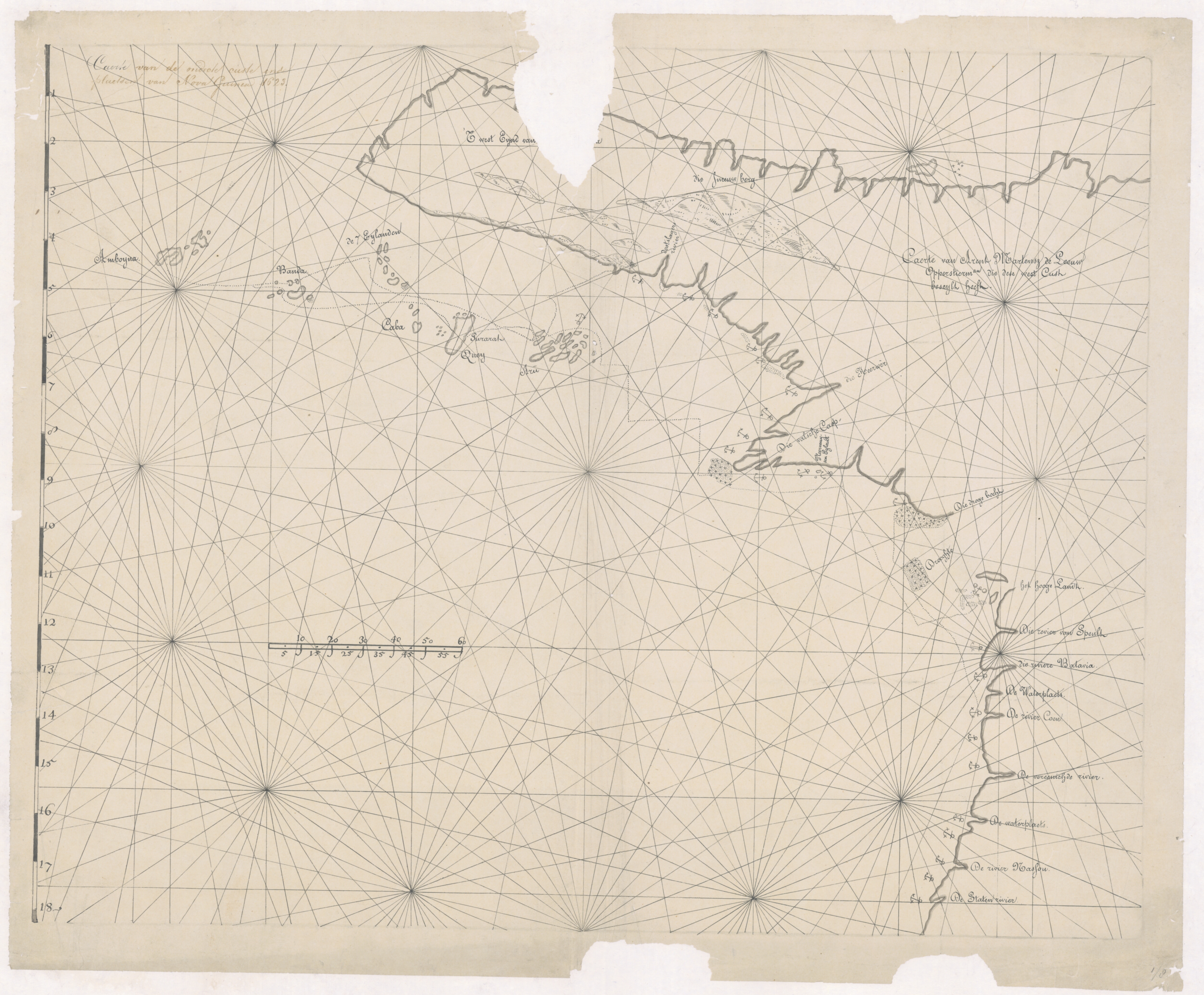
Manuscript copy of a map made by Arent de Leeuw on the Pera and the Arnhem’s 1623 expedition.
Image credit: Arent de Leeuw, Caerte van Arent Martensz de Leeuw opperstierman die dese west cush beseijlt Heeft (1623), National Library of Australia, MAP RM 392.
As the journals of Carstenszoon indicate, the ships anchored before the traditional lands of almost all of the different Indigenous nations of the region. At several places, Indigenous Australians interacted with the visiting mariners. At others, their knowledge of the presence of outsiders is documented by the presence of smoke signals.
The interactions of Indigenous Australians with the crews of Pera and Arnhem are among the first documented examples of encounter on the continent. They have left impressions not only in the archival records of the VOC, but also in the oral traditions of the Wik people, and possibly others.
This contact may not be limited to the many nations of the Cape York Peninsula. On 27 April, the Pera and Arnhem parted company. As the Pera continued southward, the crew of the Arnhem returned to Ambon, on the way being sighted by the Yolngu people, who today inhabit the region called, after the ship, as Arnhem Land.
The 1623 Project: What is it?
Over the next month, between 12 April and 16 May, the Global Encounters team will recognise the significance of these encounters, and remind modern observers of their importance, by re-presenting extracts from the journals of Jan Carstenszoon, commander of the Pera.
The text of the journal is a matter of public record, and is excerpted from the English translation printed in J. E. Heeres’ The Part Borne by the Dutch in the Discovery of Australia 1606-1765 (London: Luzac & Co, 1899).
The journal itself is an interesting document. Befitting its origins as a product of the bureaucratic demands of a multinational company, it is a dry, and not particularly detailed, record of the principal occurrences on the voyage.
Its descriptions of encounters with Indigenous nations of Cape York are naturally redolent with the prejudices of its time. These prejudices were products of centuries of cultural preconceptions, some of which are not always obvious. The violent experiences of several VOC mariners on the south coast of New Guinea, for example, almost certainly predisposed Carstenszoon’s crew to expect violence from the peoples of Cape York.
But every now and again, the journal hints at another quality to these contacts, one that went deeper and was more meaningful, and enduring, between the various peoples.
In addition to re-presenting excerpts from the journals in a blog format, The 1623 Project will also be ‘live-tweeting’ the journey of the Pera and Arnhem as they passed by the various Indigenous nations of Cape York. Furthermore, the occasional blog post or commentary will be offered to flesh out aspects of the encounters.
This page will be progressively updated with significant moments from the voyage – use the Contents section to jump to a particular date.
You can also follow the voyage at the Global Encounters Twitter page @GlobalEMonash and the hashtag #1623Project.
12 April 1623
Traditional lands of the Anggamudi, Tjungunjl, and Yupangathai.
Carstenszoon’s Journal:
In the morning of the 12th the wind was S.E. with good weather; at sunrise we saw the land of Nova Guinea, showing itself as a low-lying coast without hills or mountains; we were then in 13½ fathom, clayey bottom; course held S.S.W.; at noon we were in Lat. 11° 45’ South, having sailed 10 miles on a S.E. course in the last 24 hours.3
On this day, the Pera and Arnhem sighted the northernmost tip of Cape York Peninsula. Over the subsequent five weeks, until 16 May, they sailed up and down the western coast of the peninsula. The whole time, their crews believed that they were exploring part of New Guinea.
15 April 1623
Traditional lands of the Wik – Kirke River/Cape Keerweer.
Carstenszoon’s Journal:
In the morning of the 15th … course held S. by E. in 3 and 2½ fathom along a sandbank, situated about one mile from the mainland; at noon we were in 14° 36. The land which we have hitherto seen and followed, extends S. and N.; it is low-lying and without variety, having a fine sandy beach in various places. In the afternoon we dropped anchor owing to the calm, having sailed 11 miles South. Great volumes of smoke becoming visible on the land, the subcargo got orders to land with the two pinnaces, duly manned and armed, and was specially enjoined to use his utmost endeavours for the advantage of Our Masters*; when the pinnaces returned at nightfall, the subcargo reported that the pinnaces could get no farther than a stone’s throw from the land, owing to the muddy bottom into which the men sunk to their waists, but that they had in various places seen blacks emerging from the wood, while others lay hid in the coppice; they therefore sent a man ashore with some pieces of iron and strings of beads tied to a stick, in order to attract the blacks; but as nothing could be effected and the night was coming on, they had been forced to return to the yachts.4
* The States General (Parliament) of the United Provinces of the Netherlands
On this day, an encounter took place between the Wik people and the crew of the Pera and Arnhem as they attempted to land at Cape Keerweer.
The “great volumes of smoke” that Carstenszoon observed from the Pera were probably signal fires, a good defensive strategy to warn people of the ships’ approach. In 2020, the National Museum of Australia commissioned filmmakers Alison Page and Nik Lachajczak to create a short film on this topic in collaboration with Indigenous communities along Australia’s east coast. Produced for the 250th anniversary of James Cook’s 1770 voyage on the Endeavour, The Message: The Story from the Shore reimagines the messages in smoke that were passed up the east coast to warn people of the Endeavour’s arrival.
Cape Keerweer was the most southerly point reached by Willem Janszoon’s voyage on the Duyfken in 1606; it was Janszoon who named the place Cape Keerweer. The Wik-Mungkan people have passed down an account of the Duyfken’s landing at Cape Keerweer in 1606, seventeen years before the Pera and Arnhem’s attempted landing:
The Europeans sailed along from overseas and put up a building at Cape Keerweer. A crowd of Keerweer people saw their boat sail up and went to talk with them. They said they wanted to put up a city. Well the Keerweer people said that was all right. They allowed them sink a well and put up huts. They were at first happy there and worked together. The Europeans gave them tobacco. They carried off the tobacco. They gave them flour—they threw that away. They gave them soap, and they threw away the soap. The Keerweer people kept to their own bush tucker.5
According to the account, some of Janszoon’s crew began taking women – “Then one European took away from my cousin-brother his wife and lived with her” – and forcing Wik people to hunt for them – “They just work, work, work, work”.6
Violence broke out when one of Janszoon’s crewmen pointed a gun at a Wik man while explaining how to use it. The Wik man, thinking he was about to be shot, wrestled the Dutch man to the ground and strangled him, while others called out a warning. As the story goes, “then other white men went to pick up the gun, and they get killed too. They wrestle with those European people so the Europeans picked up their guns and shot the men belonging to that place. They kill a lot”.7
The Wik then used bark canoes to get in among the Duyfken’s boats and set them on fire, and fought the crewmen using spears and woomeras. Janszoon and his crew were forced to discontinue their southward passage and fled north, which is why he named the place Cape Keerweer, Dutch for “Cape Turnback”.8
17 April 1623
Yir Yoront (possibly Koko-bera) Country – Mitchell River Mouth/Topsy Creek area.
Carstenszoon’s Journal:
In the morning of the 17th … we made sail, course held S. by W., along the land in 4½ fathom; towards the evening, it fell a calm, so that we dropped anchor with the ebb, after which I went ashore myself with the two pinnaces duly provided with men and arms; we went a considerable distance into the interior, which we found to be a flat, fine country with few trees, and a good soil for planting and sowing, but so far as we could observe utterly destitute of fresh water. Nor did we see any human beings or even signs of them; near the strand the coast was sandy with a fine beach and plenty of excellent fish.9
On this day the Yir Yoront (possibly the Koko-bera) people observed a second landing by thirsty VOC mariners in search of fresh water. Yet they remain safely hidden.
18 April 1623
Yir Yoront (possibly Koko-bera) Country – Mitchell River Mouth/Topsy Creek area.
Carstenszoon’s Journal:
In the morning of the 18th … course held S. by W. along the land; about noon, as we saw persons on the beach, we cast anchor … the skipper of the Pera got orders to row to land with the two pinnaces, duly provided for defence; in the afternoon when the pinnaces returned, we were informed by the skipper that as soon as he had landed with his men, a large number of blacks, some of them armed and others unarmed, had made up to them; these blacks showed no fear and were so bold, as to touch the muskets of our men and to try to take the same off their shoulders, while they wanted to have whatever they could make use of; our men accordingly diverted their attention by showing them iron and beads, and espying vantage, seized one of the blacks by a string which he wore round his neck, and carried him off to the pinnace; the blacks who remained on the beach, set up dreadful howls and made violent gestures, but the others who kept concealed in the wood remained there. These natives are coal-black, with lean bodies and stark naked, having twisted baskets or nets round their heads; in hair and figure they are like the blacks of the Coromandel coast, but they seem to be less cunning, bold and evil-natured than the blacks at the western extremity of Nova Guinea; their weapons, of which we bring specimens along with us, are less deadly than those we have seen used by other blacks; the weapons in use with them are assagays, shields, clubs and sticks about half a fathom in length; as regards their customs and policy and the nature of the country, Your Worships will in time be able to get information from the black man we have got hold of, to whom I would beg leave to refer you.10
On this day, the Yir Yoront (possibly the Koko-bera) people became the second nation to encounter the crewmen of the Pera, as the ship headed south on its voyage in search of tradeable commodities and commercial intelligence.
At first, the encounter was friendly, leading the VOC mariners to conclude that “they seem to be less cunning, bold and evil natured than the blacks at the western extremity of Nova Guinea,” a circumstance which perhaps allowed the comparison to the inhabitants of the Coromandel Coast in India.
However, the situation deteriorated into conflict when the mariners attempted to fulfill another task that had been given to them before sailing. As the sailing orders indicated:
In places where you meet with natives, you will either by adroit management or by other means endeavour to get hold of a number of full-grown persons, or better still, of boys and girls, to the end that the latter may be brought up here and be turned to useful purpose in the said quarters when occasion shall serve.11
One Yir Yoront man was indeed captured in the affray, and conducted to the Pera by mariners. Unfortunately, no oral traditions have been collected from this region which might document the Indigenous side of this dramatic encounter, in which it seems that the Yir Yoront encountered Europeans for the first time.
19 April 1623
Yir Yoront (possibly Koko-bera) Country – Mitchell River Mouth/Topsy Creek area.
Carstenszoon’s Journal:
On the 19th, the wind being S.E., we remained at anchor, and since the yachts were very poorly provided with firewood, the skipper of the Pera went ashore with the two pinnaces duly manned and armed; when the men were engaged in cutting wood, a large number of blacks upwards of 200 came upon them, and tried every means to surprise and overcome them, so that our men were compelled to fire two shots, upon which the blacks fled, one of their number having been hit and having fallen; our men then proceeded somewhat farther up the country, where they found several weapons, of which they took some along with them by way of curiosities. During their march they observed in various places great quantities of divers human bones, from which it may be safely concluded that the blacks along the coast of Nova Guinea are man-eaters who do not spare each other when driven by hunger.12
After the successful capture of a Yir Yoront man yesterday, Jan Sluijs, skipper of the Pera, was sent ashore again in search of firewood, a fuel useful for cooking, repairs, and operating the smithy aboardships.
This time the Yir Yoront were ready, and confronted the mariners with an army of more than 200 warriors, determined to defend their land, and possibly to seek revenge for the events of the day prior.
Shots were fired in the ensuing conflict, and the VOC sailors believed that they saw quantities of human bones, which led them to the conclusion that the people they encountered were cannibals. Cannibalism is not documented in the region: was this harried observation merely a hasty surmise prompted by the dramatic encounter?
20 April 1623
Yir Yoront (possibly Koko-bera) Country – Mitchell River Mouth/Topsy Creek area.
Carstenszoon’s Journal:
On the 20th ... we set sail on a S.S.W. course; at noon we came to anchor with the ebb-tide running from the South … and ordered the skipper to go ashore with the two pinnaces, duly provided for defence, and diligently inquire into the state of things on shore, so far as time and place should allow; when he returned in the evening, he informed us that the surf had prevented them from getting near the strand, so that there could be not question of landing.13
Hastily retreating south from Yir Yoront country, on this day VOC mariners continue to search for water and tradable goods. But they meet further resistance from an unruly seascape that prevents them from going ashore.
24 April 1623
Koknar/Kurtjar Country – near the Staaten River or Accident Inlet area.
Carstenszoon’s Journal:
On the 24th … course held S.S.W. … at noon we were in 17° 8’. This same day the council having been convened, I submitted to them the question whether it would be advisable to run further south, and after various opinions had been expressed, it was agreed that this would involve divers difficulties … to act for the best advantage of the Lords Managers, it has been resolved and determined to turn back, and follow the coast of Nova Guinea so long to northward as shall be found practicable; to touch at divers places which shall be examined with the utmost care, and finally to turn our course from there to Aru and Quey ... it was furthermore proposed by me and ultimately approved of by the council, to give 10 pieces of eight to the boatmen for every black they shall get hold of on shore, and carry off to the yachts, to the end that the men may use greater care and diligence in this matter, and Our Masters may reap benefit from the capture of the blacks, which may afterwards redound to certain advantage.14
Today the ships’ councils of the Pera and Arnhem met to debate the question of whether it might not be more profitable for the Company to turn back northward on their voyage of discovery. The samples of cloves, nutmeg, mace and sandalwood that they had brought with them were unrecognised by the Wik, Yir Yoront, Kokobera, and other peoples. They had not observed any valuable plants or animals on the shore.
The motion was affirmed, in light of the imminent onset of monsoon season, which might otherwise strand the ships in the Gulf of Carpentaria. Another factor in the decision may have been the parlous state of the ship Arnhem, and the dwindling supplies of drinking water.
The ships’ crews were confident that no tradeable commodities were to be found, so they decided to pursue with renewed dedication another major order for the voyage: to capture another Indigenous person who in time could become a valuable source of information and a guide to the region in the future. It was a decision that would mean terror and disaster for several Indigenous nations of the Cape York Peninsula.
25 April 1623
Koknar/Kurtjar Country – near the Staaten River or Accident Inlet area.
Carstenszoon’s Journal:
On the 25th the skipper of the Pera got orders to go ashore with the two pinnaces well-manned and armed, in order to make special search for fresh water, with which we are very poorly provided by this time; about noon the skipper having returned, informed us that he had caused pits to be dug in various places on the coast, but had found no fresh water. Item that on the strand they had seen 7 small huts made of dry hay, and also 7 or 8 blacks, who refused to hold parley with them. In the afternoon I went up a salt river for the space of about half a mile with the two pinnaces; we then marched a considerable distance into the interior, which we found to be submerged in many places, thus somewhat resembling Waterland in Holland, from which it may be concluded that there must be large lakes farther inland; we also saw divers footprints of men and of large dogs, running from the south to the north; and since by resolution it has been determined to begin the return-voyage at this point, we have, in default of stone caused a wooden tablet to be nailed to a tree, the said tablet having the following words carved into it: “Anno 1623, on the 24th of April there arrived here two yachts dispatched by their High Mightinesses the States-General”.15
Following the drama of the past few days and the decision to embark on a return journey to the Spice Islands in light of the oncoming monsoons, Carstenszoon and some crew of the Pera fulfilled one of the crucial instructions issued before the journey:
Of all which places, lands and islands, the commander and officers of these yachts, by order and pursuant to the commission of the Worshipful Governor-General Jan Pieterszoon Coen, sent out to India by their High Mightinesses the States-General of the United Netherlands, and by the Lords Managers of the General Chartered United East India Company established in the same, will, by solemn declaration signed by the ships’ councils, take formal possession, and in sign thereof, besides, erect a stone column in such places as shall be taken possession of; the said column recording in bold, legible characters the year, the month, the day of the week and the date, the persons by whom and the hour of the day when such possession has been taken on behalf of the States-General above mentioned.16
Lacking a suitable stone, a tablet of wood was used instead to mark the passage of Pera and Arnhem. The solemnity and importance of the occasion was signalled by Carstenszoon’s personal presence; a great personal risk that would not have been undertaken. As for the tablet itself, it fulfilled the issued instructions to an extent, but the inscription failed to mention the name of the ships, the officers, or indeed the act of taking possession.
It seems that Carstenszoon never once considered the act of taking possession to this portion of ‘New Guinea’ to be either legal or appropriate. As his journal indicates the land was, after all, clearly inhabited by Indigenous Australians at virtually every point that the ships touched on the shore, and even when no people were espied, the ample evidence of huts, weapons, tracks, and smoke signals all confirmed their invisible presence.
As such, the attitude of Carstenszoon and the VOC contrasts greatly with that of Cook in 1770, who claimed possession of the east coast of Australia in spite of the presence of Indigenous peoples.
Naturally, the tablet erected by Carstenszoon and the Pera crew has long since rotted away. Although a monument to VOC exploration in the region was unveiled at Mapoon in 2006, this commemorated only the voyage of the Duyfken.
27 April 1623
Koknar/Kurtjar Country – near the Staaten River or Accident Inlet area.
Carstenszoon’s Journal:
On the 27th … the skipper of the Pera rowed ashore with the two pinnaces duly provided for defence, in order to seek fresh water, but when he had caused several pits to be dug, no water was found; we therefore set sail forthwith, holding a N.E. by E. course along the land; at noon we were in Lat. 16° 30’, and … made for the land, sailing with our foresail only fully two hours before sunset, in order to wait for the Arnhem which was a howitzer’s shot astern of us; in the evening, having come to anchor … 1½ mile from the land, we hung out a lantern, that the Arnhem might keep clear of us in dropping anchor, but this proved to be useless, for on purpose and with malice prepense she away from us against her instructions and our resolution, and seems to have set her course for Aru (to have a good time of it there), but we shall learn in time whether she has managed to reach it.17
Cartenszoon’s frustration with the surprising defection of the crew of the Arnhem is palpable here. Against orders, the ship had abandoned the mission as commissioned by the VOC and contravened the orders agreed during the ships’ council. In a second version of the journal, the commander noted that:
the yacht Arnhem, owing to bad sailing, and to the small liking and desire which the skipper and the steersman have shown towards the voyage, has on various occasions and at different times been the cause of serious delay, seeing that the Pera (which had sprung a bad leak and had to be kept above water by more than 8000 strokes of the pump every 24 hours) was every day obliged to seek and follow the Arnhem for one, two or even more miles to leeward.18
Furthermore, the Arnhem had been seriously undermanned since the ship touched at New Guinea proper on 11 February, where nine mariners, including skipper Dirk Meliszoon, were killed in a skirmish with Indigenous Papuans.
Carstenszoon and his crew were left alone in a foreign land. And while the fate of the ship Arnhem then remained unknown to Carstenszoon and his crew, the cartographical impression made by that ship on its return voyage to Ambon is well known to all Australians, for a land mass to the west espied by the Captain still bears today the name that was bestowed upon it by the VOC mariners: Arnhem Land.
28 April 1623
Koknar/Koko-bera Country – near the Nassau River.
Carstenszoon’s Journal:
On the morning of the 28th … the skipper once more went ashore … to seek water, but when several pits had been dug in the sand, they found none; we therefore set sail again on a N.E. by N. course along the land … but when we had run a distance of 2½ Miles, a violent landwind drove us off the land, so that we had to drop anchor in 3 fathom, the blacks on shore sending up such huge clouds of smoke from their fires that the land was hardly visible; at night in the first watch we set sail again and after running N.N.E. for 3½ miles, we came to anchor in 2 fathom.19
Having finally decided to turn back north and retrace their route along the coast of Cape York, Carstenszoon and the crew of the Pera find that the people of Koknar/Koko-bera Country have no desire to encounter them again. As such, smoke is deployed once more, this time not as a form of communication, but to obscure the countryside from prying European eyes.
29 April 1623
Koknar/Koko-bera Country – near the Nassau River.
Carstenszoon’s Journal:
In the morning of the 29th … course held N.E. by E. along the land … when we had run 1½ mile we came to anchor … and landed here as before in order to seek fresh water; we had some pits dug a long way from the strand, but found no fresh water; the blacks showed themselves from afar, but refused to come to parley, nor did we succeed in luring any towards us by stratagem; at noon we were in 16° 10’ near a river which in the chart is marked Nassauw revier: when we saw that we could do nothing profitable here, we set sail … on a N.N.E. course along the land, and came to anchor in the evening.20
Once more, the Indigenous people of Cape York prove wary of the VOC presence – and with good reason! We should not forget that, only a few days earlier, Carstenszoon had offered a bounty to any of his men who could capture a second Indigenous person.
3 May 1623
Yir Yoront (possibly Koko-bera) Country – near the Mitchell River Mouth.
Carstenszoon’s Journal:
On the 3rd we went on taking in water as before … I went ashore myself with 10 musketeers, and we advanced a long way into the wood without seeing any human beings; the land here is low-lying and without hills … it is very dry and barren, for during all the time we have searched and examined this part of the coast to our best ability, we have not seen one fruit-bearing tree, nor anything that man could make use of; there are no mountains or even hills, so that it may be safely concluded that the land contains no metals, nor yields any precious woods, such as sandal-wood, aloes or columba; in our judgment this is the most arid and barren region that could be found anywhere on the earth; the inhabitants, too, are the most wretched and poorest creatures that I have ever seen in my age or time; as there are no large trees anywhere on this coast, they have no boats or canoes whether large or small; this is near the place which we touched at on the voyage out on Easter-day, April the 16th; in the new chart we gave given to this spot the name of Waterplaets; at this place the beach is very fine, with excellent gravelly sand and plenty of delicious fish.21
Once again, Carstenszoon risks treading on the soil of Australia, in a part of Yir Yoront or Koko-bera Country. On the ship’s first landing in the region, on 15-16 April, a man had landed with some beads, and attempted to entice one of the warriors observing the landing to approach, so he might be kidnapped. Carstenszoon’s presence in the landing party indicates the seriousness of this second VOC visit to the area, for he desired to be able to report on the presence, or absence, of commodities in the region for the benefit of the Company. As part of what might be called his “due diligence”, Carstenszoon’s resoundingly negative judgement of the country and its people excuses, to some extent, the failure of his mission to discover commodities and trading partners in the region.
5 May 1623
Wik Country – near Cape Keerweer.
Carstenszoon’s Journal:
At noon we were in 14° 5’ Lat. … we made for the land and cast anchor in 2 fathom; I went ashore myself in the pinnace which was duly armed; the blacks here attacked us with their weapons, but afterwards took to flight; upon which we went landinward for some distance, and found divers of their weapons, such as assagays and callaways, leaning against the trees; we took care not to damage these weapons, but tied pieces of iron and strings of beads to some of them, in order to attract the blacks, who, however, seemed quite indifferent to these things, and repeatedly held up their shields with great boldness and threw them at the muskets; these men are, like all the others we have lately seen, of tall stature and very lean to look at, but malignant and evil-natured.22
Today Carstenszoon’s group continue their search for potential captives and intelligence concerning the country. Ignoring their hostile reception, the VOC mariners proceeded, for the first time, a substantial distance inland. Evidently, their encroachment caused the warriors observing them to take flight, leaving their weapons. While Carstenszoon’s crew tried to tempt them back within reach through the use of trinkets, the warriors proved themselves, to Carstenszoon’s mind at least, “indifferent” to the inducements. Somehow, this proved the “malignancy” of the Wik people.
7 May 1623
Wik Country – near Cape Keerweer.
Carstenszoon’s Journal:
In the morning of the 7th … the skipper went ashore with the pinnace, with strict orders to treat the blacks kindly, and try to attract them with pieces of iron and strings of beads; if practicable, also to capture one or more; when at noon the men returned they reported that on their landing more than 100 blacks had collected on the beach with their weapons, and had with the strong arm tried to prevent them from coming ashore; in order to frighten them, a musket was accordingly fired, upon which the blacks fled and retreated into the wood, from where they tried every means in their power to surprise and attack our men; these natives resemble the others in shape and figure; they are quite black and stark naked, some of them having their faces painted red and others white, with feathers stuck through the lower part of the nose; at noon … we set sail on a N. course along the land.23
Today the confrontation between VOC and Wik warriors that had been brewing for several days erupted into violence. This time, the Wik lured the mariners inland in an attempt to ambush them. As such, the mariners had to beat a hasty retreat, being unable to effect any of their goals. A tremendous victory for the Wik.
8 May 1623
Winda Winda Country – north of Norman Creek.
Carstenszoon’s Journal:
In the morning of the 8th … I went ashore myself with 10 musketeers; we saw numerous footprints of men and dogs (running from south to north); we accordingly spent some time there, following the footprints aforesaid to a river, where we gathered excellent vegetables or pot-herbs; when we had got into the pinnace again, the blacks emerged with their arms from the wood at two different points; by showing them bits of iron and strings of beads we kept them on the beach, until we had come near them, upon which one of them who had lost his weapon, was by the skipper seized round the waist, while at the same time the quartermaster put a noose round his neck, by which he was dragged to the pinnace; the other blacks seeing this, tried to rescue their captured brother by furiously assailing us with their assagays; in defending ourselves we shot one of them, after which the others took to flight, upon which we returned on board without further delay; these natives resemble all the others in outward appearance; they are coal-black and stark naked with twisted nets round their heads; their weapons are assagays, callaways and shields; we cannot, however, give any account of their customs and ceremonies, nor did we learn anything about the thickness of the population, since we had few or no opportunities for inquiring into these matters; meanwhile I hope that with God’s help Your Worships will in time get information touching these points from the black we have captured … in the afternoon the wind being W., we set sail on a N. course along the land, and in the evening came to anchor in 3 fathom.24
In place of a comment today, we offer instead some observations made by Carstenszoon in a second version of the Pera’s journal:
In all places where we landed, we have treated the blacks or savages with especial kindness, offering them pieces of iron, strings of beads and pieces of cloth, hoping by so doing to get their friendship and be allowed to penetrate to some considerable distance landinward, that we might be able to give a full account and description of the same; but in spite of all our kindness and our fair semblance the blacks received us as enemies everywhere, so that in most places our landings were attended with great peril; on this account, and for various other reasons afterwards to be mentioned, we have not been able to learn anything about the population of Nova Guinea, and the nature of its inhabitants and its soil; nor did we get any information touching its towns and villages, about the division of the land, the religion of the natives, their policy, wars, rivers, vessels, or fisheries; what commodities they have, what manufactures, what minerals whether gold, silver, tin, iron, lead, copper or quicksilver.25
This passage repeats several of the features of today’s and earlier journal entries, and was of course written to excuse the trifling amount that Carstenszoon and his crew had learnt about the land, its commodities, and the people they had encountered.
Nevertheless, his additional comments hint at a depth of contact between the various Indigenous nations and the mariners of the Pera, more substantial than the journal entries might initially lead us to suppose.
9 May 1623
Winda Winda Country – near Pera Head.
Carstenszoon’s Journal:
In the morning of the 9th … we set sail on a N.N.E. course along the land, and when we had run on for 2 miles, came to anchor in 9 fathom close inshore; I went ashore in person with ten musketeers, and found many footprints of men and of large dogs, going in a southerly direction. We also came upon fresh water flowing into the sea, and named the place de Waeterplaets. … In the afternoon the wind was S.W., course held as before; from the Waterplaets aforesaid to a high cape there is a large bay … in the evening we dropped anchor.26
After the dramatic events of yesterday, there is some respite. For the next two days the Pera continues its journey of exploration as the crew endeavours to return to Ambon and the Spice Islands. While little of interest occurs on these days, it should not be forgotten that aboard the ship there sat two Indigenous men who had been kidnapped and taken from their lands.
10 May 1623
Winda Winda Country – north of Pennefather River.
Carstenszoon’s Journal:
In the morning of the 10th … with steady weather, we set sail on a W.N.W. course; at noon we were in 12° 5’. I went ashore myself with the skipper, and as before found many footprints of men and dogs, going to the south. The land here is high and hilly, with reefs near the sandy beach; as we were pulling back to the yacht, some armed savages showed themselves, upon which we landed again and threw out some pieces of iron to them, which they picked up, refusing, however, to come to parley with us; after which we took to the pinnace again.27
Another landing, and this time the warriors are prepared to defend themselves. It is possible, by this stage in the journey of the Pera, that news of these strangers had filtered up and down the Cape York Peninsula among many different peoples.
11 May 1623
Tjungundji Country.
Carstenszoon’s Journal:
In the morning of the 11th … we set sail again on a N.N.E. course along the land; in the afternoon we sailed past a large river (which the men of the Duifken went up with a boat in 1606, and where one of them was killed by the weapons of the blacks); to this river, which is in 11° 48’ Lat., we have given the name of revier de Carpentier in the new chart.28
This entry by Carstenszoon offers one of the few contemporary references by VOC authorities to the possession of the journal of the earlier voyage of Duyfken in 1606. The river in question is generally considered to be the Pennefather River. Might the experiences of the Duyfken and its crew have made Castenszoon and company more reluctant to land in the region?
12 May 1623
Tjungundji Country.
Carstenszoon’s Journal:
In the morning of the 12th I went ashore myself with the skipper, and found upwards of 200 savages standing on the beach, making a violent noise, threatening to throw their arrows at us, and evidently full of suspicion; for, though we threw out to them pieces of iron and other things, they refused to come to parley, and used every possible means to wound one of our men and get him into their power; we were accordingly compelled to frighten them by firing one or two shots at them, by which one of the blacks was hit in the breast and carried to the pinnace by our men, upon which all the others retired to the hills or dunes; in their wretched huts on the beach we found nothing but a square-cut assagay, two or three small pebbles, and some human bones, which they use in constructing their weapons and scraping the same; we also found a quantity of black resin and a piece of metal, which the wounded man had in his net, and which he had most probably got from the men of the Duyfken; since there was nothing further to be done here, we rowed back to the yacht, the wounded man dying before we had reached her; at noon we set sail … on a N.N.E. course along the land, and … came to anchor after having run on for 2 miles.29
Once more, the spectre of the Duyfken haunts the landscape in Tjungundji Country. Perhaps on account of the earlier encounter with the Duyfken some seventeen years prior, Tjungundji warriors were determined to meet the visitors of the Pera with a show of arms. A Tjungundji man was wounded in the battle that followed on the beach. While Carstenszoon’s crew believed they had captured another potential guide, the man died before reaching the ship.
14 May 1623
Anggamudi/Muralag Country – west of Muralag/Prince of Wales Island.
Carstenszoon’s Journal:
On the 14th we made sail again before daybreak … I went ashore here myself with the skipper and 10 musketeers and found a large number of footprints of men and dogs going south; we also came upon a very fine fresh-water river, flowing into the sea, whence fresh water can easily be obtained by means of boats or pinnaces; the river is in 10° 50’, and is marked Waterplaets in the chart. The land here is high, hilly, and reefy near the sandy beach; seeing that nothing profitable could be effected here, we returned to the yacht, which was lying-by under small sail; towards the evening we were at about 1 mile’s distance from three islets, of which the southernmost was the largest; five miles by estimation farther to northward we saw a mountainous country, but the shallows rendered (or render) it impossible for us to get near it.30
A last ditch attempt to squeeze any profit from the journey for the VOC ends in failure. Again, the crewmembers find evidence of the presence of people, but no trading partners. As if to highlight the failure of the voyage, the mariners here at the end of their journey discover, finally, a broad freshwater river to slake their thirst, a matter which gave them considerable trouble elsewhere on the voyage.
15 May 1623
Muralag Country – west of Prince of Wales Island.
Carstenszoon’s Journal:
In the morning of the 15th we set sail on a W. course … we had lost sight of the land here, and found it impossible to touch at it or follow it any longer, owing to the shallows, reefs and sandbanks and also to the E. winds blowing here; on which account it was resolved and determined – in order to avoid such imminent perils as might ultimately arise if we continued to coast along the land any longer – to turn back and hold our course first for the Vleermuijs Eijlant.31
And thus the shores of Australia bid farewell to the Pera and her crew. Aboard were two Indigenous men, one of whom would survive the journey back to Ambon, where he would live out his days. It seems likely that he never returned to his homeland, but perhaps he started a family in Ambon, where his legacy may well live on.
What are the legacies of the Pera journey? Stay tuned for a summary in the coming days.
References
- Cited in J. E. Heeres, The Part Borne by the Dutch in the Discovery of Australia 1606-1765. London: Luzac & Co, 1899, p. 21.
- Cited in Heeres, p. 21.
- Cited in Heeres, p. 35.
- Cited in Heeres, p. 35-6.
- Cited in Luise Hercus and Peter Sutton (eds.), This is What Happened: Historical Narratives by Aborigines. Canberra: Australian Institute of Aboriginal Studies, 1986, p. 86.
- Cited in Hercus and Sutton, p. 86.
- Cited in Hercus and Sutton, p. 86.
- Cited in Heeres, p. 28.
- Cited in Heeres, p. 36.
- Cited in Heeres, p. 36.
- Cited in Heeres, p. 21.
- Cited in Heeres, p. 36-7.
- Cited in Heeres, p. 37.
- Cited in Heeres, p. 37.
- Cited in Heeres, p. 37-8.
- Cited in Heeres, p. 20.
- Cited in Heeres, p. 38.
- Cited in Heeres, p. 38.
- Cited in Heeres, p. 38.
- Cited in Heeres, p. 38-9.
- Cited in Heeres, p. 39.
- Cited in Heeres, p. 39-40.
- Cited in Heeres, p. 40.
- Cited in Heeres, p. 40.
- Cited in Heeres, p. 41.
- Cited in Heeres, p. 42.
- Cited in Heeres, p. 42.
- Cited in Heeres, p. 42.
- Cited in Heeres, p. 42.
- Cited in Heeres, p. 43.
- Cited in Heeres, p. 43.