
The Wreck of the Tryall: the First English Ship to Encounter Australia
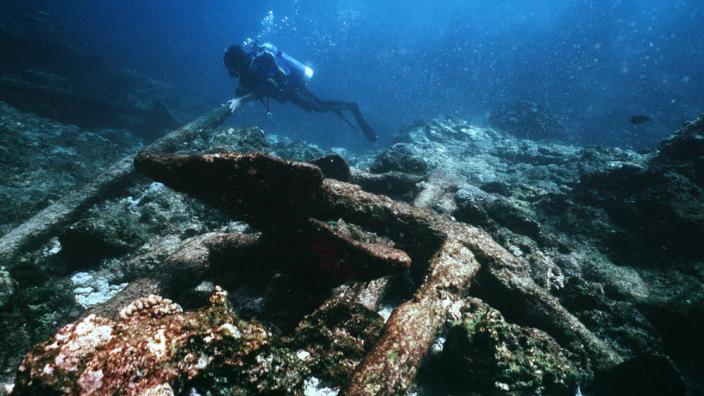
Suspected Tryall Shipwreck (© Copyright 2022 The Western Australian Museum)
Four hundred years ago, on 25 May 1622, a group of forlorn British sailors aboard the ship Tryall became the first of their countrymen to make landfall on the Australian continent.
Arriving centuries before Cook, they were not explorers, but rather merchants.
The Tryall, a ship of some 500 tons, had been built for the English East India Company in 1621, and departed Plymouth on her maiden voyage in September of the same year. Commanded by Captain John Brooke, and company factor Thomas Bright, her hold bulged with textiles, silver, and even a gift for the King of Siam. Manned by 143 seamen, her destination was Bantam, an entrepôt on the western end of Java, where the English had a factory.
While such a mercantile voyage to the Indies was more or less routine, the Tryall voyage was different. Her captain had been ordered to ply a new route to the east. Instead of hugging the coasts of Africa, the Indian subcontinent, and east Asia—a perilous journey of around 12 months—the ship had been instructed to sail across the open Indian Ocean at around 35 latitude south.
For the best part of a decade, this path across the open ocean had been a trade secret of the Dutch, pioneered by the VOC navigator Hendrik Brouwer in 1611. The route took advantage of the roaring westerly winds, and cut the journey from the Cape to the Indies to six months or less.
The only problem with the route was that, with no reliable method to reckon longitude, it took healthy doses of skill, experience, and luck to judge precisely how far east a ship had travelled, and when was the ideal time to turn to the north.
Under the novice guidance of Brooke, the Tryall strayed too far to the east, prompted to head north only after sighting the Southland at Barrow Island on 1 May 1622.
But on their northward voyage, the Tryall’s luck ran out. On the evening of 25 May 1622 the ship struck submerged rocks off the Montebello Islands. More than 90 men were killed in the wreck and its aftermath. The rest dwelled briefly on the islands, which had otherwise not been inhabited by Australians for some 8,000 years.
From amidst the chaos, the sailors managed to save a longboat and skiff from the wreck. While Brooke and a select crew set off immediately for Java in the skiff, Bright and more than forty others spent several days gathering their strength before heading off in the longboat: a journey of almost 2,000 kilometres.
In early July, both of the Tryall’s boats reached the VOC-controlled port of Batavia—to the great surprise of Dutch administrators.
Brooke attempted to blame the loss of the ship on the admiralty, but Bright, who had his own career in mind, was quick to point out that Tryall had strayed much too far to the east, and blamed the loss of the ship and cargo on Brooke’s incompetence.
The wrecksite of the Tryall was identified in 1934 by the Australian historian Ida Lee, but it was not found by divers until 1969. It was thereafter subjected to an archaeological investigation by the Western Australian Maritime Museum, and several artefacts from the wreck are now on display in Fremantle. The site of the wreck has since been renamed to Trial Rocks.
The voyage and wreck of the Tryall are significant for providing a substantial number of ‘firsts’: it was the first English ship to spot the Australian coast, it was the first European shipwreck in Australian waters, and lastly, it was the first time that Europeans spent a substantial amount of time on the continent.
But the Tryall is arguably more significant to Australia’s history for the reaction it prompted from the VOC. Worried that some of their own ships might be lost on the rocks—which had otherwise not been documented by any Dutch chartmaker—in September 1622 they ordered the ships Haringh and Hasewint to explore in detail these regions of the Southland.
These ships, for various reasons, never actually departed on their voyage of exploration. This is a shame, because they had orders to make contact with Southlanders, and to engage in trade with them where possible. Nevertheless, the die had been cast. In 1623, a much more successful voyage to the Southland was arranged by the VOC, and undertaken by the ships Pera and Arnhem under the command of Jan Carstenszoon. This voyage initiated one of the earliest major encounters between Australians and Europeans, along the Gulf of Carpentaria. But that is a story for another time.