
Bio-inspired Composites
Patterned, morphing composites via maskless photo-click lithography
Morphing materials, also known as smart materials are attracting increasing attention as sensors, actuators and in soft robotic applications. In this work bilayered morphing composites were created by exploiting the thiol–ene photoclick reaction via maskless digital light processing (DLP). This technique allows for gradients and patterns of near infrared (nIR)-triggered materials to be efficiently crosslinked to substrates, with suitable interfacial adhesion to realise complex morphing. Photo-thermally responsive
composites are produced by DLP patterning of reduced graphene oxide-filled chitosan-methacrylamide (rGO-chitosan-MA) on thiolated polydimethylsiloxane substrates via thiol–ene photoclick reaction. Morphing composites with parallel striped patterns and box-like hinges were printed via DLP to realise self-rolling and self-folding behaviours. Bilayered structures, with gradient rGO-chitosan-MA thicknesses (2–8 mm), were produced by controlling the light intensity from the DLP device. These gradient bilayered
structures enable photothermal-triggered gradient bending and morphing exemplified here by a ‘‘walking worm’’ and a kirigami-inspired ‘‘opening flower’’. Thermo-mechanical calculations were performed to estimate bending angles, and finite element analysis applied to simulate self-folding and bending. The difference between simulation and measurements is in the range 0.4–7.6%, giving confidence to the assumptions and simplifications applied in design.
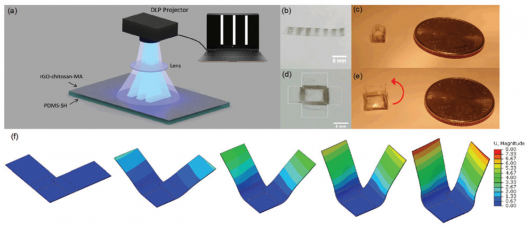
(a) Schematic setup of the DLP. (b and c) rGO-chitosan-MA/PDMS composite with parallel patterns before and during the nIR irradiation. (d) rGO-chitosan-MA/PDMS composite with box-like hinges before nIR irradiation (white dash line labelled boundary). (e) Four edges of the sample fold up along hinges during nIR irradiation as the red arrow shows. (f) Simulated self-folding of the box-like hinges with the increase of temperature, modelled as one quarter of the box.
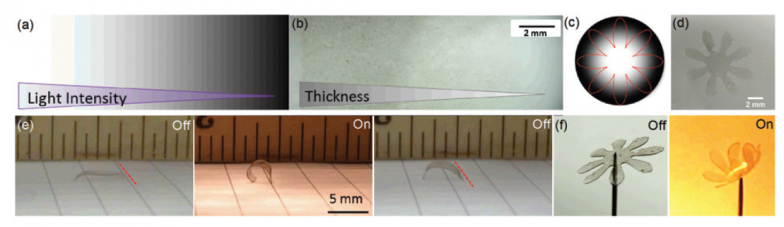
(a) Grey scale image projected. (b) RGO-chitosan-MA/PDMS composite with gradient thickness printed via (a). (c) Grey scale circle shown in the computer. (d) RGO-chitosan-MA/PDMS composite with gradient thickness printed via (c). The flower shape was cut along the red crease shown in (c). (e) ‘‘Walking worm’’ moves forward during the IR irradiation on and off. (f) ‘‘Flower’’ closes the petals when the IR irradiation on (secured stand by the pin in the middle).