
Ready to apply?
Are you ready to start your Master of Professional Engineering journey?

Gain the skills to drive real-world innovation in electrical engineering—from developing affordable health technology and next-generation AI processors to designing efficient electric motors for a renewable future.
As we enter a new era of smart, connected technologies, learn from experienced engineers as you apply theory in hands-on lab sessions and design projects.
You might develop non-invasive foetal heart monitoring techniques. Build neural prosthetics like bionic eyes to help people regain function. Integrate smart cities to ensure pedestrian and cyclist safety. Or design autonomous trains and delivery vehicles to safely transport people and goods – while cutting emissions.
You’ll expand your understanding of signal processing, electronics design, electromagnetism, antennas, real-time system design, multimedia communications and smart grids.
As the adoption of automation and AI accelerates, organisations need a new generation of electrical engineers to analyse data, boost efficiencies and build better products. We’ll show you how to take charge and lead the way.
You need to satisfy the following entrance requirements to be considered for entry to this course.
Depending on prior qualifications:
Entry level 1:
Duration: 3 years full-time (144 points to complete)
An Australian bachelor degree (or equivalent) with at least high credit (65%) average and prior studies in mathematics (inc. Linear Algebra and Calculus), physics and/or chemistry as required by the specialisation chosen for admission:
Entry level 2:
Duration: 2 years full-time (96 points to complete)
A four-year Bachelor of Engineering degree in a discipline relating to the specialisation to be studied within the Master course as approved by the Faculty, with at least high credit (65%) average.
Applicants must also meet the English language requirements.
Minimum entrance requirements for admission to Monash University Australia.
Applicants must have completed the subject prerequisites or equivalent university units no more than 10 years prior to admission.
To complete your degree, you will need to demonstrate that you have the abilities, knowledge, and skills to achieve specific core learning outcomes, these are called inherent requirements.
Find out more about inherent requirements for this course.
Applicants must have completed the VCE subject prerequisites or equivalent university units no more than 10 years prior to admission.
Use the course map alongside the Handbook to plan your studies throughout your master’s degree. If you’re unsure about your course progression, contact your course adviser.
Fees are subject to change annually.
Fees are per 48 credit points which represents a standard full-time course load for a year. The fees for 2027 are:
Note: see information on how average fee is calculated.
As a full fee-paying student, you may be eligible to apply for the optional FEE-HELP to assist you to pay all or part of your tuition fees.
For information on other study costs and fees, see other study costs.
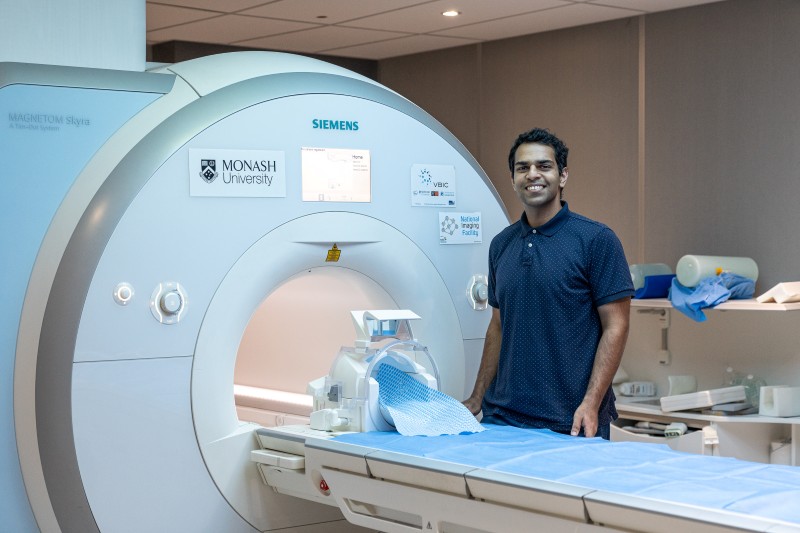
My work in artificial intelligence and medical imaging significantly reduces MRI scan times, providing greater comfort to patients.”
DR. MEVAN EKANAYAKE
PhD, Electrical and Computer Systems Engineering
As more industries embrace a connected, smart future, the demand for electrical engineers exceeds supply – presenting you with countless career opportunities. You might:
By specialising in electrical engineering, you’ll be able to pursue your passions and direct your development in these areas:
Electrical Engineering specialisation is also available through the Master of Engineering.
If you have any queries about the Master of Professional Engineering, or if you’d like to find out more, please contact us:
Telephone: 1800 MONASH (1800 666 274)
Domestic student enquiry form
Telephone: +61 3 9903 4788
International student enquiry form