Monash University logo

Monash Art, Design and Architecture Student Exhibition 2022

Nell Mooney

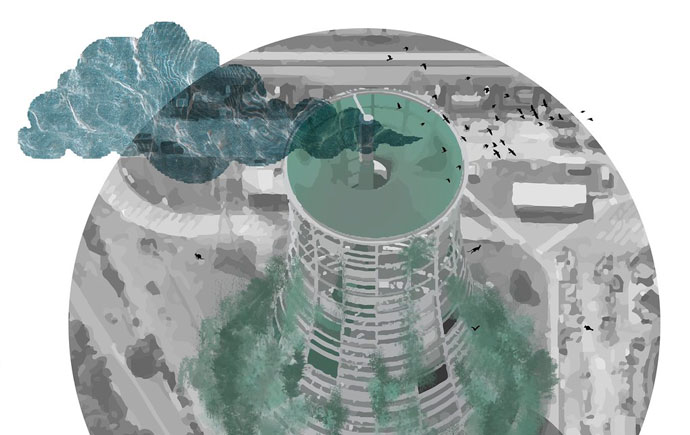
The project proposes an alternative remediation strategy for Yallourn W Power Station that prioritizes natural rehabilitation of the land. A new, vertical landscape typology is tested on the existing cooling tower structure where specific climatic conditions are mimicked in an effort to re-establish naturally occurring bioregions.

Axonometric Section

Operating within a larger scheme taking place over a significant time frame, the cooling tower has become a conservation nursery. The space features both public landscape exhibitions to showcase various bioregions as well as research facilities to preserve and cultivate Indigenous fauna for future landscape remediation initiatives. The cooling tower is vindicated through its transformation from a symbol of degradation to one of conservation.

Structural Strategy

The existing shell of the cooling tower is kept intact, while the vacant vertical condition is occupied by a series of landscaped platforms. Materials include concrete made using fly-ash (left over from coal production) as a cement substitute, timber and recycled plastics.

Lowland Forest Bioregion

Public landscapes encourage visitors to interact with the vegetation. A fog net is designed to capture moisture from the air to keep humidity at the optimal range for vegetation to thrive whilst allowing the tree canopy to grow freely.

Wetland Bioregion

The existing water basin and spray nozzles are retained to create the climatic conditions needed for the swampy wetland bioregion. By keeping the hyperbolic shape of the cooling tower, natural draft still occurs to passively cool the space.

Ecology Diagram

The different bioregions cultivated in the project are derived from pre-colonial mappings of Yallourn. They will act as a cohesive ecosystem to nurture and encourage Indigenous plant growth within the restored cooling tower. Creating healthy ecosystems is crucial to the longevity of the project but also the efficiency of the landscape remediation.

Phytoremediation Soil Recovery Strategy

The native species preserved and cultivated in the project will eventually be planted throughout the site surrounding the cooling tower. Over time, this vegetation will remediate the damaged soil through a process called Phytoremediation. Plants absorb, stabilize, degrade and filter chemicals from the soil to return the soil to a healthy state that can support ecosystems.

Explore more

View all

Other years

Back to top