Monash Art, Design and Architecture Graduate Exhibition 2023
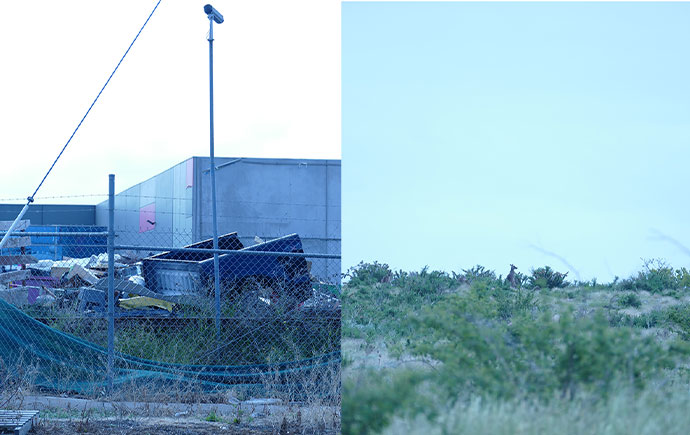
The use of land by industrial buildings is one of the fastest growing land use types in Melbourne underpinned by its perceived economic stimulus. Much of this expansion occurs on the flat volcanic plains to the north and west of Melbourne. This before and after condition is neatly juxtaposed at the expansion of the northern industrial corridor in Craigieburn, where on one side of the Merri Merri creek is Galgi Ngark, a grassland reserve, and on the other an industrial estate.
We looked closely at the nature of the industrial estate that has displaced the grasslands over the past forty years. Far from the rhetoric of economic stimulus we observed a range of conditions: real estate speculation; highly inefficient occupation; a significant proportion of non-industrial program; very large buildings used for storage by logistics companies using inefficient single storey storage technologies; generally a home to anyone who needs cheap space for whatever purpose including storage of wrecked cars, rubbish, discarded and unused items. Volcanic boulders speckle the small amount of unsealed ground, reminding us of the volcanic origins.
Much of the industrial estate serves as a proxy for actual commercial zones, displaced from the inner and middle north through high property prices and land banking of ex commercial and light industrial buildings. The resulting quality of the urban areas is one of decline while speculators await rezoning.
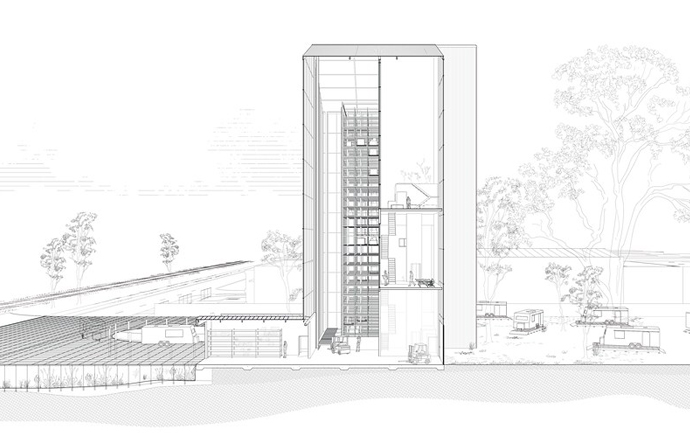
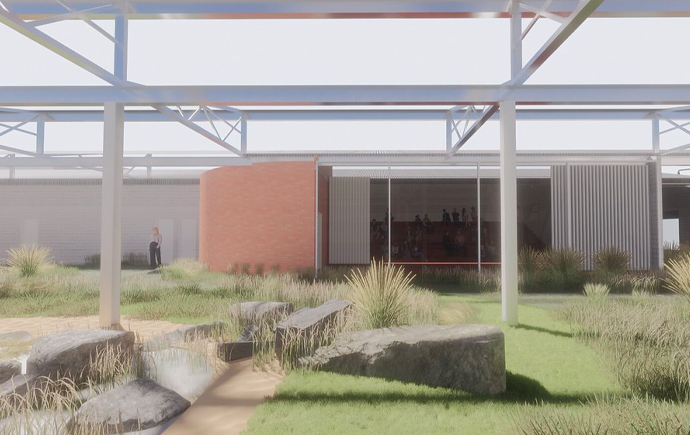
In the studio Minus, we imagine a planning scheme that places priority on the natural environment, biodiversity conservation, repair and minimising extraction of resources as ingredients of longer-term economic stimulus, climate change action and cultural repair. We are interested in the reuse of buildings already built, and in more efficient typologies of industrial buildings that can be reimagined to contribute to the urban realm.
Students have selected two programs from the Craigieburn estate and relocated them in existing currently unused buildings. They have reimagined typologies through mixed programs and a focus on the relationship to their context. Their sites in Craigieburn are proposed as sites of environmental repair and an extension of Galgi Ngarrk: environmental and social repair.
This studio imagines a reversal of the way cities have been made, where the plan is redefined on the terms of natural systems. It proposes that strategically removing, reassessing or relocating buildings, and hybrid multi use buildings are both 21st century core architectural skills.
Studio Leader: Louise Wright
Image: west and east side of Merri Merri at Galgi Ngarrk, photograph: Louise Wright