
Research

-
-

MNM Research witnessed growth in both outputs and income over the past year, with our researchers receiving well-deserved recognition. Heartfelt congratulations to Professor Elizabeth Manias and Dr. Cliff Connell for their national and global accolades. Their achievements are truly commendable. MNM also achieved success across all tiers of funding categories. A special acknowledgment goes to Dr. Kaori Shimoinaba, Dr. Stephanie Grant, and Renee Molloy for securing the 2023 MNM Research Development Grants, designed to position researchers for larger grants in the future.
Our monthly Research Forums, biannual Research Seminars, and Writing Retreats attracted significant participation, complemented by in-house peer reviews, pitching sessions, and research inductions. These activities will persist into 2024 in alignment with our strategic principle of investing in our people.
As Director of Research, I extend my gratitude to the support provided by the Faculty and Monash Research Office. I offer sincere appreciation to all MNM members who contributed to crafting the Research Strategy. Special thanks to the MNM Leadership group for their steadfast support. Additionally, I express my deepest gratitude to Emma Craige, Research Executive Officer, for her exceptional contributions, and to Associate Professor Wendy Pollock for her support and dedication as Deputy Director of Research.
Together, we have made significant strides, and I look forward to the continued success and growth of MNM Research in the coming years.
Professor Philip Russo
-
-
Research Strategy
The MNM Research Strategy 2023-2027 is our 5-year strategic plan. Our vision is to be global leaders in transformative health research by investing in our people, fostering local, national, and global partnerships, and delivering solutions to address important and pressing health challenges.

-
-
Research highlights
-
Professor Elizabeth Manias awarded two substantial, prestigious grants.
 Professor Elizabeth Manias has been awarded NHMRC Investigator Grant and ARC Discovery Project funding totalling over $3.3million for projects commencing in 2024,
The competitive NHMRC Investigator Grant was awarded to Elizabeth for her project ‘ENgaginG older people Across transitions of care to improve medication manaGEment’ (The ENGAGE Project). The project provides an evidence-based model for optimising medication management across transitions of care and empowering older patients including those of non-English speaking backgrounds and those with cognitive or sensory impairments.
Additionally, she was awarded the Australian Research Council Discovery Projects Grant for the project ‘Engaging residents and families about managing psychotropic medicines in aged care facilities’. This project involves examining how communication occurs between residents, family members and care providers about psychotropic medicines management, as well as to develop and test strategies promoting resident and family engagement in aged care facilities. Residents, family members and care providers will examine audio recorded interviews and observations to identify possible data-driven strategies for improving engagement, which will be tested depending on what they perceive is important about the use of psychotropic medicines. The focus on what counts as being important to residents and families is a crucial component missing in past work.
Significantly, this is the first ever ARC Discovery Project grant awarded to a member of Monash Nursing and Midwifery.
-

A-PRECISE Australia PReventing infECtions In reSidential agEd care
People living in residential aged care homes (RACHs) are at a higher risk of acquiring healthcare-associated infections (HAIs) due to residents ageing and health conditions, operational, environmental and cultural characteristics, knowledge and compliance with infection prevention and control (IPC) practices and workload pressures. This project will bring together researchers, consumers (residents and family members/informal carers), staff and age care providers, to co-design and implement an innovative practice and education strategy, and evaluate its effectiveness to optimise IPC practice and protect people from HAIs in RACHs.

Carers in need of care: Co-designing interventions to support health and wellbeing of the aged care workforce
There are around 370,000 aged care workers in residential and community care in Australia. This workforce includes registered and enrolled nurses, personal care workers and allied health practitioners and assistants in direct care roles. There remains unprecedented pressure on the aged care workforce which was heightened by the COVID-19 pandemic. The workforce is at risk of occupational burnout which can negatively impact their health and wellbeing, resulting in reduced job satisfaction, increased levels of absenteeism and turnover rates, and poor retention rates. Staff burnout can also have an impact on quality care delivery. Associate Professor Helen Rawson is a CI on a team co-designing supports to enhance the aged care workforce health and wellbeing. This 3-year project has received funding from the Arcare Family Foundation.
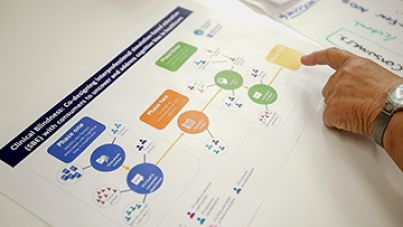
Monash Nursing and Midwifery has been collaborating with Peninsula Health on research to address cognitive bias in healthcare.
Every year across Australia, adverse events are reported in healthcare, of which many relate to healthcare professional cognitive bias. Cognitive bias is estimated to contribute to 75% of all errors in internal medicine. Cognitive bias refers to flaws or distortions in judgement and decision making which contribute to ineffectual clinical reasoning and adverse events in healthcare.
Cognitive bias results from systematic, known and predictable errors in thinking, therefore there is an opportunity to develop interventions to reduce the impact of cognitive bias. A number of strategies have been proposed to address cognitive bias, including simulation. Therefore, this project aimed to co-design and evaluate an interprofessional simulation developed to support healthcare professionals and students to surface and respond to cognitive bias in their clinical practice. There has been a call to collaborate with healthcare consumers when designing education to ensure that it is meaningful and responds to real-world challenges. Therefore, this project has been co-designed with healthcare consumers and professionals.
This research is the first to evaluate interprofessional simulation to help healthcare professionals and students recognise and respond to cognitive bias. It is also the first co-designed simulation to address cognitive bias, drawing on the experiences and expertise of healthcare consumers and professionals throughout the entire project to ensure that the simulation, evaluation and recommendations respond to needs of consumers.
The following outputs have arisen from this project:
- Australian Simulation Congress conference presentation
- Peninsula Care Newsletter submission (for publication in February 2024)
- Presentation to Peninsula Health consumer representative group by Pauline D'Astoli OAM (Consumer Advocate)
- 'One Peninsula Health News' article
- Submission of methodology paper to Medical Teacher (under review)
- ANZAHPE conference presentation
- AMEE 2024 conference presentation abstract submission (under review)
- An interprofessional simulation to help healthcare professionals and students surface, recognise and respond to cognitive bias in healthcare
- An evaluation paper (due for submission early 2024)



The care crisis facing hospital emergency departments
Dr Cliff Connell remembers when he was an emergency nurse working in a Victorian hospital emergency department (ED) in the late 1990s and early 2000s, when he and the ED consultant would routinely walk the floor during a practice called “rounding reviewing” each patient.

COP28: Why going beyond net zero is necessary to protect public health
The 28th United Nations Climate Change Conference of the Parties – COP28 – started in late November 2023 in Dubai. The World Health Organisation (WHO) hosted the first Health Day and climate health ministerial, aiming to encourage commitments towards climate-resilient and sustainable low-carbon health systems.

Taking the temperature of nurses as the spotlight focuses on the aged care workforce
The tumultuous royal commission into the Australian aged care system concluded in 2021 with a suite of 148 recommendations. A/Prof Helen Rawson has led a study to specifically look at aged care nurses in two Victorian residential aged care homes, and how they feel about and operate within their workplaces.

The health impact of climate change is not adequately recorded: study
The work uncovered gaps in clinical terminologies available to healthcare professionals during disaster-related events. Notably, hazards related to meteorological, hydrological, extraterrestrial, geohazard, environmental, technological, and societal factors were poorly mapped. Enhancing globally agreed terminology would enable clinicians, public health officials, and health informaticians to manage vast volumes of clinical data, and retrieve, analyse, and contextualise it to specific climate-related situations. This data can be utilised to develop evidence-based interventions, predict future impacts more precisely, and support informed decision-making by policymakers and government leaders for climate change mitigation and adaptation strategies. The study mapped the United Nations Office for Disaster Risk Reduction-International Science Council (UNDRR-ISC)’s Hazard Information Profiles (HIP) to SNOMED CT International, a widely used clinical terminology for electronic health records. The resulting paper called for global collaboration to expand SNOMED CT International to include unique geographical and regional hazard contexts disproportionately experienced in countries most affected by climate change.

World Health Day 2023: A net-zero healthcare system
The Australian healthcare sector contributes 7% of the nation’s total carbon emissions. Following the Australian Medical Association (AMA) and Doctors for the Environment Australia’s (DEA) a call was made on the Australian healthcare sector to reduce its carbon emissions to net zero by 2040, with an interim emission reduction target of 80% by 2030.
For 2023 World Health Day, Associate Professor Zerina Tomkins shared updates on her work in developing a sustainable healthcare system and her views on what we need to do to improve health outcomes for all. She called for all disciplines to work together to deliver practical and economically-viable solutions that support the transition to sustainable, low-carbon models of care and healthcare service delivery. Often, clinicians delivering care at the bedside will have great ideas for improving processes. However, they need support from information technologists, computer scientists, engineers, health informaticians, architects or builders to make these solutions a reality. To achieve sustainable healthcare systems, Associate Professor Tomkins has been working with computer scientists and information technologists to decarbonise digital healthcare, as well as with major tertiary hospitals to support their journey to reducing the carbon footprint of their pathology laboratories.
Intensive Care Unit nursing workforce – optimising patient outcomes.
 The Intensive Care Unit (ICU) is seen as a challenging and rewarding area to work in. ICU is where the sickest people in the hospital go to receive life-saving care. Attracting nursing staff to work in ICU is relatively easy, however keeping staff who are post-graduate qualified and experienced is a chronic issue. The COVID-19 pandemic has exacerbated this retention challenge, with many staff working in ICU over the pandemic choosing to leave working in ICU altogether, or reducing the hours they are prepared to work there.
Our research program seeks to address the retention of post-graduate qualified and experienced ICU nursing staff. We conducted a study interviewing ICU Nurse Unit Managers to explore ‘what constitutes safe, sustainable ICU nurse staffing’. Common challenges included staff burnout, redeployment of staff out of ICU if the unit was ‘quiet’, and the Nurse Unit Managers feeling that ‘every day is a battleground’ where they needed to fight to hold their ground for what they perceived was needed from a staffing perspective. We created a safe, sustainable ICU nursing model that recognises at the heart, that ICU nurses must feel safe at work and they must feel that the ICU they work in provides safe care to patients; that individual ICU nurses need to feel valued and supported, to have career development opportunities; that ICUs need to offer recruitment paths into ICU whilst ensuring the skill-mix of nurses and adequate resources to support novices in ICU; and ICU Nurse Unit Managers need an organisational culture that supports them to be autonomous in their role.
The right skill-mix of nurses is critical to achieve optimal patient outcomes. Other recent research we have conducted found that when there are too many novices or non-specialist ICU nurses, patients in ICU are about 20% more likely not to survive. This highlights the need to retain post-graduate qualified and experienced ICU nurses working in ICU. Associate Professor Wendy Pollock was awarded the Australian and New Zealand Intensive Care Society Peter Hicks Fellowship Award at the ANZICS/ACCCN Annual Scientific Meeting in 2023 for the presentation ‘ICU nurse staffing: What can data tell us and what do we want to know?’ in recognition of the importance of this critical research area.
-
-
Our research areas of expertise
-