Home

Welcome to One Water
The One Water Consortium brings together researchers, industry, and government to tackle the hidden burden of waterborne disease in Australia. Despite the health and economic risks, no national system currently monitors waterborne infections.
We are building Australia’s first multidisciplinary surveillance framework through linking sampling innovation, biobanking, genomics, and data integration to close critical gaps in the national response.
Through strong partnerships and evidence-based practice, the One Water Consortium is driving safer water management and protecting public health.
The One Water Team
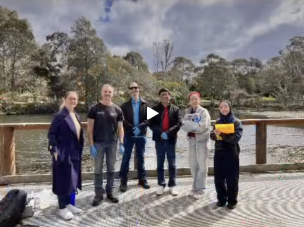
The One Water Consortium consists of inter-disciplinary researchers from across, public health, civil engineering, genomics and biology during together to combat global water challenges
Check out some of our recent publications.
Assessing accuracy and specificity of faecal source library for microbial source-tracking, using SourceTracker as case study
Understanding the quality of the source library prior to undertaking library-dependent microbial source-tracking (MST) is an essential, but often overlooked, primary analysis step.
Beyond borders: A systematic review and meta-analysis of human-specific faecal markers across geographical settings
This systematic review quantified the performance of human-specific fecal markers to identify those suitable for use across various geographic regions.
Enhanced detection of animal-derived microbial hazards in forested catchments using high-volume ultrafiltration and amplicon-based microbial source tracking
Demonstrates how high‑volume EasyElute ultrafiltration enhances microbial recovery, supporting more reliable detection and hazard assessment in source water systems.
Bridging sanitary surveys and microbial evidence: Advancing recreational water risk assessment through community-based microbial source-tracking
Combines community‑based MST with adjusted FIB concentrations to generate source‑specific contamination profiles for eight Australian beaches, improving hazard assessment.