
Sanger Sequencing

Long-read DNA sequencing is a core service and has been in operation at MGBP since 1993. Great pride is taken to offer the highest possible quality long reads and very fast turnaround. Our objective is to provide a fully-personalised and custom service. Client support is a hallmark of our service and staff are always available to assist you with comprehensive troubleshooting and technical advice. Samples are individually monitored from receipt to data despatch and all results are extensively assessed during data processing so that you achieve the best possible outcomes from your sequencing.
Our Services
Capillary Separation Only
For researchers who have already completed the cycle sequencing reaction and subsequent clean-up.

Cycle Sequencing Reaction & Separation
For researchers who would like MGBP to perform the entire cycle sequencing process. Purified DNA template and primer can be submitted separately or pre-mixed.

Custom
Specialised, custom cycle sequencing protocol for templates with complex secondary structure and difficult to sequence templates, PCR product purification prior to the cycle sequencing (extension) reaction and enhanced sequence analysis using the PeakTrace basecaller for increased basecall resolution and read length.
Submission Guidelines
We will accept any type of purified DNA template for sequencing, including plasmid DNA, PCR product and large DNA (e.g. BACs, cosmids and small bacterial genomes). We recommend speaking with our staff prior to submitting any large DNA samples.
Samples are accepted in both tube and plate format with pricing and processing throughput structured accordingly.
An iLab account is required to access our Sanger sequencing services and you will need to contact MGBP to obtain the login details for our FTP server if you are a customer, external to Monash University. Please contact us for further information on any matter relevant to our Sanger sequencing service.
The capillary separation service is for customers who have already completed the cycle sequencing reaction and subsequent clean-up. The dried extension products are sent to MGBP in either tubes or plates, together with a printed copy of the iLab order form (for sample identification and tracking). The turnaround time for this service can vary but is generally between 6-24 hours from sample receipt at our facility. The capillary separation service, process flow is outlined below. | 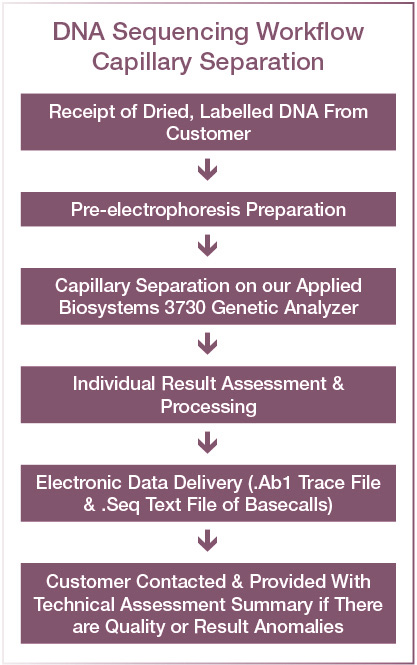 |
 Guide for preparing purified template DNA for Sanger sequencing
The customised service (reactions and separation) is for clients who would like Micromon Genomics to perform the entire cycle sequencing process. The purified DNA template and primer in separate sealed tubes, or as premixed, are sent to us together with a printed copy of the iLab order form (for sample identification and tracking). The turnaround time for this service can vary but is generally between 24-48 hours from sample receipt at our facility. The complete cycle sequencing service, process flow, is outlined below. You will need to supply any custom primers required but we do have a limited selection of stock primers in-house for use in your reactions if desired. These are:
For further details, see the guide Our template DNA and primer requirements for the full custom service in tube format |  |
MGBP offers a number of Sanger sequencing format and pricing options to suit all requirements:
- Standard casual rate – Tube format
- Express service – Plate format
- Monash University
- Academic – university, research institution or school
- Industry
- High-throughput agreements
A price quote is provided in iLab when you complete details for a sequencing request, and prior to submitting the request. Alternatively, please contact the MGBP Genomics Node manager, Dr Natasha Ng, to arrange a quote and to discuss and negotiate any of these options and how they might apply to your project requirements.
It is an important consideration, when choosing a service provider, to note that MGBP uses a 1/8 dilution of the Applied Biosystems BigDye Terminator Reagent. Greater dilutions of this key reagent, as used by cheaper service providers, may lead to decreased quality, shorter reads or failure if your template DNA is marginal.
All pricing options include our highly-reputed customer support and troubleshooting provided by our well known and friendly staff.
Additional options are available on request which include enhanced sequence analysis using the PeakTrace basecaller, and specialised, custom cycle sequencing protocols for difficult templates and templates with complex secondary structure.
MGBP uses the Agilent iLab online service request system. Sanger sequencing requests must be made via this system and registration for an account is essential for access.
To register for an iLab account
Monash University Users - registration guide
External (non-Monash) Users - registration guide
Guides for submitting requests in iLab
Step-by-step instructions on how to access the MGBP site in iLab and how to make a request for services.
Separation Only for samples submitted in TUBES
Reaction and Separation for samples submitted in TUBES
Registration and sample submission enquiries
Due to the size and complexity of the .AB1 file type, we provide the results as compressed files attached to the iLab order. Upon order completion we inform the customer via iLab and a link is provided for quick access. Data files are backed up to a permanent archive for long-term storage and old files can be accessed on request.
It is critical that you view the trace file for the full length of the read and manually check the basecalls against the provided sequence file. This will allow you to manually trim the sequence file at both ends and correct any ambiguous basecalls. The Applied Biosystems Kb basecaller will make an error where it determines that the base spacing is irregular or the resolution of the peaks is too poor to call with acceptable confidence (nearer the end of the run). Our policy is to have the analysis software call bases at every position and then allow the customer to manually check, edit and trim the read. If you would like us to re-configure the software to call Ns where appropriate, please request this on your order form together with the Quality Value (QV) which you would like us to use for the basecall threshold. There is a range of freeware (trace file viewing programs) available that will perform some, or all of the basic functions of viewing, editing and printing the trace files. Additionally, there are some free and inexpensive programs that also offer the extra capability of performing multiple sequence alignments, clipping, blast searches and sequence assembly. |
|

An excellent outline of the basic concepts of Sanger Sequencing is provided in Chapter 1 of the Applied Biosystems Chemistry Guide (3rd edition, 2016): For a concise coverage of the most common sequencing problems you are likely to encounter, we recommend our guide Common reasons for DNA Sequencing failure For a much more comprehensive coverage, please see Chapter 8 in the Applied Biosystems Chemistry Guide (3rd edition, 2016) We have created additional guides which might prove useful in overcoming technical sequencing problems. How to prepare DNA templates to achieve the best possible sequencing results Overcoming problems with short mononucleotide repeats (This 2010 research paper from the journal BioTechniques outlines a fusion enzyme methodology to improve sequence data generated from PCR products that contain mononucleotide repeats of 15 bases or less.) |
|

Instrumentation and Analysis Software
We use an Applied Biosystems 3730s Genetic Analyser fitted with a 50 cm array and is capable of processing 48 samples per run. Our instrument can generate read lengths in excess of 1,000 QV20+ bases with an enhanced basecaller. The proprietary Kb basecaller used during data analysis, incorporates advanced algorithms that produce accurate sequence basecalls. The file output (.AB1) is Windows format. The sequence data is supplied to you as an electropherogram (trace file) together with a standard text file of the basecalls. Standard Chromatogram format (.scf) and Phred format (.phd.1) are both available on request. PeakTrace, an optional enhanced basecaller (uses a more sophisticated algorithm to the Kb basecaller) is also available which may generate up to an additional two hundred QV20+ basecalls dependent on the quality of the input template DNA. This enhancement provides far greater resolution throughout the sequence read. We strongly recommend that you perform a full manual edit of all your sequence data using the trace files as a standard research practise. |
|

Chemistry
The cycle sequencing chemistry currently used by MGBP is the Applied Biosystems PRISM BigDye Terminator Mix (versions 3.1 and 1.1) incorporating the key enzyme AmpliTaq DNA polymerase - FS. Version 3.1 is the mix recommended for most sequencing applications and we can supply the terminator mix directly to you, significantly discounted from the Applied Biosystems list price.
While our sequence runs generate in excess of 1,000 QV20+ basecalls, using the Kb basecaller, around 900 bases are routinely called with quality values exceeding QV=20 (error probability of 1.0% or less), the majority exceeding QV=50 (error probability of 0.001% or less) using the BigDye v3.1 chemistry.
The quality of the basecalls (resolution) is significantly dependent on the purity of the starting DNA template. A reduction in final resolution and signal quality can be caused by the presence of RNA, salt, protein and other contaminating chemicals. These contaminants can be eliminated by effective template purification prior to cycle sequencing and a thorough post-reaction clean up. These are both key factors in the generation of long, highly resolved reads.
The Applied Biosystems Chemistry Guide is a comprehensive guide to Sanger sequencing and includes an comprehensive section on troubleshooting with actual examples. The Qiagen guide is still an excellent basic resource, although quite dated now. It is important to note that the amounts of BigDye Terminator mix recommended in the AB guide are not practical for the current AB instruments and the recommended amounts can be diluted by at least, one in eight.
User Information
Applied Biosystems Genetic Analysis web site
 Applied Biosystems Chemistry Guide - DNA Sequencing by Capillary Electrophoresis
How To Use Our Sanger Sequencing Services
Data Analysis
It is critical that you view the trace file for the full length of the read and manually check the basecalls against the provided sequence file. This will allow you to manually trim the sequence file at both ends and correct any ambiguous basecalls. The Applied Biosystems Kb basecaller will make an error where it determines that the base spacing is irregular or the resolution of the peaks is too poor to call with acceptable confidence (nearer the end of the run). Our policy is to have the analysis software call bases at every position and then allow the customer to manually check, edit and trim the read. If you would like us to re-configure the software to call Ns where appropriate, please request this on your order form together with the Quality Value (QV) which you would like us to use for the basecall threshold. There is a range of freeware (trace file viewing programs) available that will perform some, or all of the basic functions of viewing, editing and printing the trace files. Additionally, there are some free and inexpensive programs that also offer the extra capability of performing multiple sequence alignments, clipping, blast searches and sequence assembly. |
|
An excellent outline of the basic concepts of Sanger Sequencing is provided in Chapter 1 of the Applied Biosystems Chemistry Guide (3rd edition, 2016): For a concise coverage of the most common sequencing problems you are likely to encounter, we recommend our guide Common reasons for DNA Sequencing failure For a much more comprehensive coverage, please see Chapter 8 in the Applied Biosystems Chemistry Guide (3rd edition, 2016) We have created additional guides which might prove useful in overcoming technical sequencing problems. How to prepare DNA templates to achieve the best possible sequencing results Overcoming problems with short mononucleotide repeats (This 2010 research paper from the journal BioTechniques outlines a fusion enzyme methodology to improve sequence data generated from PCR products that contain mononucleotide repeats of 15 bases or less.) |
|
Instrumentation and Analysis Software
We use an Applied Biosystems 3730s Genetic Analyser fitted with a 50 cm array and is capable of processing 48 samples per run. Our instrument can generate read lengths in excess of 1,000 QV20+ bases with an enhanced basecaller. The proprietary Kb basecaller used during data analysis, incorporates advanced algorithms that produce accurate sequence basecalls. The file output (.AB1) is Windows format. The sequence data is supplied to you as an electropherogram (trace file) together with a standard text file of the basecalls. Standard Chromatogram format (.scf) and Phred format (.phd.1) are both available on request. PeakTrace, an optional enhanced basecaller (uses a more sophisticated algorithm to the Kb basecaller) is also available which may generate up to an additional two hundred QV20+ basecalls dependent on the quality of the input template DNA. This enhancement provides far greater resolution throughout the sequence read. We strongly recommend that you perform a full manual edit of all your sequence data using the trace files as a standard research practise. |
|
Chemistry
The cycle sequencing chemistry currently used by MGBP is the Applied Biosystems PRISM BigDye Terminator Mix (versions 3.1 and 1.1) incorporating the key enzyme AmpliTaq DNA polymerase - FS. Version 3.1 is the mix recommended for most sequencing applications and we can supply the terminator mix directly to you, significantly discounted from the Applied Biosystems list price.
While our sequence runs generate in excess of 1,000 QV20+ basecalls, using the Kb basecaller, around 900 bases are routinely called with quality values exceeding QV=20 (error probability of 1.0% or less), the majority exceeding QV=50 (error probability of 0.001% or less) using the BigDye v3.1 chemistry.
The quality of the basecalls (resolution) is significantly dependent on the purity of the starting DNA template. A reduction in final resolution and signal quality can be caused by the presence of RNA, salt, protein and other contaminating chemicals. These contaminants can be eliminated by effective template purification prior to cycle sequencing and a thorough post-reaction clean up. These are both key factors in the generation of long, highly resolved reads.
The Applied Biosystems Chemistry Guide is a comprehensive guide to Sanger sequencing and includes an comprehensive section on troubleshooting with actual examples. The Qiagen guide is still an excellent basic resource, although quite dated now. It is important to note that the amounts of BigDye Terminator mix recommended in the AB guide are not practical for the current AB instruments and the recommended amounts can be diluted by at least, one in eight.
User Information
Applied Biosystems Genetic Analysis web site
Applied Biosystems Chemistry Guide - DNA Sequencing by Capillary Electrophoresis
