
How to Get Student and Graduate Eyes Interested in Your Job Descriptions - Key Event Takeaways
In a world full of job opportunities, how do you get students and graduates as excited about your openings as they are about all four versions of Taylor Swift’s new album?
Brought to you by scalr and Monash Talent, it’s time to take a deep dive into all things graduate recruitment and how to get all eyes on your offerings. Across three focused events, we’ll be taking a closer look at key aspects of the recruitment journey and how you can refine each step to start finding the talent your business needs.
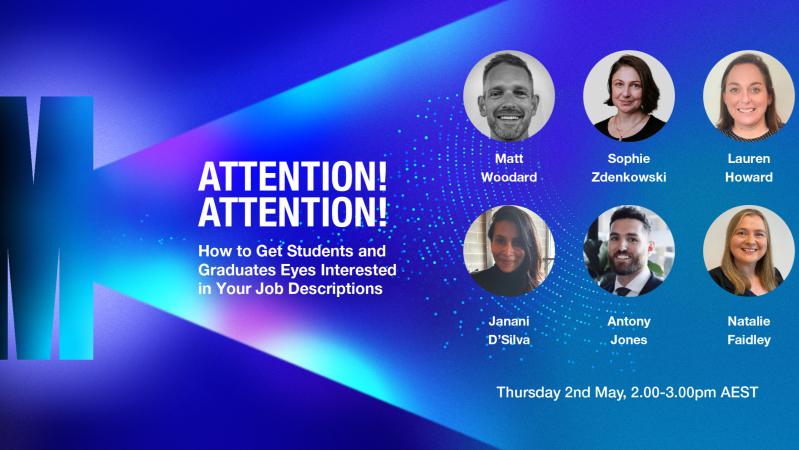
To kick off the conversation, we tackled the topic of job descriptions and how to draw people in with the right words. Our conversation with Matt Woodard (Founder of scalr), Lauren Howard (Engagement and Delivery Manager at Monash Talent), Sophie Zdenkowski (Early Careers Specialist), Janani D’Silva (Head of Culture, Engagement and Early Careers at Capgemini), Antony Jones (Campus Recruitment Lead at IMC Trading) and Natalie Faidley (Early Careers Lead at Stantec) revealed some really interesting insights, words of wisdom and expert experiences.
Breaking through the noise
Every day we’re all inundated with hundreds, if not thousands, of messages. The internet and social media are great tools, but it’s also created a whole lot of noise that we have to try and break through to get all eyes on us. So how exactly do you do that? As Sophie noted, if we’re out here telling students to get their CVs and cover letters in tip-top space, our job descriptions should be too.
First tip from Antony, watch your spelling and grammar. Also, don’t miss the opportunity to highlight what long-term benefits and opportunities candidates have. Show them why it’s worth jumping over to you and sticking it out for the long haul. What makes your workplace cooler than the others? Don’t forget your inclusive language and imagery as well. As Janani noted, “Be as inclusive as you can so that you're not immediately setting cues to exclude people from the get-go.”
Next, how do you get it out into the world? Your strategy here will depend on your situation. As Natalie highlighted, maybe it’s posting on University job boards, SEEK, using services like Prosper or Grad Connection or even going to career fairs.
Standing out from the crowd
A well-rounded and carefully considered job description with no spelling errors is a great first step, but you also need something that is going to get graduates looking at you before anyone else.
Antony says to start with your USPs (unique selling points). Not sure what they are? “Speak to other people in different departments at your organisation, find out what they like. Talk to recent grads who have come through … why did they come and join you? And, more importantly, what are they enjoying about it so far?”
Even when you think you’ve got everything figured out, Natalie notes you should always keep coming back to this step and reviewing. “Each time we have a campaign, we are changing the way we write our job ads.”
Tell me you’ve got a good culture without telling me you’ve got a good culture
Speaking of selling points, one of the big ones for all candidates is culture. So how do you show how great your work culture is in your job ad without literally saying the words? Antony believes authenticity is key.
“The best way to show the culture is to have people within the organisation, not just the senior leadership, actually living and breathing it … sending reps from the business out to different activities so graduates and interns can actually meet them … when candidates are coming in for interviews … get one of your engineers, scientists or whoever it may be from inside the business to actually sit down with them … give them some time to ask any questions they have.”
Stop filling quotas
To round out the conversation, we wanted to take a moment to touch on diversity. Having diversity in the workplace is obviously great and something to strive for, but it’s important to think about the why. As Janani highlighted, “Do you want to have diversity because you want to put up a rainbow flag during pride month? .. or are you doing it because it's really important for business and the bottom line and social progress?” When you start bringing people in just to fill a quota you not only risk bringing in the wrong talent, you can also leave people feeling undervalued and with a serious case of imposter syndrome.
“We aren't looking for girls. We're not looking for neurodiverse. We're not looking for people with disability. We're looking for people with all kinds of backgrounds because we need diversity of thought.”
Want to catch up on the full conversation? Click here to watch the full recording.