
A New Work Relations Architecture
Professor Marilyn Pittard's law reform work is holding up the roof of a new architecture for work relations.
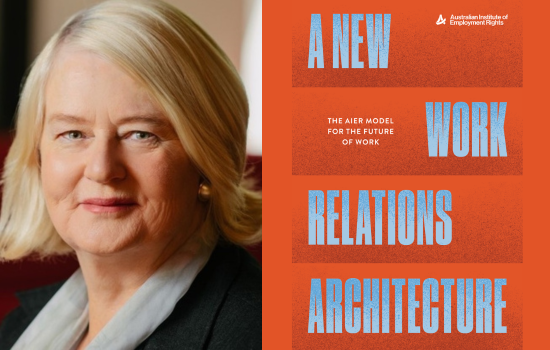
In 2022, CLARS Member, Professor Marilyn Pittard, was part of a think tank of industrial relations law experts exploring a new design for relations between businesses, employees and unions. Working with the Australian Institute of Employment Rights, the think tank adopted the metaphor of a Greek building for a new architecture in work relations - foundations, pillars and a roof.
The think tank has since resulted in the publication of a book, A New Work Relations Architecture, featuring a chapter by Professor Marilyn Pittard. Marilyn's chapter or 'pillar', redesigned fair labour standards and remuneration for the new model.
A New Work Relations Architecture was launched on Wednesday 27 September at the State Library of Victoria. The book is available for purchase on the Australian Institute of Employee Rights website. Editor James Fleming summed up the book in his Introduction, saying, "This book outlines a new work relations architecture: new rules of the game between workers and business, new rules for a fairer system and a more just society."
Also, in a recent grant-funded project with Professor Adriana Topo at the University of Padua, Italy, Marilyn explores the potential for innovative technology and digitalisation to protect workers in both the business and public sectors. The theme of labour protection continues in her recent article, ‘A Fair Deal? Justice in Dismissal in Australia’ (King’s Law Journal) and in her chapters, ‘Criminalization, Social Exclusion, and Access to Employment’ and ‘Protecting Vulnerable Workers, Fairness and State Intervention’ (in edited collections published by Oxford University Press and Hart respectively).
Marilyn’s research has a strong focus on workers’ vulnerabilities. For example, she has recently written on the issue of modern slavery, discussing how, as a result of the Modern Slavery Act, Australian businesses are now required to take proactive measures to avoid slavery in their supply chains.
This story was featured in the first edition of CLARS Highlights. Download the first edition.
Updated 9 October 2023
Posted 16 November 2022