
Competition Law and Economics in Australia: Routledge Publishes Volume I
A 50-Year History
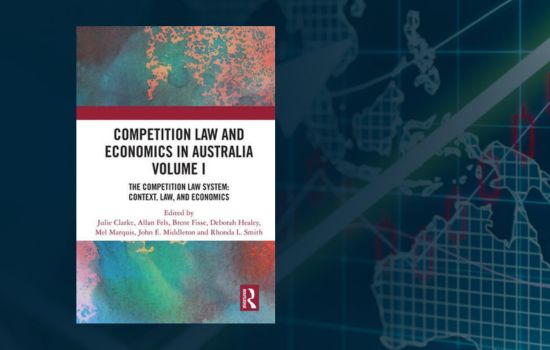
Celebrating half a century of competition law and policy in Australia, Routledge has published Volume I of Competition Law and Economics in Australia—part of a 35-chapter, two-volume set. Contributors to Volume I include former Chief Justice of the High Court Robert French AC, Justice of the Federal Court Michael O’Bryan, former Justice of the Federal Court and former President of the Competition Tribunal John E. Middleton AM, and other eminent authors from the field of competition law and economics such as Allan Fels AO, Frédéric Jenny and Rhonda L. Smith, to name just a few. CLARS Affiliate Brent Fisse and CLARS Member Mel Marquis contributed as writers and editors.
The book may be ordered from the Routledge website.
Volume I discusses the history, statutory provisions, precedents and current controversies in this field of competition law and economics. The Volume is entitled The Competition Law System: Context, Law, and Economics and has five parts: Context and History, Economic Issues, Legal Issues, Distinctive Features of Australia’s Competition Law, and Reform of the Competition Law Provisions. To keep this account brief, only a few chapters are summarised below.
Context
After earlier ill-fated attempts to establish competition law in Australia, the Trade Practices Act 1974 (‘TPA’) entered into force on 1 October 1974.3 The TPA banned conduct that was common at the time but harmful, such as price fixing. Many businesses were sceptical, some regarding the TPA as an attack on their freedom to maximise profit. The actions of politicians were sometimes unhelpful: some of them curried support by offering to review or weaken the Act if successful in elections. For their part, firms lobbied for changes to various provisions, especially those relating to mergers and misuse of market power. Yet the TPA and its successor the CCA survived without being diluted too much.
The second chapter, ‘Australian Competition Law: Legislative Context and Appraisal’ by Allan Fels and Brent Fisse, outlines important achievements in Australian competition law since 1974. It assesses the past legislative evolutions using multiple lenses: effectiveness, integration of law and economics, coverage of anticompetitive harm, market concentration, and others. The chapter highlights the transformative effects of sound competition law and the general embrace of a competition ethos in Australia, but it also discusses the unfinished business that still presents challenges today.
The contribution of the courts is discussed in ‘The Federal Courts and Evolution of Judicial Practice in Australian Competition Law’, by Robert French. This chapter discusses the judicial role and points out that while the Courts are reactive and do not determine policy, they have had a central role in building a large body of law to respond to factually complex cases. The interdisciplinary relationship of economists and lawyers is also discussed, having regard to the particular nature of the work required to facilitate sound decisions in this domain of law.
It will be interesting to assess, in future years, how the brand-new merger control regime in Australia (fully effective in 2026) will change the role of the Federal Court, and the extent to which it drives merger outcomes. Flowing from this reform, one may witness a subtle but significant shift in the balance of power in relation to contentious mergers. The Federal Court will still be involved, and will decide important questions of law when determinations of the Tribunal are challenged. But the ACCC, now equipped with a formal apparatus without precedent in Australia, may be embarking on a path of ascending power in merger control as first-instance decision maker and practical gatekeeper.
Economic Issues
Economics was always important in Australian competition law and policy. For example, and apart from well-known contributions of Professor Maureen Brunt as a member of the Trade Practices Tribunal, a small cohort of economists often provided advice to lawyers and acted as expert witnesses in early cases, helping to develop a basic understanding of competition economics. They included, notably, Neville Norman, Bob Officer, Tom Parry, and current ACCC Commissioner Philip Williams. Economists continue to enrich competition policy discussions today. For example, ‘Competition and Competition Law’, by former ACCC Commissioner Rhonda L. Smith, discusses the concept of competition itself, and considers the analytical frameworks used to assess the effects of certain business practices. Another chapter, ‘The Role of Economics and Economic Analysis in Australian Competition Law and Policy’ by George Siolis, examines several issues in the shared space between competition law and economics, such as the shift in emphasis in merger analysis from collusion to unilateral effects; illustrative case studies are also discussed.
In the last 15 years, there has been an increasing focus on issues raised by the power of large digital platforms, around which entire economies may revolve. This development has further challenged the economics underlying competition assessments, necessitating nuanced analysis of multi-sided markets and a reconsideration of standard assumptions. The 2024 revision of the European Commission’s Notice on Definition of the Relevant Market illustrates the importance of such matters. In Australia, the government continues with its reflection on how best to regulate platforms that have a “critical position in the Australia economy”, which again highlights the need for policy and legal frameworks based on sound economic principles and evidence.
Legal Issues
Anticompetitive conduct is prohibited by the Competition and Consumer Act, as most recently amended in December 2024. Price fixing and other forms of horizontal collusion are of course illegal and deemed pernicious without need to consider their effects. Resale price maintenance as well is usually described as illegal per se, though there is a bit more wiggle room for this type of restraint. Other agreements and unilateral conduct are subject to a ‘substantial lessening of competition’ (SLC) test, which has been refined in the field of merger control so that the SLC concept also includes the ‘creating, strengthening or entrenchment’ of a position of substantial market power in any market.
‘The “Substantial Lessening of Competition” Test’, by Andrew Christopher, argues, among other things, that the suitability of this test as a blanket standard may require reconsideration due to the challenges of digital and technology-dependent markets. ‘Anticompetitive Agreements between Competitors and Cartel Enforcement’, by Brent Fisse and Rob Nicholls, reviews several past developments regarding the prohibition of anticompetitive agreements, including ‘concerted practices’ (the latter concept diverging from the classic notion developed long ago in Europe). The chapter suggests that the law of anticompetitive agreements has meandered down the wrong path and that statutory reform and different approaches could address the deficiencies. The chapter also discusses the challenge of ‘robotic’ collusion via the commercial use of algorithms.
Regarding mergers, some frustrating litigation outcomes for the ACCC over the years have spurred the above-mentioned reforms. ‘Merger Control: An Evolutionary Tale’, by Luke Woodward and Caroline Coops, provides the background to these reforms, tracking the development of merger control and the important role played by the ACCC in this context. The chapter then considers the ‘road ahead’, taking account of the changes as they were proposed at the time of writing. The chapter concludes with predictions as to greater transparency, an enhanced role for economic analysis, more instances of ACCC opposition to mergers, and expanded responsibility for the Tribunal.
Distinctive Features of Australia's Competition Law
‘Australia’s Dual System of Administrative and Judicial Competition Law Adjudication’, by Justice Michael O’Bryan, analyses the distinctive characteristics of different systems of competition law adjudication. The chapter compares the nature of adjudication, admission of evidence, rights of review and appeal, and time frames in the administrative and judicial contexts. Overall, the chapter concludes that Australia’s dual system has worked well, with the inquisitorial and adversarial features operating in a complementary manner. ‘Authorisation and Notification: Case Practice and Assessment’, by Andrew Monotti, explores the origin and expanded use of the processes of authorisation and notification, which are “central features and integral elements” of the Australian competition law system. The degree of ‘satisfaction’ needed for a decision to be properly based in the context of an administrative decision, the durability of the ‘net public benefit’ test, and the broad meaning of ‘public benefit’ are all explored. With reference to the authorisation procedure and public benefit, the chapter also considers the increasing relevance of sustainability and the potential trade-off between the need to prevent restrictions of competition and the social objective of facilitating business activities promoting environmental restoration, biodiversity, and similar sustainability goals.
Reforms
As noted, Australia recently introduced far-reaching reforms to its merger control regime, transforming it from a voluntary, informal system to a formal, mandatory and suspensory system of ex ante notification, triggered where transactions are sufficiently large and have a nexus with Australia. Australia’s new merger system features institutional and procedural innovations and, less dramatically, changes to substantive law as well. Also alluded to earlier is an ongoing effort by the government to land on a properly nuanced regulatory framework for powerful digital platforms. Further consultations and options for primary and secondary legislation tailored for digital markets can be expected in 2025 and 2026.
With regard to law reform, it is recalled that in 2017, s 46 CCA was amended by removing the requirement to prove that a respondent firm had ‘taken advantage’ of its market power. As this reform eliminated the need to establish a causal link between the firm’s market power and its conduct, it was no longer necessary to counter the argument that the conduct was facilitated by that market power by claiming that the firm would have acted similarly even if (hypothetically) it did not have substantial market power. The post-2017 version of s 46 has yet to be tested in any fully litigated case: much remains unknown. A pending legal action by the ACCC against Mastercard in the Federal Court may provide further guidance.
In the digital sphere, data privacy and its interaction with competition law also call for consideration, and may require new elements of law and/or policy. ‘Misuse of Market Power and Data Privacy Justifications’, by Katherine Kemp, discusses how a court could take account of data privacy or data security justifications raised by a respondent alleged to have misused its market power by denying access to data, hardware, software or other services. The importance of these issues has grown due to the Privacy Act Review ending in 2022 as well as the increasing anxiety following data security breaches and chronic misuse of data siphoned from all of us. Courts may have difficulties allowing privacy claims unless the respondent can show that its conduct promotes data privacy or security in the market in which the SLC allegedly occurs. In some cases, the underlying problem may require more rigorous control of data practices under privacy laws. The chapter calls for greater efforts to achieve constructive harmonisation between competition laws and data privacy laws.
Together, the 18 chapters of Volume I constitute a significant survey of some of the most pressing issues facing Australia in the field of competition law and economics today. Volume II, to be published by Routledge later this year, is edited by the same team and contains 17 more chapters covering subjects such as consumer law, penalties and remedies under the Competition and Consumer Act and the Australian Consumer Law, the Digital Economy, and Australian competition law considered through a comparative lens. Contributors include Justice Murphy and Justice Wigney of the Federal Court, ACCC Deputy Chair Mick Keogh AO, former ACCC Chair Rod Sims AO, Jeannie Paterson, Kathryn McMahon, Bill Kovacic and many other experts.