
The ACCC-Monash Australian Competition Summit 2025: Maiden Voyage
On 30 October, Monash University and the Australian Competition and Consumer Commission (ACCC) convened the first annual Australian Competition Summit at the Park Hyatt in Melbourne’s CBD. This new joint annual conference series has been agreed between CLARS member Dr Mel Marquis together with the ACCC Executive Office. It is another project featuring inter-faculty collaboration between CLARS and colleagues in Monash’s Business-Economics Faculty. Eighteen featured speakers and more than 240 national and international attendees were on hand for the first edition of this conference.

ACCC Chair Gina Cass-Gottlieb with CLARS member Dr Mel Marquis (right) and Monash Bus-Eco colleagues Dean Simon Wilkie and Associate Professor Chengsi Wang (left)
The new annual forum, expected to become a signature, globally-focused feature of Australia’s competition law calendar, provided a high-level platform for national and international experts to explore some of the most pressing issues confronting regulators, policymakers, and practitioners. The 2025 Summit was opened by Dean Simon Wilkie of Monash’s Business-Economics Faculty and Dean Steven Vaughan of the Law Faculty.
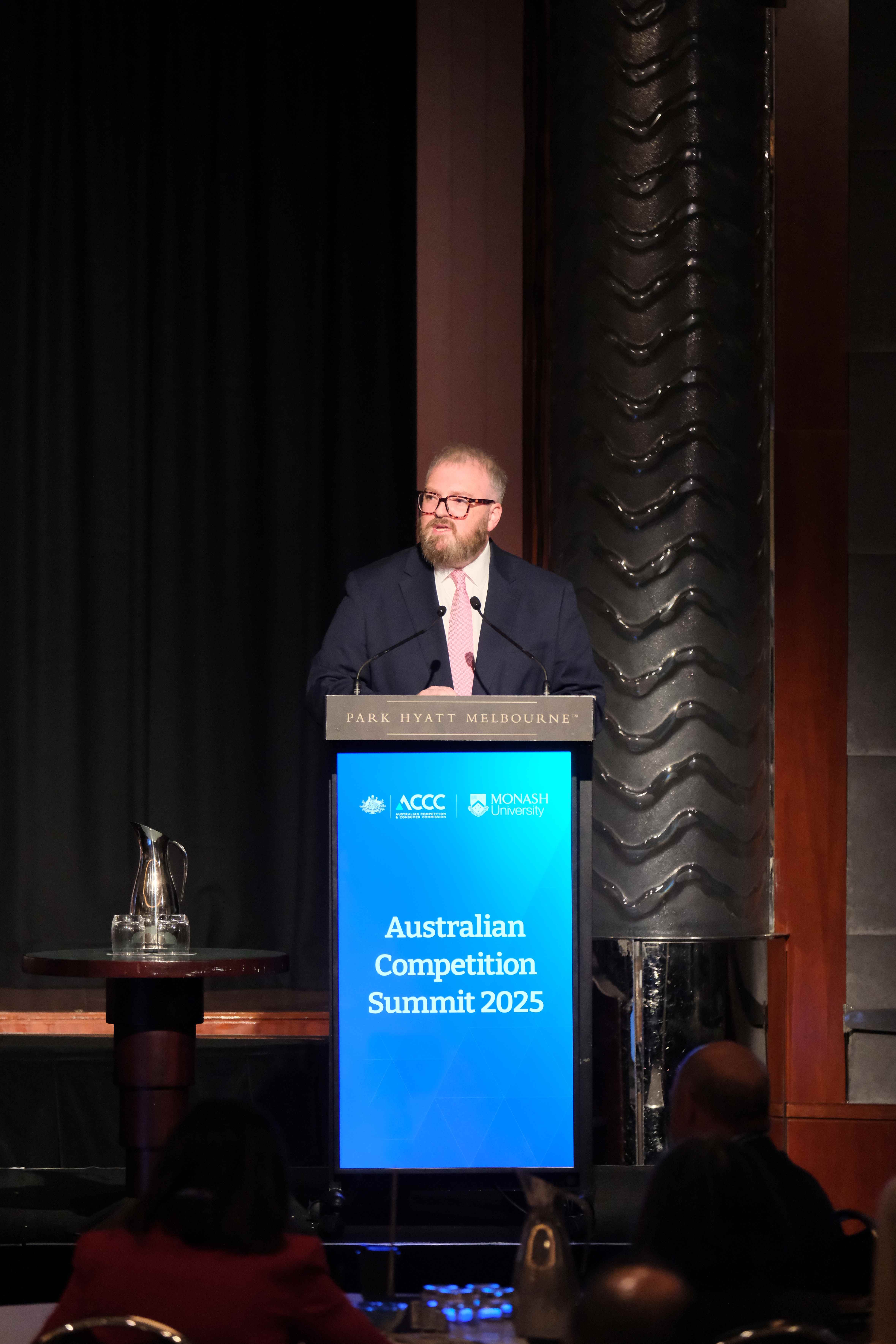
Dean Steven Vaughan opening the Australian Competition Summit: Melbourne Park Hyatt, 30 October 2025
Speakers included top leadership from various competition authorities and well-known experts in the field. The Summit brought together Chairs, Commissioners and other senior leaders of several competition authorities: Gina Cass-Gottlieb (Chair, ACCC), Dr Philip Williams (Commissioner, ACCC), Luke Woodward (Commissioner, ACCC), Reiko Aoki (Commissioner, Japan Fair Trade Commission), Dr John Small (Chair, New Zealand Commerce Commission), Matthew Boswell (Head of the Canadian Competition Bureau), Joel Bamford (Executive Director, UK Competition and Markets Authority), Senikavika Jiuta (Chief Executive Officer, Fijian Competition and Consumer Commission), Morag Bond (General Manager, ACCC) and Maria Coppola (Senior Policy and Strategic Advisor, ACCC). The audience was also addressed by Aru Armando, Commissioner of the Indonesian Competition Commission (KPPU).
Other moderators and speakers included Professor emeritus Frédéric Jenny (ESSEC Business School and Visiting Scholar at Monash), the above-mentioned Dean Wilkie, Professor Julian Wright (National University of Singapore), The Honourable Justice Michael O’Bryan of the Federal Court of Australia, Dr Jill Walker of the Australian Competition Tribunal, solicitor Ian Reynolds and barristers Dr Ruth Higgins and Robert Yezerski. Other distinguished guests included ACCC Deputy Chairs Catriona Lowe and Mick Keogh AO, ACCC Commissioner Anna Brakey, and ACCC Commissioner Peter Crone.
The speakers discussed four themes of distinct relevance that also intersect to a significant degree:
- the implications of artificial intelligence (AI) for competition policy;
- the ongoing transformation of Australia’s merger control regime;
- the integration of economic analysis into enforcement and decision-making; and
- the evolving landscape of competition policy and enforcement in the Asia-Pacific region.
These themes are playing out against a backdrop of rapid technological innovation, volatile geopolitical shifts, and global economic uncertainty. Together they illustrate the challenges facing both Australian and international competition agencies as they navigate a world in which market power is often rooted in data advantages, algorithms, and digital ecosystems.
Chatham House rules applied to the interventions of the speakers. The keynote speech of ACCC Chair Gina Cass-Gottlieb is published on the ACCC’s website.
Some of the general themes that were discussed are summarised here.
Artificial intelligence and implications
Speakers at the Summit emphasised that AI’s implications for competition law are multifaceted. On the one hand, AI systems can lower barriers to entry and increase efficiency by enabling firms of different sizes to optimise production, pricing, and logistics. It should also not be overlooked that AI can boost the capacities of competition authorities, including small and medium-sized authorities, for example by facilitating the detection of secret cartels. On the other hand, AI may strengthen the ability of powerful firms to entrench and extend their dominance in markets characterised by network effects and access to large proprietary datasets.
The ACCC’s Digital Platform Services Inquiry discussed anticompetitive risks linked to a wide variety of commercial activities, including, for example, risks associated with ‘algorithmic collusion’ and ‘self-preferencing’ in digital markets. The integration of generative AI into search, advertising, and retail ecosystems raises new questions about the adequacy of existing legal tools to detect and deter anticompetitive conduct. Comparative experience indicates that regulators globally are converging on similar concerns, even if their institutional responses differ. At the Summit, a featured speaker discussed the AI vertical ‘stack’ (hardware, cloud services, data sources, foundation models and applications) and the risk that many AI markets will be controlled by a small number of firms, not least due to the ongoing vertical integration of ‘hyperscalers’ such as Google. However, the extreme, winner-take-all domination that occurred years ago in certain markets such as online search may not be replicated in certain parts of the stack, for example due to the distinct characteristics of products such as foundation models, and due to the disruptive potential of AI technology.
The speaker also considered the possibility of new and emerging forms of competition problems associated with AI. For example, concerns may arise from large digital platforms integrating AI models with operating systems. Another concern relates to the use of ‘no-poaching’ clauses that prevent human talent from switching from one firm to another, to the ultimate detriment of competition and innovation, not to mention the effects on worker mobility. Further, talented employees may be co-opted through ‘acquihires’, i.e., acquisitions driven at least in part by the goal of capturing such employees (who might otherwise pose a competitive threat). Competition law and competition authorities are just beginning to respond to the challenges posed by phenomena such as these.
The merger control eagle has landed: A giant step for Australia
Another ‘hot topic’ discussed at the Summit was Australia’s dramatically redesigned merger review system. Merger control will now be governed by a formal and complex regime for the first time, with mandatory requirements taking effect on 1 January 2026. As I said in an article in the European Competition Law Review earlier this year, the new framework (a) is largely inspired by the merger control procedures that apply in many other jurisdictions, but (b) also has distinctive features not found elsewhere.
One remarkable institutional element of the new mandatory and suspensory notification system is that, with regard to mergers, it accords more power to the ACCC than ever before. One may argue that the reform is in fact the most impactful set of amendments to Australia’s competition law since the Trade Practices Act 1974 was first enacted. There are substantial questions about what the precise impact of mandatory merger control will be, including whether it can overcome a trend of growing concentration in many industries.
Under the 2026 merger regime, the ACCC formally becomes a first-instance decision-maker; it will pursue this role on the basis of its considerable legal, economic and bureaucratic expertise. ‘Notifiable acquisitions’—i.e., those triggering thresholds linked to turnover or transaction value—are legally prevented from proceeding without the ACCC’s prior clearance, unless the ACCC dispenses with the notification requirement by granting the merger parties a waiver (typically on the basis that a merger is unlikely to raise concerns). This reverses the old informal practice of voluntary notification of mergers, and the need for the ACCC to apply to the Federal Court for an injunction to stop a merger from going forward. The new amendments to the Competition and Consumer Act reflect a range of complaints from the ACCC itself and certain other observers about the traditional informal system, including the argument that new rules were necessary to prevent serial acquisitions and ‘creeping concentration’, particularly in sectors with large retailers, and sectors dominated by digital or vertically integrated firms. On the other hand, there were critics who opposed the reform, for example on the basis that a more interventionist regime could cause delays and create uncertainty for legitimate business transactions; and ultimately on the basis that the old system worked well enough, and perhaps only needed some tweaks.
Summit participants underscored that the success of the new system will depend on clear guidance, transparent decision-making, and the rigorous application of economic principles. Here again, international experience offers useful lessons: for example, the EU’s merger control regime has generally operated with reasonable degrees of efficiency and effectiveness over time. The future application of European merger control may evolve in certain sectors as part of a new push to take Internal Market-driven industrial policy considerations into account; but arguably this can be done without an overhaul of the merger review system.
A key improvement introduced by the 2026 merger system consists of a range of obligations on the ACCC to make merger notifications and the Commission’s decision-making far more transparent than it was in the past. This enhanced transparency will enhance the ability of observers to track data and hopefully assess the impact (and error costs) of prohibitions and conditional clearances by means of ex post evaluations in relevant industries, taking account of key competitive parameters including consumer choice and dynamic innovation.
The role of economics in competition decision-making
The subjects touched on above—the multi-layered field of AI and the fundamental remoulding of Australia’s merger system—both call for economically sound decision-making in matters of law and policy at micro- as well as macro-levels. The increasing need for well-integrated interdisciplinary expertise and insights in competition law and the related spheres of prioritisation and law enforcement was a significant theme during the Summit. Indeed, as markets and business models become more complex and data-driven, the need for robust, empirically grounded analysis has never been greater. The timelines imposed by the new merger regime will no doubt add to this challenge, not least because it may limit or remove the ACCC’s ability to involve external experts. Further, economists and lawyers alike noted the challenge of translating sophisticated models into decisions that are legally sound and practically enforceable. One hopes and expects that the Competition Tribunal will contribute to effective merger control due to its interdisciplinary expertise and its ability to consider economic evidence unconstrained by the rules of evidence that would apply in court.
The ACCC’s evolving use of economics-based tools reflects a broader international trend. At the same time, economic evidence must be integrated with, and consistent with, the law as established by Parliament. As one speaker noted, the pioneering Monash economics professor Maureen Brunt often stated that between the two disciplines of law and economics, it is the law that ultimately sets the rules of the game and must be respected. On the other hand, subject to that principle, there is scope for greater interdisciplinary cooperation between economists (and now data scientists as well) and lawyers to ensure that enforcement decisions remain analytically rigorous and relevant to social and economic reality in a challenging age.
Global and regional perspectives: International developments and regulatory cooperation, with a focus on the Asia-Pacific
The Summit also turned to developments abroad, as discussed by speakers from Canada, France, the UK and the US; and by competition officials from Australia, Fiji, Japan and New Zealand. The various agency representatives shared insights into their enforcement priorities and institutional challenges. Particular attention was given to the Asia-Pacific region, where some competition laws have a long history while others are still finding their footing. One official from a less experienced jurisdiction highlighted a number of challenges that face younger agencies, including, for example, limited resources to respond to cutting edge high-tech issues when traditional competition concerns are still a central part of practice.
Enhanced regional cooperation—through capacity building, regular communication and information sharing within legal limits—was identified as a key strategic goal. For Australia, this regional engagement supports economic diplomacy, policy learning and policy diffusion. With global supply chains and digital markets that cut across national boundaries, consistent and coordinated enforcement is essential to maintaining contestable markets and resilient competition.
Looking ahead
The challenges discussed at this first Summit are interrelated. For example, technological transformation influences market structures; regulatory reform shapes business incentives; and international cooperation can significantly influence the effectiveness of enforcement at the domestic level.
In this context, Australia’s competition policy community faces a dual task: to preserve the core benefits of efficiency and dynamic, innovation-driving competition that underpin the Competition and Consumer Act, while adapting the institutional framework to an economy for which breakneck-speed change is now the norm. The establishment of the Summit as an annual forum marks an important step in support of forward thinking, constructive dialogue and problem solving, all of which contribute to more effective law and policy responses to the damaging economic (and social) harms that would ensue in a technological wild west.
In 2026, the ACCC-Monash Competition Summit will build on the success of this year’s inaugural event with an emphasis on interdisciplinary learning, comparative engagement, and a commitment to the promotion of well-functioning markets serving the public interest in a complex and changing world.
See Dr Mel Marquis’ academic profile and publications.