The Global Rebalancing of Corporate Governance Norms
Conferences hosted by the National University of Singapore brought together leading scholars to examine the significant challenges facing corporations, regulators and policymakers.
The first conference focused on corporate scandals, with a particular emphasis on developments across the Indo-Pacific region. Participants explored the causes of major corporate scandals, their broader implications for markets and society, and the policy responses needed to address emerging governance risks.
The second event, the Global Corporate Governance Colloquia (GCGC), examined how shifting geopolitical and economic conditions are reshaping corporate governance norms around the world.
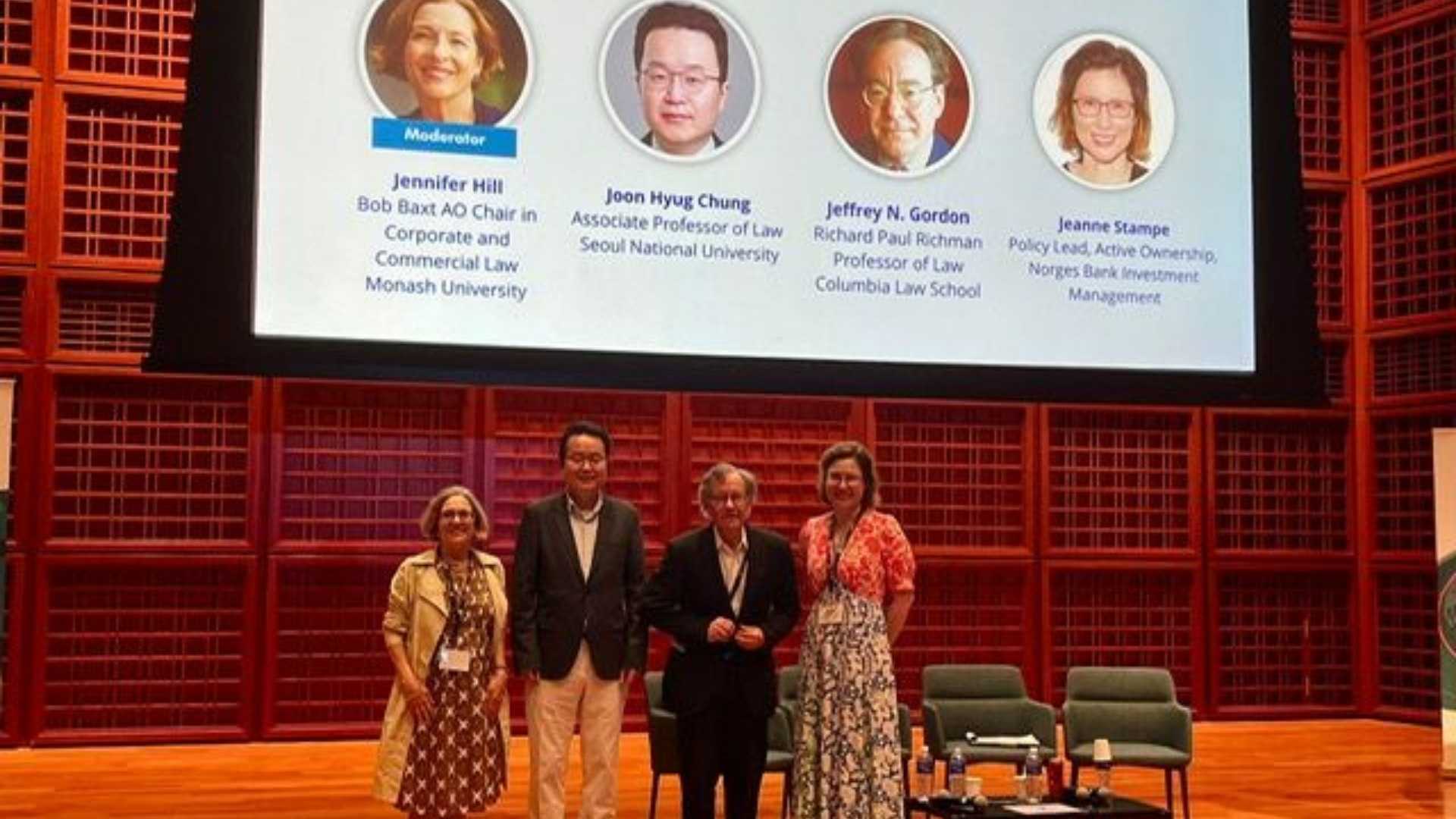
As part of the conference program, Professor Jennifer Hill moderated a panel discussion on The Global Rebalancing of Corporate Governance Norms, featuring Professor Joon Hyug Chung (Seoul National University), Professor Jeffrey Gordon (Columbia University) and Jeanne Stampe (Norges Bank Investment Management).
(L to R): Jennifer Hill, Joon Hyug Chung, Jeffrey Gordon and Jeanne Stampe at the 2026 GCGC Conference.
The panel addressed a shift away from decades of assumed convergence toward what Mark Carney has called "variable geometry," a geopolitical fragmentation replacing global integration. Jennifer Hill (Monash University, ECGI) grounded the discussion in Gordon's recent chapter distinguishing two axes of corporate law: the familiar internal governance axis, and an emerging "externalities governance" axis, exemplified by climate disclosure, where divergence may follow competing Brussels, Washington, or Beijing models.
The discussion considered a range of developments influencing corporate governance globally. Topics included the growing fragmentation of global markets, the rise of new regulatory approaches to corporate governance, the increasing importance of accountability for technology companies, and changing patterns of shareholder influence across different jurisdictions.
Panellists also reflected on emerging differences between governance approaches in the United States, Asia and other regions. The panel compared how the US, Europe, and Asia are moving in different, sometimes opposite, directions along both.
Discussion highlighted how corporate governance debates are increasingly extending beyond traditional questions of board oversight and shareholder rights to encompass broader questions about external impacts, public policy and corporate responsibility.
Adding to the relevance of the discussion, the panel took place during a period of heightened interest in founder-controlled technology companies, which informed discussion of controlling shareholders, accountability and corporate governance trends.
The conferences provided a valuable opportunity for international exchange on emerging issues in corporate law and governance and underscored the importance of comparative perspectives in understanding the future direction of corporate regulation.