
Healthy leadership in a sustainable water system
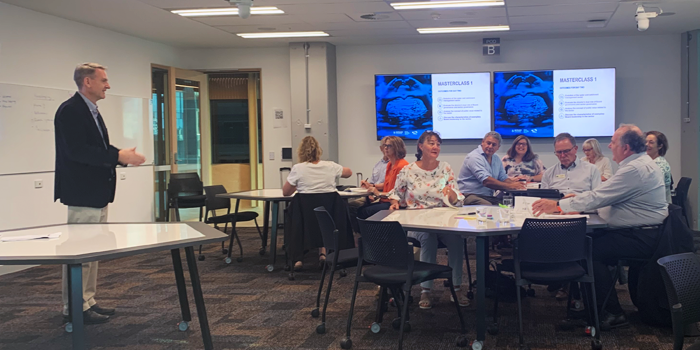
In March and May, the MSDI Water team conducted a Masterclass program for Victorian Directors of Water Authorities and Catchment Management Authorities (CMA) to create a legacy of healthy and sustainable water systems and communities.
There are 19 Water Authorities in Victoria and nine CMAs governed by independent boards of directors. Our Masterclasses had 50 representatives from all regions of the State.
The two series of workshops consisted of pre-workshop learning and reflection activities and eight hours of interactive workshops facilitated over two half days. The first Masterclass gave Directors a grounding in the history of the water industry and a focus on contemporary approaches to governance and leadership. The second Masterclass explored the responses and capacities required for long term challenges such climate change and Indigenous water justice. There was a strong focus on new ways of thinking drawn from sustainability transitions research and Indigenous knowledge systems and practices.
While the whole program supported the leaders to deepen their knowledge and strengthen their strategic leadership and governance skills, it was also an opportunity to create a supportive culture where colleagues from across organisations help to problem solve through information sharing.
The Masterclasses were challenging, informative and a wonderful opportunity to strengthen relationships with colleagues”
– Stephen Angus, Masterclass participant from East Gippsland CMA.
MSDI water team member and participant in her role as Wimmera CMA Director, Michelle Graymore says, “We were able to share stories, ideas and solutions. Outside of our annual Department of Energy, Environment and Climate Action (DEECA) event, it’s a good opportunity to talk through director issues with other directors in the water sector and learn from the expertise in the room from both the facilitators and other water directors.” DEECA has since invited our MSDI team to deliver the first Masterclass series on history and governance at their conference in March 2024.
The Masterclasses are designed to empower directors’ capacity to influence policy-making that will benefit the whole water system, providing value to the people and the environment in their catchment and beyond.
Peter Hilbig, Chair of Wimmera CMA says, “The Masterclass enabled an insightful look at the historical context of our current approach to water governance. With this background, directors could recognise opportunities for government policy and community engagement to improve water and catchment planning, and how to make this happen in a contemporary context.
A positive, forward thinking approach challenged directors to return to their boards with enhanced foresight and open minds, particularly about sovereignty and climate change. The Masterclass provided a detailed and insightful backstory to water and catchment management in Victoria, which really helped me understand the evolution of governance in the sector. Reflecting on the influence of policy and the importance of community engagement helped me focus on my role in leading aspirational thinking about contemporary challenges.”
Les McLean, a current CMA director and past Water Authority director says, “I found the workshop to be both highly engaging and valuable to better understand and execute my role… I gained more knowledge and understanding on the opportunity to create value by working with Traditional Owners on waterway management than at any other workshop.”
Michelle explains how her board is using the knowledge gained in the Masterclasses, “The Masterclasses really shift you out of ‘tick box’ thinking to push for more innovative strategies, including climate change and ensuring Traditional Owners have power in decision making processes.
At the start of each Board meeting, we now have a strategy discussion around challenges for our organisation and how we can transition into the future. We’re building relationships with our Traditional Owners so that we can work together to get the best outcomes for Indigenous people, the wider Wimmera community and the environment. We’re always looking at how we could do better.”