
Managing Mental Health

What is mental health?
The World Health Organisation (WHO) describes mental health as:
A state of wellbeing in which every individual realises his or her own potential, can cope with the normal stresses of life, can work productively and fruitfully, and is able to make a contribution to her or his community.
Mental health is often associated with challenges such as depression and anxiety. However, mental health is complex. It is not only about whether we experience mental health challenges or not, but how it also implicates our cognitive, emotional, and social health. This is why it is important to consider what it means to have good mental health.
When our mental health is in a good place, we can:
Work in a more productive manner |
|
Maintain positive interpersonal relationships |
View ourselves with positivity and acceptance |

 Become more resilient to life's stressors
If you are struggling with your mental health, you are not aloneThe Monash Graduate Association (MGA) conduct annual surveys looking into graduate student satisfaction, wellbeing, mental health, and more. In the October 2021 surveys, MGA found that... |
|
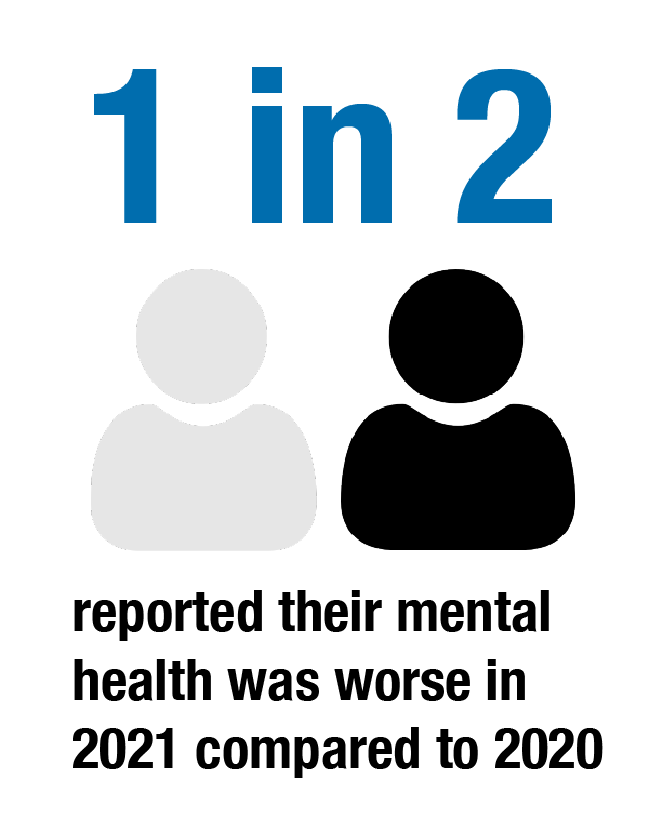
Mental health often fluctuates; everyone feels down or stressed at times. It is common to struggle with one’s mental health during a graduate degree. Research shows that graduate students disproportionately experience heightened levels of stress, depression, and anxiety.
| Recognising the signs earlyIt is important that we can recognise when our difficult emotions are impacting our ability to function in our day-to-day lives. The Black Dog Institute has fact sheets to learn more about what it feels like to experience depression, anxiety, and stress. If you are concerned about your mental health, consider seeking help. To see how and where you can seek help, click here. |

Need help now?
Access emergency services (000), Lifeline (13 11 14), Employee Assistance Program (EAP) , Monash Counselling and Psychological Services (CAPS) or other free, confidential counselling services:
Beyond Blue (1300 22 4636),
Qlife - LGBTQIA+ (1800 184 527)
Mensline (1300 78 99 78)
WIRE - Women, non-binary and gender diverse people (1300 134 130)
13YARN - Aboriginal and Torres Strait Islander people (13 92 76)
Beyond Blue, Mensline, WIRE and Qlife also have webchat options if you prefer messaging.
People often only begin to prioritise their mental wellbeing when they are struggling, however you should always be striving to build up our mental wellness. Especially when your degree requires you to engage with clients, exposes you to sensitive topics, or involves excessive workloads.
It may seem counterintuitive to take time away from work to take care of yourself, but doing so will enable you to work more effectively and feel less overwhelmed from any ongoing demands and abrupt changes you may experience throughout your degree.
Here are how some HDR students foster mental wellness:
| "I try to find joy in little things even when I am really stressed. I always keep some art and craft project running on the side so that I can relax and feel a sense of achievement. I try to catch up with friends I trust, who I know will not judge me and will be considerate." |

"Exercise, eating well, trying to get plenty of sleep and take regular scheduled breaks." |
|
What can you do to foster mental wellness?
| Finding time for yourselfIn academia, there can be a work culture students feel obligated to work 24/7 to keep up with their peers. It can be easy to slip into a routine that neglects ones personal needs, leading to graduate students being more likely to experience mental health challenges than undergraduate students. You should be making time to allow yourself to rest and engage in activities that are enjoyable to you. |

Engaging in your hobbiesExploring your hobbies can be a valuable way to improve your mental wellbeing, as doing so can increase your resilience to stressful circumstances. Monash offers many opportunities to explore your hobbies. If you prefer a more physical hobby, you can engage in team-based or social sports at Monash. There are also several creative or social clubs that you can join. |
|

| Building healthy habitsResearch has clearly demonstrated that nutrition, sleep, and exercise build the foundation of wellness. Therefore, as we build a routine that allows us to have good quality sleep, regular exercise and a balanced diet, our mental wellbeing and resilience to stress improves as a result. Visit Healthy habits for more information on how to do this. |

Social connectedness
In 2021, the Monash Thrive team conducted focus groups with HDR students to better understand what unique issues were impacting their wellbeing. Our analysis found that an overwhelming majority of our HDR participants experienced feelings of loneliness and isolation during their degree.
Research shows us that loneliness can increase our vulnerability to mental health challenges such as anxiety or depression. When you have a lot on our plates as a HDR student, it can be very easy to prioritise your work and disregard your social life. Engaging with others can make you feel more connected to them, which is incredibly beneficial to your wellbeing.
Connect with your peersFeeling connection to the HDR community is especially important, as being a HDR student involves a very specific set of pressures that sometimes only your peers can understand. By connecting with your peers, you may find out about helpful resources or that you are not alone in your struggles. For information on how and where you can meet other HDRs, click here. |
|

 | Be mindfulBeing mindful involves taking notice of what you are currently feeling, with compassion and without judgement. By practicing this regularly, you can better understand and regulate difficult emotions, which will make you more resilient to any mental health challenges you may face. Monash offers free or discounted mindfulness online resources where you can learn how to incorporate it into your everyday routine. To see a what mindfulness resources Monash offers, click here. |
It is important to be able to recognise when difficult emotions have impacted your ability to function in your day-to-day life. When this happens, it can be helpful to seek mental health support from our friends, family or a mental health professional.
It may be uncomfortable to ask for help, however no one can do everything alone, and no issue is too big or too small to talk about.
Seeking support from friends and familyMental health can be quite a personal topic, this is why speaking to a friend or a relative can be a valuable way to seek help as there is typically already trust and comfortability built within your relationships. If you are feeling nervous before talking with your friends or family, it may be helpful to first write down what you want to say or let them know that what you want to talk about is quite personal. |
|

 | Seeking support from your supervisor(s)It could be that your course or studies are impacting your mental health. If so, it may be helpful to have a conversation with your supervisor(s) about it. Below, we talk more about how you can approach this conversation and what you can do if you feel uncomfortable talking to your supervisor about mental health. If you are struggling with navigating supervisory relationships, we offer further information on our Navigating workplace culture and candidature page. |
MGA Advocacy
Monash Graduate Association (MGA) offers advocacy for graduate students. MGA advocacy is not associated with Monash University and is completely confidential. Advocates can:
Graduate students can make an appointment with an MGA advocate via email. |  |
Seeking professional support
Mental health professionals are available to provide you with emotional support and strategies to improve your mental health.
As a HDR student, you are entitled to free and confidential mental health services
While the source of your struggling may be related to your studies, this is not the only reason needed to access mental health support. Some reasons you may access counselling services are, but not limited to:
Anxiety, depression, or stress Personal and/or family relationships Grief and loss Addictive behaviours | Eating or body image concerns Struggles with self esteem Sexuality or gender identity Life transitions |
What does confidentiality mean?
We’ve mentioned confidentiality a few times within this page, and while you may know the dictionary definition, what it means in practice may be unclear.
| When we say that a counselling service is confidential, we mean that:
|
The only reasons that permit a mental health professional to release your information to someone without your consent is to protect yourself, or others from serious harm or if they have been sent a court order to do so. | |

Where can you seek out professional support?
Monash Counselling and Psychological Services (CAPS)Monash CAPS is an internal, confidential, and free counselling service provided by qualified psychologists working for Monash University. Monash students are entitled to six face-to-face or telehealth sessions. Call (03) 9905 3020 to make an appointment with a counsellor via telehealth or for an in-person session. |
|

| Employee Assistance Program (EAP)EAP is a free, confidential counselling service provided by mental health professionals independent from Monash. Monash staff and their immediate family are entitled to six face-to-face or telehealth sessions for each issue they have. Students are entitled to one free session. Accessing EAP as a Monash employee will not impact your employment as your employer cannot access this information. |

General Practitioners (GPs)You can see a GP to talk about your mental health. If they have determined that you can benefit from additional support, they can write up a Mental Health Care Plan (MHCP) for you. For more information regarding MHCPs, click the relevant drop-down menu below. |  |