
Australia and the Spice Routes: Omissions, Absences, and Silences
The Asian Civilisations Museum (ACM) in Singapore is a stunning museum housed within the historic Empress Place Building, which sits alongside the Singapore River. The fabulous exhibitions and displays are a magnet for maritime enthusiasts and anyone interested in ships and shipwrecks.
The shipwreck gallery displays an extraordinary collection of ceramics rescued from an Arabian vessel that sank 600 kilometres southeast of Singapore nearly 1,100 years ago. More than 50,000 hand-painted bowls were collected from the wreck and are now in the ACM collection.
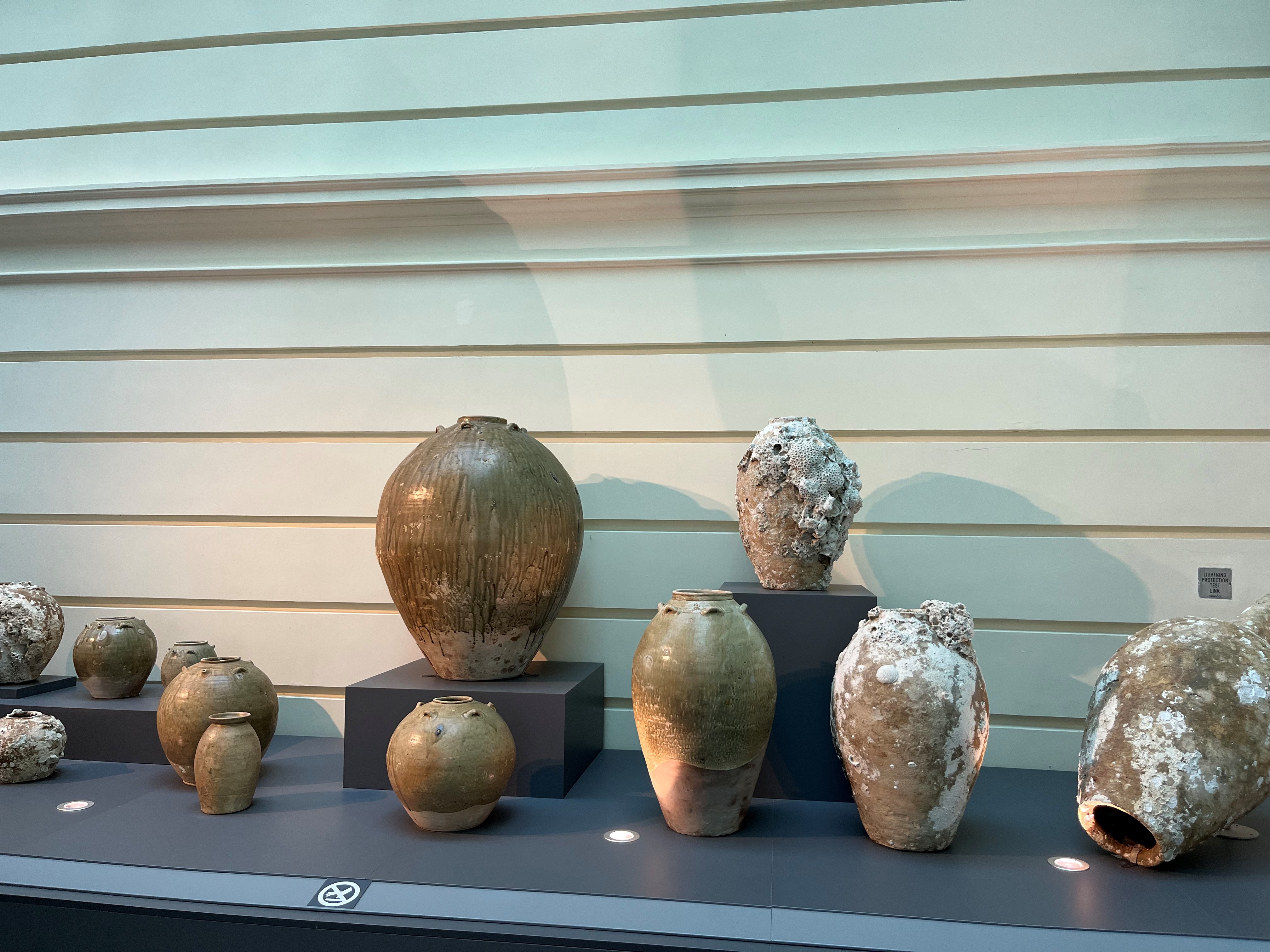
Photograph taken by the author of ceramics salvaged from the Tang Shipwreck, on display at the ACM. © Lynette Russell / Personal Collection (2022).
The wreck and the collection elegantly illustrate the global trade popularly known as the Spice Trade or the Maritime Silk Route. The shipwreck and maritime trade galleries at ACM are heavily illustrated with maps. However, these charts are ultimately poor, two-dimensional illustrations of myriad complex trade networks and exchange cycles. The maps and the routes they describe rarely dip below Indonesia, though they occasionally show the “Birds Head” of Papua or the northern Australian coastline. Yet in every case, the trade lines and routes drawn to depict the spice and silk routes never extend beyond Southeast Asia.

Photograph taken by the author of a map on display at the ACM depicting global trading networks in the 16th to 19th centuries, omitting Australia. © Lynette Russell / Personal Collection (2022).
From the Global Encounters Monash (GEM) perspective, we’d like to suggest that it is time to bring Australia into these discussions. Mariners and traders from South Sulawesi travelled to Northern Australia for hundreds of years before sustained contact with European colonisers. From the Kimberley region in the west to Arnhem Land and the Gulf of Carpentaria in the east, Aboriginal people hosted people from South Sulawesi and other parts of eastern Indonesia, especially the port of Makassar.

Main route of the trepang trade. © Peter Johnson (2013).
These visitors came to collect and process trepang, or sea cucumber, for trade into the Chinese markets. This was the tail end of a great trading network the includes the spice route and the silk road. The spice trade route was a network that connected the East and West. Goods, ideas, and people moved in an exchange system that linked the west coast of Japan, across the Indonesian archipelago, around the Indian subcontinent, Africa and the Indian Ocean, the Arabian Peninsula and beyond. China and the famous silk road were an extended part of this large scale trade network. Northern Australia played a minor but historically significant role, through the trepang industry and the other trade items including beeswax, pearlshell, and turtleshell.
Sailing their ships known as praus with the western monsoon winds, the trepangers would leave South Sulawesi around December and would work the Northern Australian trepang grounds until March or April, when they would return to the port of Makassar on the eastern trade winds. Today, we know of these visits from extensive oral histories on both sides of the Arafura and Timor Seas. Further evidence for the trepang trade can be found in the many sites dotted across Northern Australia containing the remains of trepang processing sites. Other evidence includes the presence of introduced tamarind trees, rock art paintings of praus, and Aboriginal archaeological sites containing introduced Asian pottery, metal, and glass. Linguists have shown that there is evidence of these visits – and of long-term relationships – in the inclusion of Indonesian words in local Aboriginal languages, while archaeologists have demonstrated that Aboriginal people traded and exchanged with their Indonesian visitors, going on to use newly-acquired items in their customary exchange networks. The introduction of dugout canoes, a new maritime technology, transformed Aboriginal coast and sea activities. Although the date of the trepang trade is disputed, it is at the very least many hundreds of years old, probably dating to the seventeenth century or even earlier.
Discussions of the maritime spice and silk routes invariably ignore the trepang industry and its Northern Australian connections. However, museums can begin addressing this omission by merely extending their maps and charts to include the trepang industry. As this 1872 map by John George Bartholomew evocatively illustrates, Northern Australia should be considered part of Southeast Asia, and as such the trepang trade can be seen as connected to the great maritime ventures that saw ships and their crews scour the region for spices, silver, cloth, and other trade goods.

“Sketch Map of the Dutch Possessions, in the Indian Archipelago” by John George Bartholomew (1872), part of the David Rumsey Historical Map Collection. © Cartography Associates (2000), licensed under Creative Commons.
Australia, too often thought of as isolated and remote, was a minor but significant player in the global expansion of trade and exchange. As GEM expands, we hope that collaborations with museums like ACM will change how the stories of the Spice and Silk Routes are told. Such an intervention would be timely, as Indonesia launches an extensive campaign to propose the Spice Route as World Heritage.