
Global Encounters in Jakarta
In 2024 the Global Encounters Project was again represented at the International Forum on Spice Routes (IFSR), which was held at the headquarters of the National Research and Innovation Agency (BRIN) in Jakarta.
This is the third consecutive year that Global Encounters Monash (GEM) has been fortunate to participate in the IFSR, reconnect with colleagues, and lay the groundwork for future collaborations. In a special keynote session on the first day of the conference, GEM shared its recent research activities in Melbourne and Makassar, and its plans for the future.
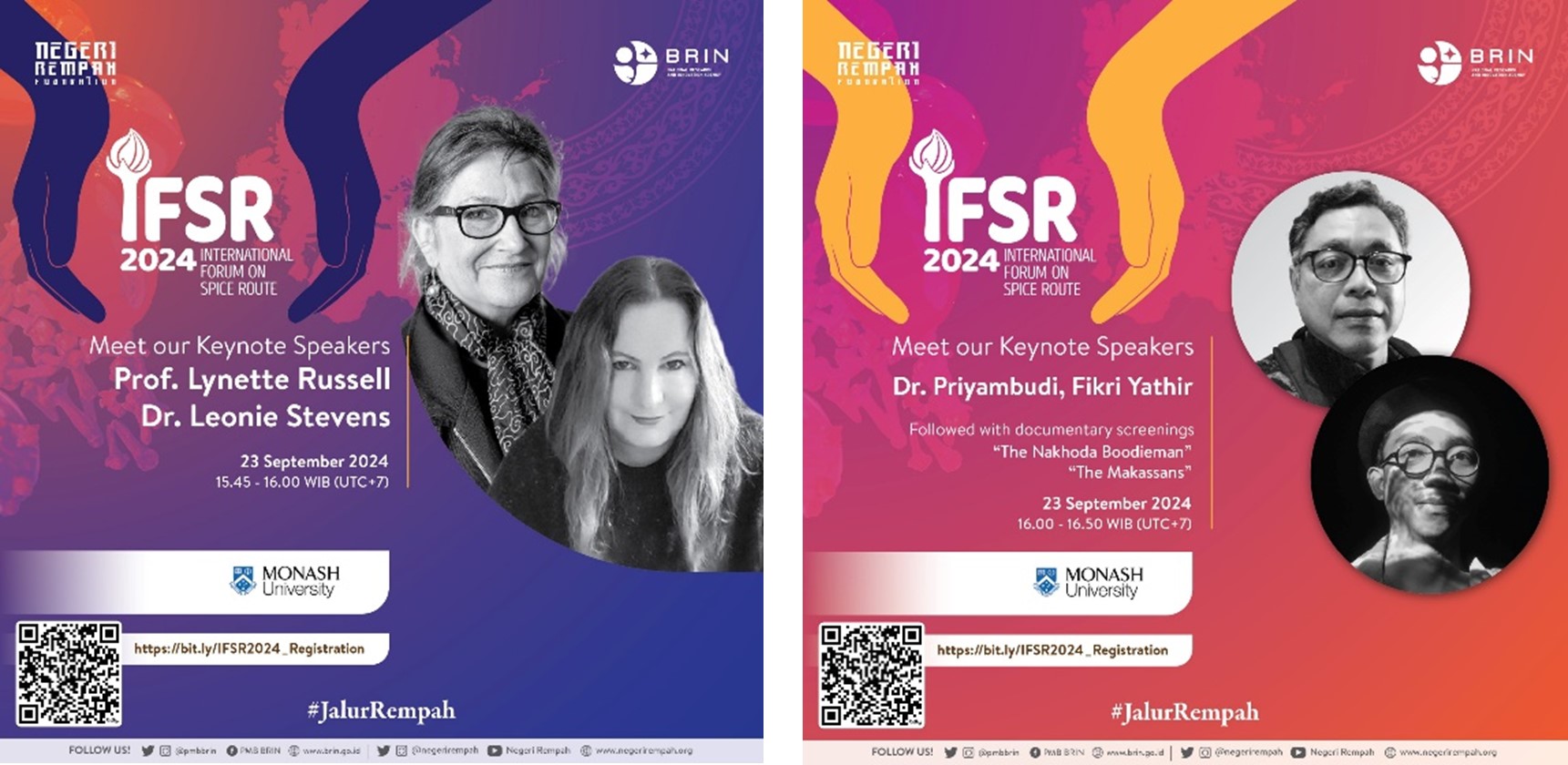
Professor Lynette Russell and Dr Leonie Stevens gave a joint presentation detailing the evolution of GEM’s focus on the Spice Routes, entitled Digging the tunnel from both ends: Makassar-Australia diplomatic traditions, and the power of Spice Routes history to change the present.
Our commitment to conceptualising trepang (sea cucumbers) as a spice, leads to the inclusion of Australia in the extensive Spice Routes networks emanating from the Indonesian archipelago. This presentation likened the research process to digging a tunnel from both ends. On a practical level, this explored the process of Australian and Makassan researchers both working to find evidence of historic connections; and on a temporal level, we asked how encounters of the past can help make sense of the current geopolitical and intellectual research climate.
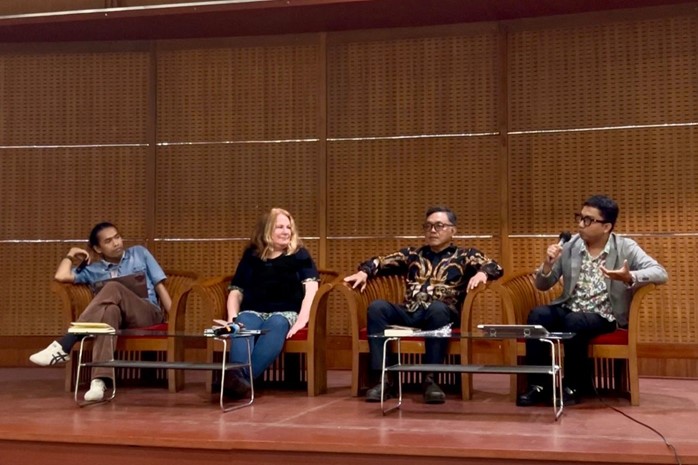
From Right: GEM’s Fikri Yathir, Priyambudi Sulistiyanto and Leonie Stevens, with host Hutomo Putra. Lynette Russell participated via zoom. Photo courtesy Daus Yathir.
GEM’s Dr Priyambudi Sulistiyanto and our long-term collaborator Fikri Yathir then gave a joint presentation titled ‘Documentary as a research method for the Trepang Route’. This used Guba and Lincoln’s quality criteria (1989) such as credibility, transferability, dependability, confirmability, fairness, ontological authenticity and educative authenticity as a lens to make two documentary films in Makassar, and along the coast of South Sulawesi (from Makassar to Port Bira) in March and April 2024.
The first documentary film titled The traces of Captain Boodieman (Jejak Nahkoda Boodieman) and the second one titled The Makassans: Past and Present (Dulu and Kini).
At the IFSR 2024, these two documentary films were screened after the presentation with a view of sharing and discussing the challenges and difficulties for finding the descendants of the trepangers in Makassar and South Sulawesi. The ultimate goals for making these documentary films are to educate the general public in South Sulawesi and Eastern Indonesia, especially among younger generations (millennials and GenZ), so that they can appreciate the people-to-people networks established by their ancestors with Indigenous peoples in Northern and Western parts of Australia a few centuries ago.
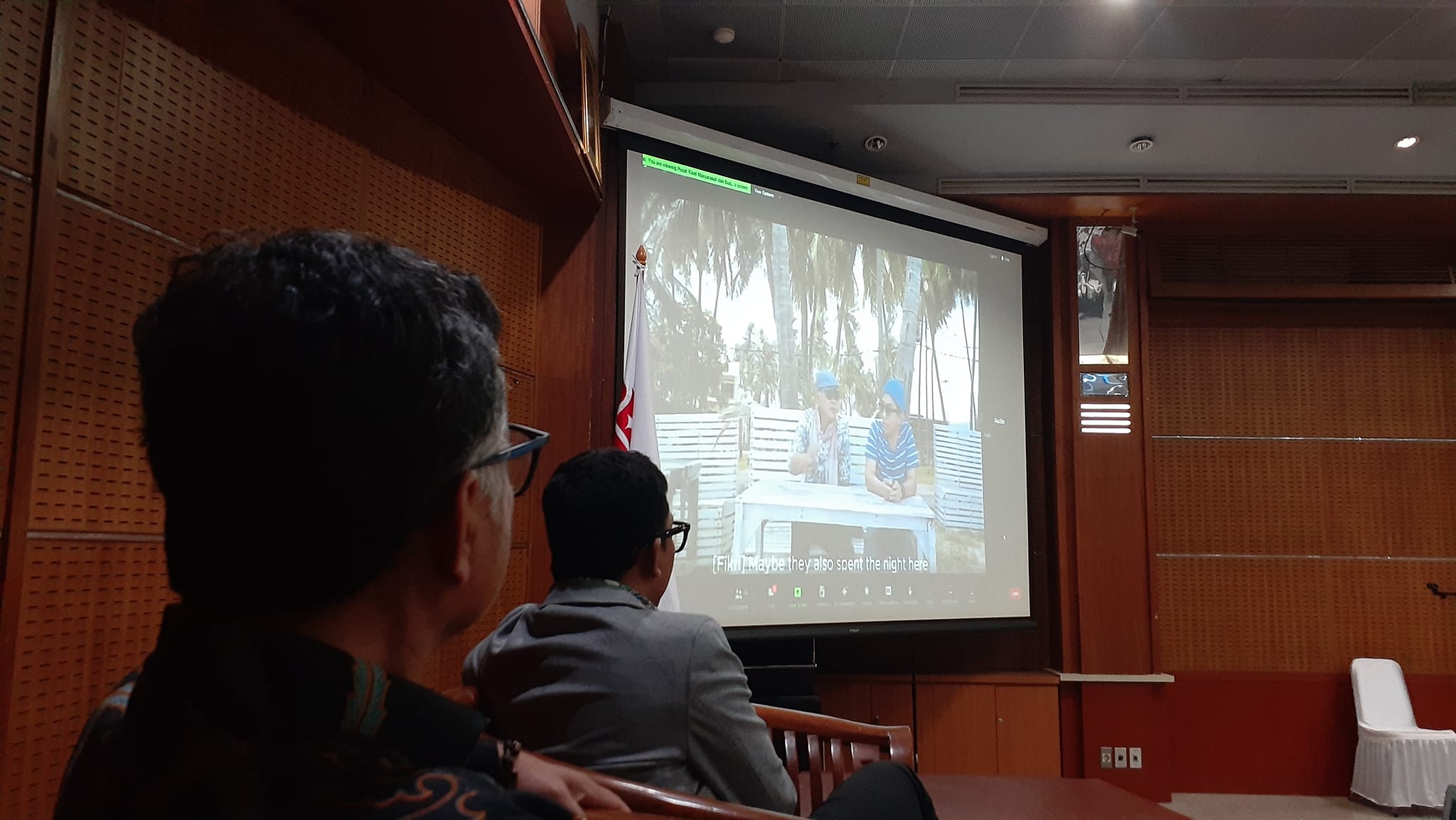
The view from the stage: Fikri Yathir and Priyambudi Sulistiyanto watching the documentary prior to open discussion. Photo courtesy Leonie Stevens.
Both presentations, and especially the documentary film screenings, inspired lively discussion at the forum, which continued at various events through the week.
Book launch – Finding Kapiten Boodieman
A second major event held during the IFSR week was the book launch for Dr Priyambudi Sulistiyanto’s new book, Finding Kapiten Boodieman: Catatan Perjalananan Intelektual di Australia dan Indonesia (Finding Captain Boodieman: Intellectual Travelogue in Australia and Indonesia).
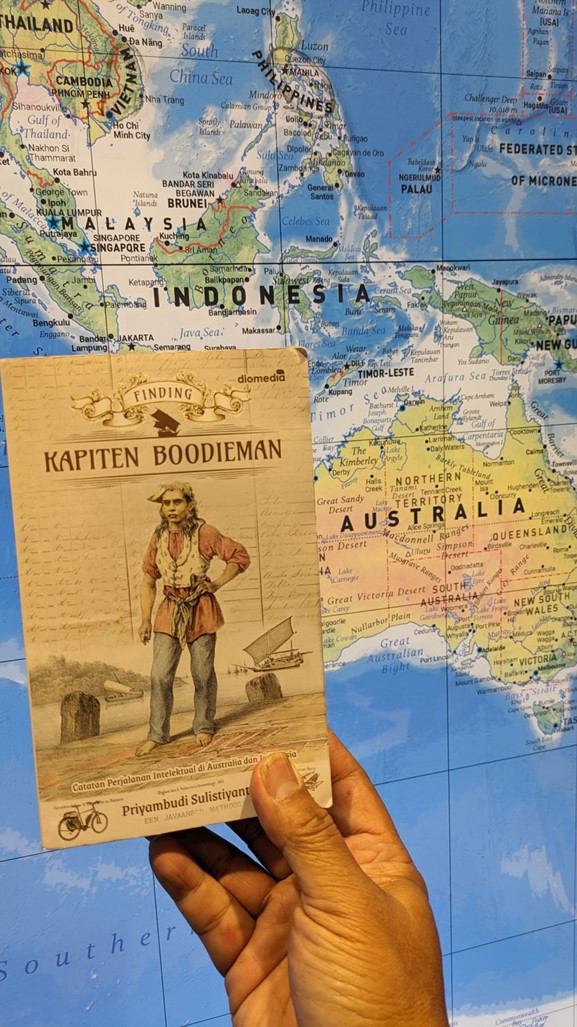
Photo courtesy Priyambudi Sulistiyanto
This book contains personal and intellectual reflections from travelling across Australia and to Indonesia (Makassar and Jakarta), in several periods, starting from 2020 until the early part of 2024. Budi travelled widely using various transportation modes such as ebike, car, plane, bus and boats, to get from one place to another. The book puts this physical and intellectual journey in a bigger picture; that is, a recognition and respect that the relationship between people-to-people and trade (sea cucumbers/teripang and other goods) between Indonesia and Australia, which was actually pioneered by the ancestors of seafarers from South Sulawesi. They did it with the custodians/owners of the Australian continent, the Indigenous peoples who lived along the northern part of Australia.
The first launch of this book on 25 September 2024 was organised by Migrant Care, a Jakarta-based NGO working for the rights of Indonesian migrant workers. Future launches will happen in various writers’ festivals and community events in Indonesia and Australia, in months to come.
Finding Kapiten Boodieman is currently only available in Bahasa Indonesian, with an English translation coming. It can be purchased online through Tokopedia or Diomedia.