
John Henry Cox and the OTHER East India Company
First Encounters, gentleman merchants, and metaphorical rabbit-holes: the Swedish East India Company's visit to lutruwita (Tasmania) in 1789
Historians often go down metaphorical rabbit-holes. Some are productive, and yield startling discoveries, synergies, or offer paths to unexpected places. Many, however, never really pay off, and we might be left after many hours, days, or weeks (regretfully, sometimes years) without a satisfying story to tell, impactful new knowledge, or even a novel, fresh angle on existing knowledge. As researchers we strike a delicate balance between persistence – just one more turn of the tunnel, it might pay off – and knowing when enough is enough. As the philosopher Rogers sang, “You gotta know when to hold ‘em, know when to fold ‘em.” Such was my experience with John Henry Cox and the OTHER East India Company.
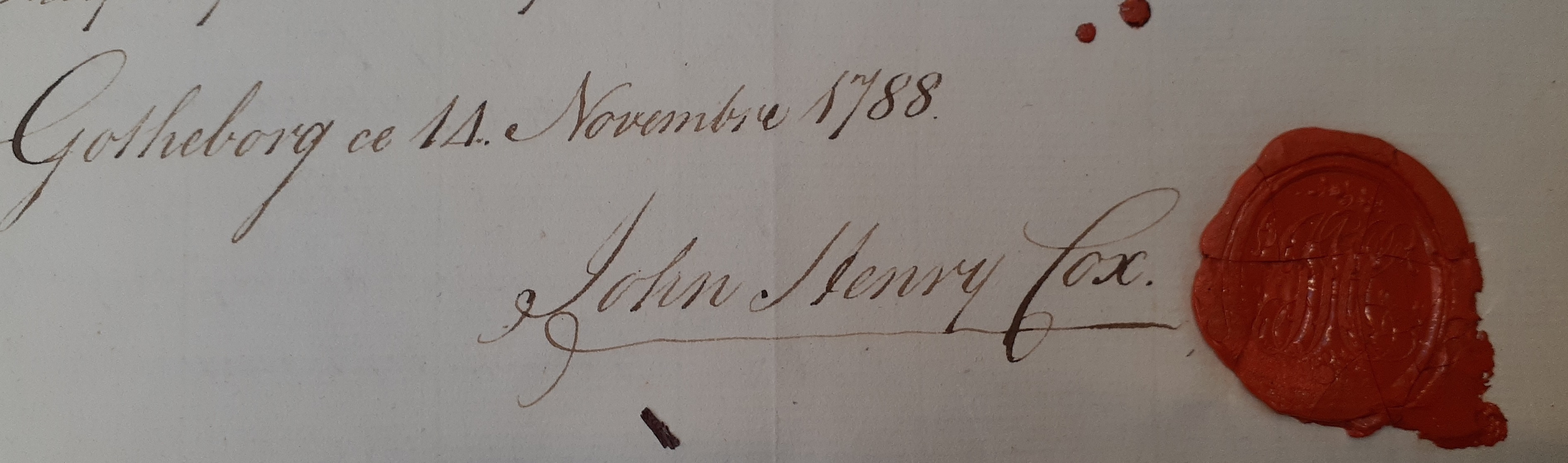
Encountering John Henry Cox
The Global Encounters Project looks at early encounters between First Nations peoples, and those who came from the sea. We are especially interested in those visitors who were temporary; not those who stayed, but those who connected on the beaches or the riverbanks, then went on their way. In lutruwita (Tasmania), those connections began in the early 1600s, as the coast and its peoples were charted, sighted, visited and explored by mariners representing Dutch, British and French imperial and mercantile interests. There was one significant outlier in the timeline of encounters, which are often traceable by the names given to Indigenous places by Europeans. That was, the naming of Oyster Bay in 1789 by an Englishman, John Henry Cox, who was sailing under the Swedish East India Company flag.
Cox’s visit to paredarerme land on the east coast of lutruwita (Tasmania) was brief and, seemingly, peaceful. On 7 July 1789, his ship the Gustaf III (known historically as the Mercury) sailed into what Cox would name Oyster Bay. The following day, they had a very brief encounter with several people on the shore, who kept a wary distance. A meeting the next day was peaceable and good-humoured, but characterised by that same sense of caution. If we were going to do a typology of encounters, this would be one of the most typical Indigenous responses: watching, warily, and observing the outsiders.
Cox and his entourage did not stay long, but sailed north-east towards Tahiti as soon as their water and wood supplies were replenished. He named the place Oyster Bay, and that name came to identify both the location, and the clans of the area. In some ways, it is a typical, peaceful style of encounter, but for one notable thing: it was conducted under the auspices of the Swedish East India Company. In a history dominated by British and Dutch East India Companies, this solitary contact with the Swedish Company was fascinating – especially as it was conducted by an Englishman. The rabbit hole emerged, and the first question for this researcher was - who was John Henry Cox?
Rabbit hole 1: The Cox family and the zimingzhongs
John Henry Cox was born around 1850 in London, the son of famed clockmaker and inventor James Cox, remembered as “one of the finest clockmakers in Europe.” Some examples of the elder Cox’s exquisite inventions can be seen in this Met Museum exhibition. One of his most famous works is the three-metre-tall Peacock Clock, an automaton commissioned for Russia’s Catherine the Great and delivered in 1781, which remains one of the key treasures of the Hermitage Museum in St Petersburg. This video gives a sense of its scale, complexity and beauty.
Amongst Cox’s vast inventory, he produced “sing-songs” or zimingzhongs - ornate mechanical clocks - which were wildly popular as status items in China. They were elaborate, almost improbable technological marvels, and over 200 years later, they still capture the imagination.
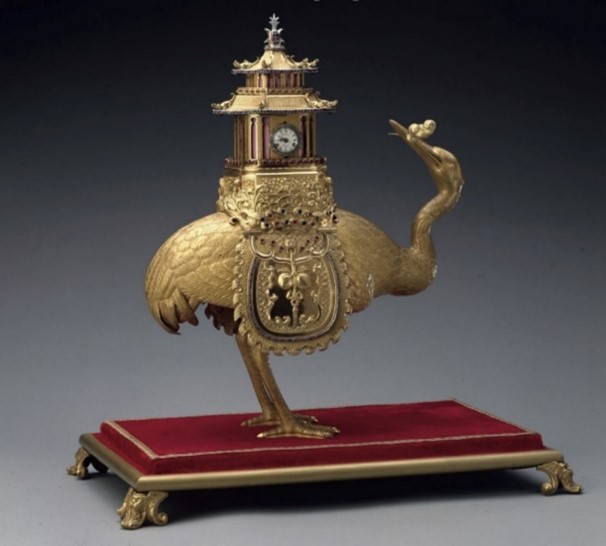
A James Cox zimingzhong from Antique Collecting Magazine, https://antique-collecting.co.uk/2024/06/10/guide-to-chinese-zimingzhong-clocks/
Their export to China helped, for a time, balance the trade deficit Britain experienced due to massive imports of tea from China. Yet James Cox also became something of a victim of his own success, when Chinese merchants petitioned the British East India Company to halt the exports, citing oversupply. Bankrupted, Cox opened Cox’s Museum in London, to exhibit his works, and this museum became very popular. Yet his fortunes continued to teeter. What to do with the excess stock of zimingzhongs now languishing in Canton (now Guangzhou) warehouses? This is where his son, John Henry, steps into the picture. Or, the rabbit hole takes a turn.
Rabbit hole 2: The Other East India Companies
In 1780, John Henry Cox obtained permission from the British East India Company to spend two years in Canton, selling his father’s inventory of zimingzhongs. This was an attempt to help settle his father’s debts. Approval from the East India Company was essential for British subjects planning to travel for trade purposes to what was defined as “East India”.
At the time, "East India" was a vast area which spanned a quarter of the globe's surface. As Christian Koninckx explains,
As far as the charters were concerned, East India included all harbours and cities east of the Cape of Good Hope. That area thus included nothing less than the east coast of Africa with Sofala and Mozambique and the regions on both sides of the Red Sea; Persia and all harbours and coastal areas under the jurisdiction of the Great Mogul like Malabar, Coromandel and Bengal; furthermore, the kingdoms of Pegu, Siam, Cochinchina, Cambodia and China; and finally also the 'Terra incognita australis', New Guinea and all islands in the 'Indian' Ocean, including Madagascar, the Maldives, Sumatra, Borneo and even Japan." (Koninckx 1978: 64)
The British East India Company and its Dutch counterpart (Vereenigde Oostindische Compagnie, or VOC) are certainly the most well-known of the major entities which dominated trade in the 17th and 18th centuries. But there were others. The French East India Company (Compagnie française pour le commerce des Indes orientales) had colonies on Reunion and Mauritius, plus controlled several trading ports in India. The Danish East India Company (Ostindisk Kompagni) had holdings in India and plied the Sunda Strait, not far from the VOC stronghold of Batavia (current Jakarta). Additionally, the Austrian East India Company (Österreichische Ostindien-Kompanie) had been set up by Dutch-born Englishman William Bolts.
The Swedish East India Company (Svenska Ostindiska Companiet) was yet another variant. Founded in 1731 partially by a Scot, Colin Campbell, it was based out of the Swedish port of Gothenburg. Its operations differ from the Dutch & British Companies: as Lisa Hellman writes, the Swedish Company “…focused entirely on commercial trading: it had no permanent settlements, nor did it employ any military force.” (Hellman 2021: 210-11) Like the other East India Companies, it went through several iterations, or cycles of boom or bust. Historian Leos Muller’s work gives an excellent overview of the Swedish Company’s history.
Sweden’s geographical distance from the East, primarily China, meant extensive sailing time, the shortest being 507 days, and the longest 1156 (Koninckx: 61). The common route was to depart from Gothenburg, sail around Scotland, south along the Atlantic, and around the Cape of Good Hope to take advantage of the “roaring forties” across the Indian Ocean. The tiny volcanic island of St Paul as a navigational aid to know when to turn.
So how did this lesser-known Company come to be amongst the first encounters with palawa people? And how did a young Englishman, intent on selling his father’s ostentatious mechanical devices, come to represent the Swedish king after a secret plot? The answer is within another rabbit hole – the cosmopolitan port of Canton.
Rabbit hole 3: The Gentlemen Merchants
With his official approval from the English Company to spend two years in Canton, John Henry Cox arrived at that thriving mercantile enclave sometime in 1780. He would have found a community of merchants from a wide range of origins, actively exploring moneymaking schemes. The foreign merchants were strictly controlled by Chinese authorities, and limited to a warehouse port zone known as the Thirteen Factories.
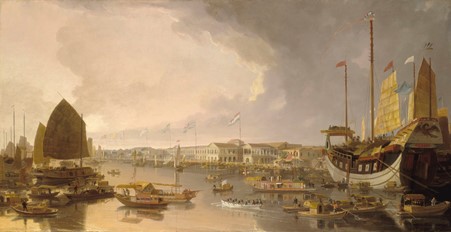
A View of the European Factories at Canton, William Daniel 1805, Royal Museums Greenwich, https://www.rmg.co.uk/collections/objects/rmgc-object-207243
Cox successfully dealt with the zimingzhongs from his Canton base and generated, it seems, a great profit. He also tapped into a network of expatriate traders who experimented with a vast range of money-making schemes. Life for Europeans in Canton in this period has been evocatively investigated by Lisa Hellman (2019). After two years, in 1782 Cox asked the British Company for an extension of his permit, and went from Canton – which was the general European trade centre - to Macau, which was primarily a Spanish and Portuguese mercantile hub.
In Macau, Cox aligned himself with two partners – a Scotsman, John Reid, and an Englishman, Daniel Beale. They were all young men, in their twenties and early thirties. In a foreshadowing of the strange and complex cosmopolitanism which was going to shape the younger Cox’s career, Reid was then acting as Austrian consul, and Beale was consul for Prussia.” (Hafitröm: 195) Like the Scot Colin Campbell who pioneered the Swedish foray into China decades earlier, and William Bolts, a Dutch-born Englishman who represented Habsburg Empress Maria Theresa in establishing an Austrian trade, these young men had what might be seen as fluid identities.
To conduct trade, they needed to augment their national identity and forge alliances with other imperial interests. Cox and his partners formed a ship-owning and wholesale company, importing products from India, including cotton and opium, to China. They were effectively competing with the British East India Company, sailing under British, Austrian, Prussian and Portuguese flags (Hafitröm: 195). Their business was profitable, and Cox became extremely wealthy.
In 1784, Cox turned his focus to the north Pacific and the lucrative fur trade. This potential market had been discovered by the remaining crews of Captain James Cook’s fatal third voyage in 1779 when, on arriving at Canton, the survivors sold sea otter furs acquired at Nootka Sound (vicinity of Vancouver Island) at great profit (Berg 2023). The encounters between Europeans and First Nations peoples at Nootka Sound are a rabbit hole of their own, as discussed by Maxine Berg.
Chasing the fur market, which had not yet been exploited by Europeans, the now very wealthy Cox equipped a ship the Sea Otter under Irishman James Hanna with goods for barter (iron, knives, nails, and other items). The Sea Otter sailed to the North American Pacific coast to the lands of the Nuu-chah-nulth people in the vicinity of contemporary Vancouver. After an initial violent encounter which saw at least twenty Nuu-chah-nulth killed, trade was established. The resulting cargo of furs and hides, when delivered to Canton, caused a sensation which was reported in the British press. The enterprise was so profitable that Cox and his partners invited other Canton- and Macau-based business associates to start "The Bengal Fur Society", based from Calcutta. (Hafitröm: 9) This group included Henry Lane, William Fitzhugh and David Lance – all British East India Company supercargoes (or merchants) based in Macau (Lamb & Bartroli: 22) - and Calcutta-based John Meares (Encyclopedia Arctica). Unlike the official East India Companies, who kept copious shipping records and monumental archives of their financial interests, records of the myriad smaller companies, such as the Bengal Fur Society, are scant to non-existent. We can often only see their traces refracted through the records of the larger companies whose paths – and business interests – they crossed.
Cox’s success in ventures which skirted and violated the British East India Company’s edicts for British citizens were both reported in the press, and noticed by Company inspectors. By the mid-1780s, Cox’s ability to act freely in Canton and Macau were limited, and he was compelled to return to Britain (DuRietz: 18).
At the time, the British imperial centre was fixated with, amongst other interests, the need for a British colonial base in the Pacific. Botany Bay had been chosen as the target location, and labour would be supplied by the youngest and healthiest inmates currently languishing in prison hulks in the Thames.
Now a man of significant means, Cox began to devise yet another way to work around the British East India Company. He was not seemingly interested in exploiting the drive for colonial expansion to what would be the colony of New South Wales, but another mercantile gentleman, who Cox had almost certainly encountered in his travels to the east, was laying plans which must have inspired Cox’s subsequent ventures. William Bolts becomes our next rabbit hole.
Rabbit hole 4: William Bolts and the Swedish plan
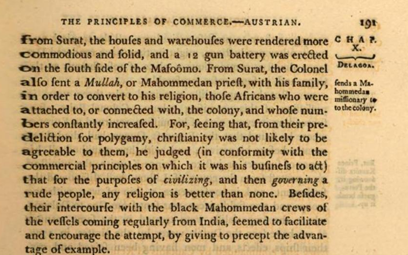
William Bolts, a Dutch-born Englishman, modelled the kind of fringes-of-empire business acumen which had made Cox’s fortune. An ex-British East India Company employee, turned independent merchant, in 1775 Bolts had proposed to the Habsburg Empress Maria Theresa establishment an Austrian trade between India and the Port of Trieste. His proposal was accepted, and he eventually set up factories in Mozambique and the Nicobar Islands. He also, significantly, brought the cochineal beetle to India from Brazil, which was to become a mainstay of red food colouring for two centuries. A 1794 essay by Carl Bernhard Wadström gives insight into Bolts’s colonial management style in Mozambique, actively encouraging the spread of Islam (he thought Christianity would not be palatable) as, for governing people, “any religion is better than none.” (Wadström: 191)
Bolts had an extensive network of business partners and agents across the East, including John Reid, one of John Henry Cox’s business partners, in Canton. (King 2005: 4) Cox was undoubtedly aware of Bolts’ endeavours, and it would be surprising if they had not crossed paths, or shipping routes, at some stage during their careers. They were in London at the same time in the mid-1780s.
Bolts’s most audacious plan was developed in the historical moment when Britain was deep in preparations for its own colony at what would be named New South Wales, designed to access Norfolk Island pines and New Zealand flax (see for example Matra’s 1783 Proposal). Bolts saw the possibilities of a mirror colony on the western side of the continent, then known as New Holland, which could act as an Indian Ocean base for trade in the East Indies. In October 1786, he travelled to Stockholm, posing as a Portuguese trader named Baretto to escape British surveillance. He met with Swedish Finance Minister, Count Liljenkrantz, proposing a permanent Swedish settler colony on an island off the coast (probably Rottnest Island). Liljenkrantz was generally impressed by Bolts and his idea, noting that he seemed a “'man of much experience and capability” who “does not seem to be a Charlatan or untrustworthy project-maker.” (cited in King 2005:6) The Finance Minister did have reservations about the cost of setting up and maintaining an overseas possession, amongst other issues, but King Gustaf III fully supported the plan. A contract was signed on 2 November 1786, promising provision of two frigates, a merchant ship, a military detachment of thirty soldiers, fifty colonists, plus scientists necessary such as a botanist and metallurgist. Bolts was to be governor for life of the settlement to be known as Boltsholm. However, geopolitical tensions flared before the plan could be carried out, and early in 1787 King Gustaf paused the plan for a year. By the time that year was out, Sweden had declared war on Russia, and establishing an overseas possession to service the East Indies seemed less important strategically.
Boltsholm was not to be: however, watching from London (and undoubtedly reading the newspaper reports of Bolts’ machinations), John Henry Cox was clearly inspired. And thus, we come to the original rabbit hole which began this exploration.
Rabbit hole 5: John Henry Cox and the Swedish East India Company
Cox meant to present King Gustaf with an offer he could not refuse. Where Bolts’s plan relied on a Swedish investment in ships and recompense, Cox, being independently wealthy, was able to present a much simpler plan. Spending a reported £4000 sterling (DuRietz: 20), Cox purchased a 16-gun copper-hulled ship of 150 tons from visionary shipbuilder Marmaduke Stalkaardtt, which was under construction at Deptford, on the Thames. Its name was then the Mercury. Cox also took advantage of Sweden being at war with Russia in his planning.
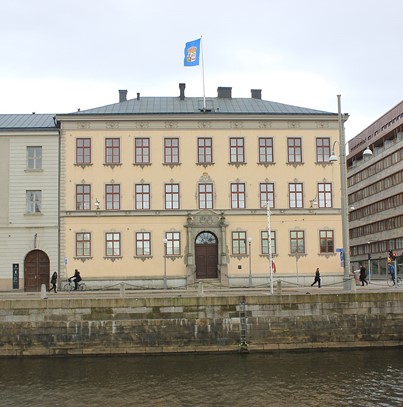
Torstensen Palace, Gothenburg, where Cox met with Gustaf and Ruuth. Photo by Andrzej Otrębski, https://commons.wikimedia.org/wiki/File:Goteborg_Palac_Torstensona.jpg
In late 1788, Cox travelled to Gothenburg. Through his network of mercantile gentleman contacts, he gained an introduction to Baron Erik Ruuth, Secretary of State for Commerce and Finance. Cox proposed sailing to the north Pacific to attack Russian holdings on with the east and west sides – modern-day Alaska and eastern Russia. Cox’s goal was the lucrative fur trade: Sweden’s was to inflict damage on Russia. For Sweden, Cox’s plan was, as we might now say, all gain no pain. All he needed, to avoid British interference, was to fly the Swedish flag.
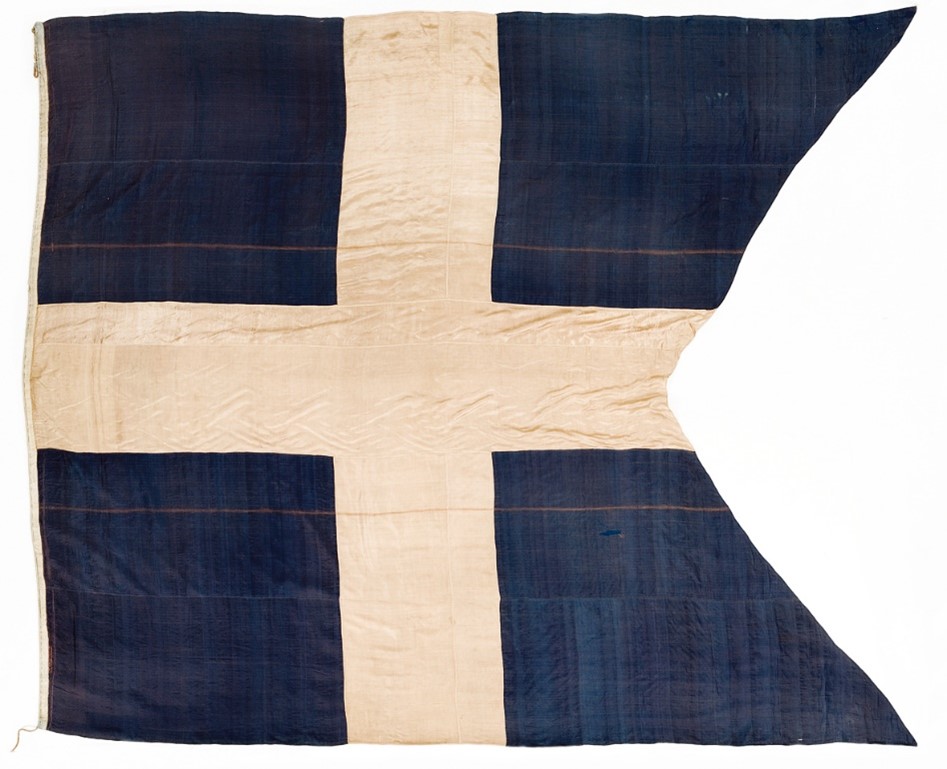
The variant of the Swedish flag used by the Swedish East India Company https://commons.wikimedia.org/wiki/File:Two-tailed_Swedish_ensign.jpg
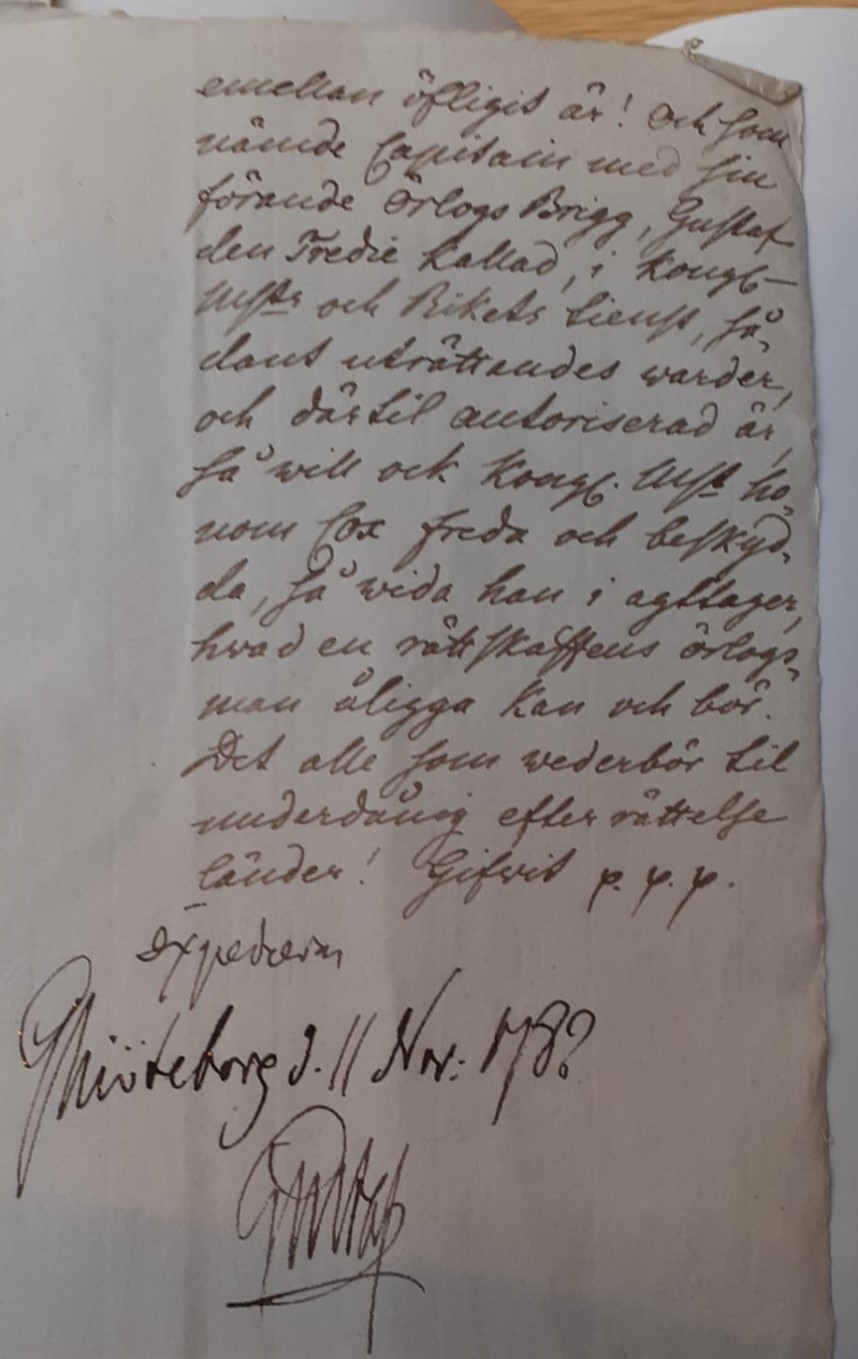
On 11 November 1788, Cox, Baron Ruuth and King Gustaf met at Gustaf’s residence in Gothenburg, Torstensen Palace. Minutes of this meeting were drawn up by Ruuth, where Gustaf commissioned Cox as a Captain in the Swedish navy, and;
…hereby graciously instructs the Captain of its navy, John Henry Cox, to sail with a naval brig equipped by him to the coasts of North America and the Eastern part of the Russian Empire, and there, during the present war with the Russian Empire, to inflict all the damage on the trade and establishment of the same; as in times of war, between powers! And as mentioned Captain with his commanding naval brig, Gustaf the Third called, in…the Kingdom of Sweden's service, such things are done, and are authorized for it … in so far as he takes care of what the duty of an upright man of war can and should. That is all that is due to subservient obedience to countries! Ghiöteborg d. 11 Nov: 1788 Gustaf (Riksarkivet: Protokoll hållet hos konungen i Göteborg 11 November 1788:)
Cox immediately set out to put his plan into action, but nature threw complications in his way. The winter of 1788-89 in London was especially severe, and the Thames froze over, as this engraving of a Frost Fair shows. The Mercury – soon to be known as the Gustaf III (also Gustav or Gustavus) – was trapped by ice in the Deptford ship yards, delaying the departure until 26 February 1789. Significantly, the delay meant that, instead of taking the proposed route across the Atlantic and around Cape Horn straight to the Pacific, Cox instead needed to go around the Cape of Good Hope, across the Indian Ocean, and around New Holland to access the Pacific.
There is no clear information on the crew or passengers of this voyage, and the record is limited to Lt George Mortimer’s entertaining Observations and remarks. Mortimer’s work was clearly a success at the time of its release in 1791, being translated into Dutch, German and Swedish (DuRietz: 10). Mortimer disavows any knowledge of Cox’s true intention, or apparently the Swedish connection, saying only that the Captain had told him of his eagerness to get to Canton. Mortimer recounts a visit to Tenerife, much shooting of bird life, including multiple albatrosses, and a shorter stay at the Isle of Amsterdam before reaching lutruwita (Van Diemen’s Land/Tasmania) in July 1789.
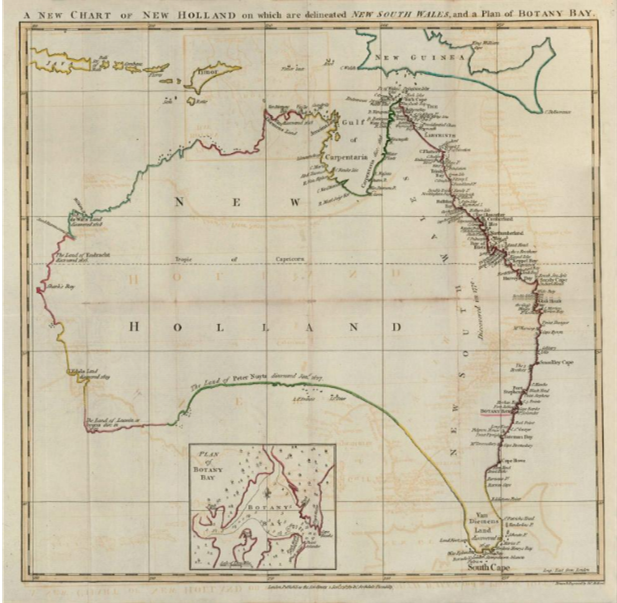
New Holland. As it appeared in maps in 1789. From The History of New Holland From Its First Discovery in 1616 To The Present Time, Stockdale, https://collections.sea.museum/objects/48730/the-history-of-new-holland-from-its-first-discovery-in-1616
At the time, it was still presumed to be a southern peninsula of New Holland – Bass Strait would not be charted by Europeans for another decade. Cox’s ship travelled around the southern coast and attempted to land at what they thought was Adventure Bay, on Bruny Island. In the morning of 7 July 1789, they found they were actually at Maria Island, sighted from the sea by Abel Tasman in 1642. Cox gave their location the name of Oyster Bay, owing to the remarkable middens observed.
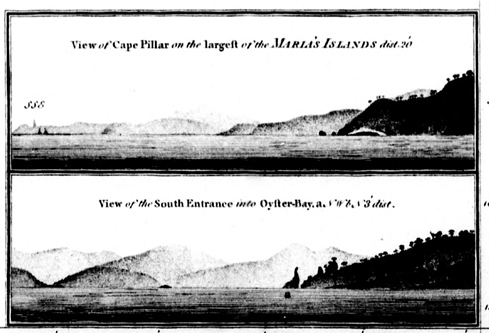
Sketch of Maria Islands and Oyster Bay, from Mortimer, fp. 17.
First contact was made on 9 July, and it was fleeting and distanced. Smoke had been seen, and a third mate immediately went towards it: he reported seeing people “moving off with pieces of lighted wood in their hands”. Mortimer writes,
He approached them alone and unarmed, making every sign of friendship his fancy could suggest; but though they mimicked his actions exactly, and laughed heartily, he could not prevail upon them to stay: he continued advancing, and they retreating, till they passed a marsh, and he was prevented from going any farther. (Mortimer p. 18)
Two days later, on 10 July 1789, there was a meeting on the foreshore. This one was atypical, as it involved paredarerme men, women and children (most commonly, it was the adult men or warriors who met with outsiders). George Mortimer recorded:
As we approached the shore, we observed several natives about the fire, and walking among the trees, some of them were carrying very long poles and pieces of lighted wood in their hands. When they perceived we had landed, and were pretty near them, they began to chatter very loud and walk away; upon which we called to them, imitating their noise as well as we could, and had the satisfaction to see them stop at a little distance from us. Several of them having long poles or spears in their hands, we made signs to throw them side, with which they immediately complied; and we in return put away our muskets. They now suffered us to come so near to them as to take some biscuit, a penknife, and other trifles from us; but they took great care to avoid being touched. Some of them indeed, would not accept anything unless it was thrown to them; and the whole party kept edging off by degrees. They seemed eager to procure every thing they saw; and even had a great inclination for our hats. Mr Cox gave one of them a silk handkerchief; and he threw him in return a fillet of skin that he wore tied around his head. ... We observed several of them to be tatowed [tattoed] in a very curious manner, the skin being raised so as to form a kind of relief... though they appeared to be very merry, laughing and mimicking our actions, and frequently repeating the words Warra, Warra, Wai, they kept retiring very fast. (Mortimer: 18-19)
Later, Cox and Mortimer went into the bush and found a camp:
We found they had kindled a large fire, and near it lay several little baskets made of rushes, in which most of the articles we had given them, carefully tied up together... (Mortimer: 20)
This account of Cox’s visit contains several evocative images: a tentative, cautious encounter; wariness of close physical contact; curiosity about objects; and most powerfully, the gifted items carefully placed in baskets. The paredarerme clearly sensed that Cox and his entourage did not pose a threat, based on their willingness to lay down their muskets, but they maintained a healthy caution. It is likely that they had some knowledge of events seven years previous to the south at Marion Bay, where Frenchman Marion du Fresne employed a much more violent approach to the encounter situation.
Cox sailed out of palawa waters four days after arriving, on 11 July 1789. They wanted to reach what they called Oonalaska as soon as possible, to carry out their mission of raiding Russian fur traders. The Mercury/Gustaf III bypassed Aotearoa (New Zealand) and sailed straight to what they called Otaheite (Tahiti), arriving one month later on 12 August. During their brief stay at Matavia Bay, Mortimer offers several quite evocative examples of surprising evidence of encounter.
In the house of a chief named Poneow, he and Cox were shown one of the prized possessions – an oil colour image of Captain Cook, left by Cook himself on his famous first journey of 1770. On the back of the picture was an inscription left by Captain William Bligh, after his visit on the Bounty several months previously. This Cook portrait, inscribed by Bligh, symbolises two key moments in time: Cook’s important 1770 visit to Tahiti to observe the transit of Venus, which would then lead to his charting of the east coast of New Holland; and Bligh’s visit to Tahiti, to gather breadfruits, on the eve of the famed mutiny. The image was kept in a hidden location, wrapped, and brought out specially to show the Englishmen.
That same day, Cox and Mortimer were approached by a particularly joyful dog. The English Pointer had been left on the island two months previously by Bligh; it
...came running up to us, having singled us out from the surrounding crowd, and demonstrated his joy at seeing us by every action of fondness the poor animal was capable of. (Mortimer: 26)
On the same walk, they came across a vegetable garden which had been established from seeds during the Bounty’s long stay. Mortimer was surprised to see it already overgrown, even though Bligh had only recently departed. The dog, which was probably left as a gift, and the planting of presumably English vegetables are reminders that even though the encounters were often brief – although in the Bounty’s case, it went for several months – botanical and even animal traces were often left behind.
The third event on 20 August puts Cox and his companions as unwitting witnesses to history. Cox was shown a club which a man told him he had purchased from an Englishman named Titreano, who had visited just three weeks before the Gustaf III’s arrival. Titreano, Cox was told, had been Captain Bligh’s first officer, and he had recently returned without Bligh. Bligh had been left at a place called Tootate, where he had been involved in an altercation with locals, resulting in guns being fired. At the time of hearing the story, Cox and Mortimer did not know that the Titreano who had only recently sailed was Fletcher Christian, Tootate was Tofua, and that they were to be the first European witnesses to the famed mutiny on the Bounty.
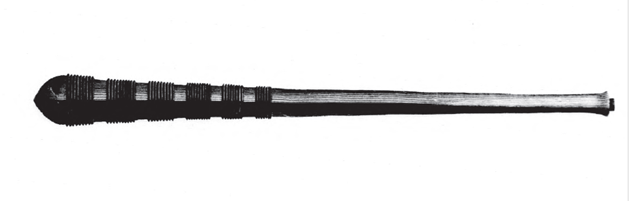
Evidence of Encounter: the club purchased by a Tahitian man from Fletcher Christian shortly after the mutiny on the Bounty. Image from Mortimer fp. 55
The Gustaf III spent several weeks at Matavia Bay, and Cox toured neigbouring islands, met numerous important people, and observed some fraught geopolitical moments. The ship was visited daily by their Tahitian hosts, and certain chiefs slept aboard on a regular basis. Amongst other reportage by Mortimer, he tells of a Tahitian man who had travelled with the Spanish to Lima, Peru, stayed for some time, and picked up some Spanish language before returning (Mortimer 46). This is a reminder of the complexity of Indigenous peoples' movements in this period, which often go unrecorded in official state and colonial records.
Cox left Tahiti on 2 September, after a six week stay, and headed north-east. After a quick stop at Takaroa, where they could not stay as there was no anchorage, the Gustaf III crossed the equator on 10 September, and on 20 September they reached Owhyhee (Hawai’i). They visited land several times, including the village of Kowrowa, where they were shown the spot where Captain Cook was killed. They also saw evidence of visiting American fur-trading ships the Washington and Colombia two years previously, who ingeniously had left specially minted medals as mementos with the local people. They left Hawai’ian waters on 26 September, heading north.
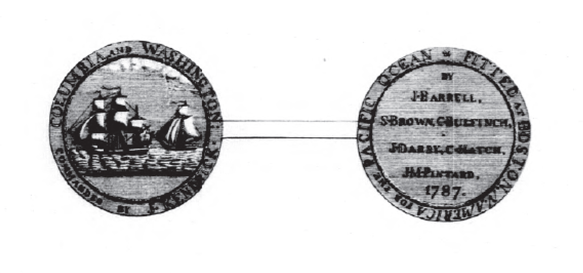
Mementoes of Encounter: specially minted coins gifted to Hawai’ians by American fur traders. From Mortimer fp. 55.
The final arrival at the Bay of Oonalaska on 26 Oct 1789 was an anti-climax. Rather than a thriving operation worthy of plunder, they found instead isolated Russian fox-hunters who had been effectively trapped there for years. Winter was coming and the men were in a very poor state. Cox took pity on the men. Instead of being attacking and robbing them, as was his mission’s objective, he instead brought them on board and fed them. Mortimer’s account of the visit paints a tense picture of impoverished Russians who dealt harshly with the First Nations peoples they employed, and a scant diet of fish and berries.
Though Cox acted kindly towards the Russians, there was clearly tension. After all, Sweden - the country he represented - and Russia were at war. The Gustaf III left suddenly on 8 November, and according to Mortimer did not even notify the Russians they were leaving. Mortimer gives no explanation here, and we can only assume that Cox's generosity was also balanced by a very justified caution.
The Gustaf III made good time sailing west across the north Pacific. A little over a month later, on December 12, they reached Tinian in the Marianas Islands. Formosa (Taiwan) was passed on 25 December, and Macao was reached four days later. Mortimer’s account of the voyage ends on 1 January 1790, where he observes
having only been ten months and five days in performing our voyage, and traversing this immense space of ocean; and what was rather extraordinary, and fortunate for us, as we had no surgeon on board, our people in general were remarkably healthy, and we only lost one man. (Mortimer: 71)
And with that, this remarkable, but somewhat ineffectual, enterprise was over. Within a day of arriving back, Cox wrote to King Gustaf and Ruuth, alerting them to the apparent failure of the project:
We found only, scattered in several parts of the island, a few Russian hunters, who were engaged in gathering skin-goods for the arrival of a ship which was expected there the following year. As the whole wealth of this people consisted only of a few wretched foxes, I considered the honour of the Swedish Flag unworthy to plunder them. (Riksarkivet: Cox To Ruuth, 2 Jan 1790)
In October 1790, the Gustaf III set out again for Alaska. This time it was without Cox, whose health was apparently deteriorating. Its crew, typically for its time, was a mixture of Chinese, Philippine, Goan, Hawai’ian, American, Irish, Welsh, British, Portuguese, and Swedish (DuRietz: 17). By the time Gustaf III returned in late October 1791, John Henry Cox was dead. We know where he was probably buried but not the cause of death, nor the eventual fate of the Gustaf III/Mercury, which was likely re-named. Three months later in March 1792, Cox’s patron King Gustaf was also dead, assassinated at a masked ball.
For a long time Cox, and the Gustaf III/Mercury, faded into obscurity. It had not been the first ship named Gustaf III, and would not be the last. Another Swedish ship of that name was operating within a year, but appears to be a different vessel. International knowledge of the 1789-90 Pacific voyage was restricted to the limited information in Mortimer’s book which, due to its omission of any references to the Swedish plot, reduced it to an interesting but not particularly significant Pacific island travelogue. William Bligh – probably ignorant of Cox’s secret pact with the King of Sweden – later referred to Mortimer, who gave evidence against him at a court martial in 1805, as the man “who made that foolish voyage to the South Sea” (Mackaness 1951: 349).
Historian Rolf E. DuRietz, who spent by his own account half a century pondering Cox’s motivations, suggests that the 1789 voyage was not foolish, but
the product of an ingenious mind and a fascinating, enigmatic personality. Possibly the voyage was a splendid and successful effort of a dying or doomed man to crown his life with a truly wonderful experience. (DuRietz: 25).
Rabbit hole 6: The Historiography
As was often the case where Europeans visited Indigenous lands, Cox’s journey was commemorated, for a time, by naming in a number of the north American places he ever-so-briefly visited. Port Cox (now Clayoquot Sound) and Cox Bay on the west coast of Vancouver Island, Cox’s Channel (now called Parry’s Passage) at Haida Gwaii in British Colombia, and Cox’s Island in that area bear his name. The story of Cox’s kindness to the struggling Russians was passed down, and in 1933 a river on Baranoff Island in Alaska was named Cox River, in admiration of his noble behaviour (Du Rietz: 14).
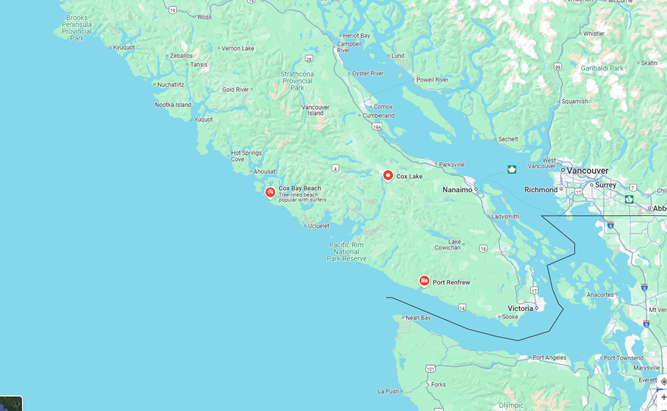
In Sweden, where the original voyage of the Gustaf III had been kept secret, this episode had been unknown until the 20th century. Variations in the spelling of Cox’s name (he was listed as Coxe in the few Swedish references) and the ship’s name (known only as the Gustaf III or Gustavus in Sweden, but the Mercury in England) prevented Swedish scholars linking with Mortimer’s account. And because Mortimer’s account made no reference to the Swedish connection, this fascinating aspect had faded into obscurity.
The naming of the river on Baranoff Island in the 1930s changed that, igniting interest in the Swedish press and amongst scholars. Yet it was not until 1950 that the story – which left almost no archival trace - began to be made public in Sweden. Ironically, or perhaps historiographically fittingly, this was through an article in a Tahitian local history journal, written in French by Commandant Jean Cottez, and eventually translated by Swedish historian of the Pacific, Rolf DuRietz. The introduction to DuRietz’s 2002 translation of Cottez remains the definitive study on Cox and his adventures.
This story is emblematic of the limitations of archival research. Aside from some scant documentation in the Riksarkivet (Swedish National Archives) and Mortimer’s rollicking travel account which omits crucial facts and context, there is little trace of Cox and the whole episode in the historical record. The historiography is telling: from what I can gather, most 20th century research activity was done by Swedish researchers inspired by the naming of places after Cox in north America, and the work of a Tahitian-based historian, writing in French in the 1950s. It took many decades for these disparate strands to be teased out then linked together, and may take many more for a more comprehensive narrative to emerge.
Emerging from the rabbit hole
The life and adventures of John Henry Cox represent a fascinating juncture in history, of usually young men, far from home, transgressing national identities and bureaucratic edicts in the search for profit. They were independently wealthy, and aligned themselves with whichever business partners or foreign entities would better facilitate their ventures. Their positions on the periphery of empire means they left comparatively little trace in the European historical record, so researching their activities leads to many metaphorical dead ends.
Most importantly, for researching interactions with First Nations peoples, Cox and his coterie of multinational gentleman merchants represent a type of encounter which was both widespread, yet ephemeral. They flew the flag of empires for convenience, but while they were witnesses and sometimes conduits, they were generally not active agents in the brutality of colonisation. They came to do quick business. Violent encounters did transpire, but these were in the minority. Their names and their ships float in and out of the historical record, obscured by cover-names and language barriers. Yet a river here, or a bay there, commemorates the importance of these fleeting encounters in folk memory, if not in broader academic scholarship.
The four years I spent chasing after John Henry Cox involved numerous rabbit holes, many not even mentioned here. I am deeply appreciative of the conversations with colleagues I have spoken to in Sweden, Denmark, the UK, and Australia during the course of this research. Many of them, especially those in Scandinavia, were intrigued by the strange tale of Cox and the secret mission on behalf of King Gustaf. We all agreed there is an interesting story to tell – but in terms of a rigorous, evidence-based academic study, it has not yet fully revealed itself.
Leonie Stevens, November 2024
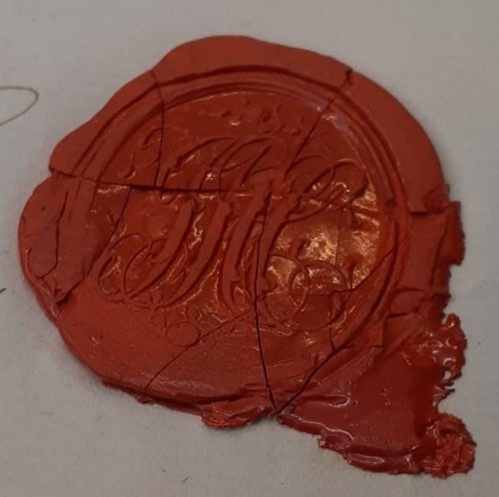
John Henry Cox's seal, from the Minutes of his meeting with King Gustaf, 11 November 1788. Photo taken at the Riksarkivet, National Archives of Sweden, February 2024.
Works cited - Archival
Riksarkivet, National Archives of Sweden, Stockholm/Täby, Ruuth collection Vol. 4.:
- Minutes held at the King’s House, Gothenburg, 11 November 1788, Instruction for John Henry Cox
- Letter from J. H. Cox to the Secretary of State, Erik Ruuth, Canton, 2 Jan 1790
Works cited - Printed
Historical records of New South Wales Volume 1 Part 2: Phillip 1783-92. Sydney: Government Printer, 1892.
Berg, Maxine. 2023. Small Spaces and Multiple Contexts: Nootka Sound’s Global Locality 1774–1794. Journal of Early Modern History, 27(1-2), 108-131.
DuRietz, Rolf E. 2002. A Secret Anglo-Swedish naval expedition to the Pacific in 1789, Banksia 5, Dahlia Books
Hafitröm, Georg (Commander). 1957. John Henry Cox as Swedish naval officer. Forum Navale 14.
Hellman, Lisa. 2019. This House Is Not a Home: European Everyday Life in Canton and Macao, 1730-1830. Leiden; Brill.
Hellman, Lisa. 2021. Everyday Life on the High Seas: Routines, Restrictions and Recreation on East Indiamen, in Andersson, G., & Stobart, J. (Eds.). Daily Lives and Daily Routines in the Long Eighteenth Century (1st ed.). Routledge.
King, Robert J. 2005. Gustaf III's Australian Colony, The Great Circle, vol.27, no.2, 2005, p.4.
Koninckx, Christian. 1978. The maritime routes of the Swedish East India company during its first and second charter (1731–1766), Scandinavian Economic History Review, 26:1, 36-65 p.64
Lamb, W. Kaye & Bartroli, Tomâs. 1989. James Hanna and John Henry Cox: the First Maritime Fur Trader and His Sponsor", BC Studies, no.84, 1989–90, 3–36.
Mackaness, George. 1951. The life of Vice-Admiral William Bligh, R.N., F.R.S.. Sydney: Angus & Robertson.
Mortimer, Lt. George. 1791. Observations and remarks made during a voyage to islands of Teneriffe, Amsterdam, Maria's Islands near Van Diemen's land; Otaheite, Sandwich Islands; Owhyhee, the Fox Islands on the North West Coast of America, Tinian, and from thence to Canton, in the brig Mercury commanded by John Henry Cox, Esq. London: Cadell & Co.
Wadström, Carl Bernhard. 1794. An essay on colonization particularly applied to the western coast of Africa: with ... brief descriptions of the colonies ... in Africa, including those of Sierra Leona and Bulama..., Volume 2. London: Darton and Harvey.