
2025 Mollie Holman Award and Faculty of Arts John Rickard Prize for Best PhD Thesis
Congratulations to School of Social Sciences PhD graduate Dr Kyra Fabianke who has been awarded the 2025 Mollie Holman Award for her thesis titled "Sustainable Business Model Innovation in Small and Medium-Sized Enterprises: An Appreciative Inquiry into the Transition from Business as Usual to Business for Good.”
Awarded to a maximum of 10 doctoral students, the Mollie Holman Award is among the highest academic honours the University bestows, marking recipients as researchers of the highest order.
Dr Fabianke has also been awarded the Faculty of Arts John Rickard Prize for Best PhD Thesis. The $5,000 Faculty of Arts Prize is endowed by the late Emeritus Professor John Rickard, who was a long-standing and generous philanthropic supporter and bequestor to Monash University and former member of the Historical Studies at Monash.
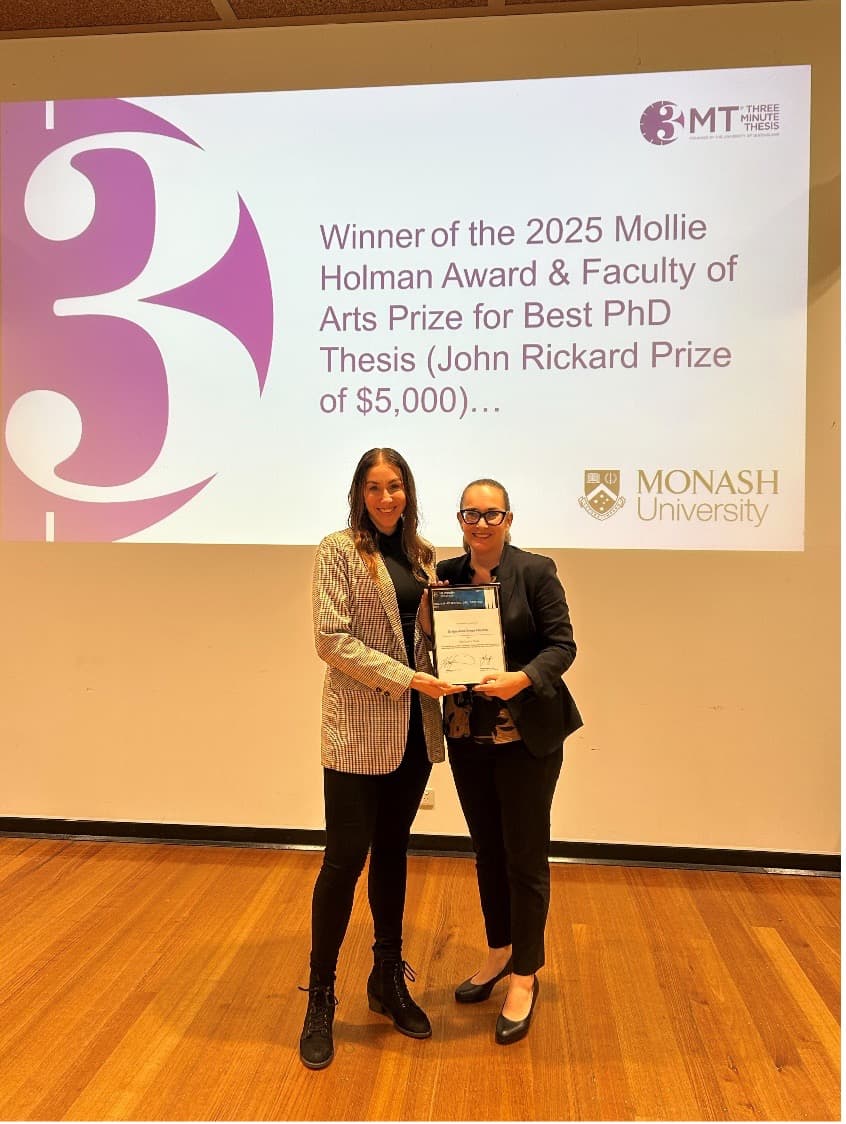
Left to Right: Dr Kyra Fabianke and Professor Megan Farrelly (Associate Dean, Graduate Research), Faculty of Arts
Dr Fabianke was supervised by Associate Professor Wendy Stubbs, Dr Benjamin Thompson and Professor Megan Farrelly in the School of Social Sciences.
We recently caught up with Dr Fabianke to learn more about her PhD journey. Read about it below.
Tell us about yourself
My background is in human geography (BA Hons) and global studies (MA) – and true to the spirit of those fields, I've spent a good part of my life moving across continents, learning to think broadly across disciplines, systems, and borders. Before entering academia, I worked as a Corporate Sustainability and Responsibility Consultant, supporting businesses, NGOs, and government organisations to navigate sustainability challenges.
What connects all of it – the studies, the years in industry, and now the research and teaching – is a deep care for this planet and its human and non-human inhabitants. That concern ultimately led me to a PhD, and it provided an important source of motivation and perseverance throughout the journey.
Today, I am a Lecturer at Deakin University, a role I was fortunate to commence shortly after completing my PhD. The research, the teaching, the conversations and collaboration, the opportunity for real impact – academia is by no means an easy path, but it feels like the right one for me, and I’m really excited about what lies ahead.
Receiving the Mollie Holman Award and the Faculty of Arts John Rickard Prize at this point represents a tremendous honour and offers enormous encouragement as I take the next steps in building an academic career. Like many PhD candidates, I had moments when I doubted myself and questioned whether the work was making the contribution I hoped it would. The awards feel like a recognition of all the effort, persistence, and people who shaped the thesis.
Why were you drawn to your PhD topic? What was your research about?
My research sits at the intersection of business, society, sustainability, and change. I'm drawn to the messy, hopeful question of how organisations can become genuine agents of positive change.
For my PhD, that curiosity took a specific shape: How do small and medium-sized enterprises (SMEs) navigate the transformation towards more sustainable business models?
There's a tendency in sustainability discourse to treat SMEs as a problem – too resource-constrained, too focused on survival to lead meaningful change. My research challenged that assumption. Through in-depth conversations with founders, leaders, and employees across a range of Australian SMEs, I found organisations that were actively striving to create positive social and environmental impact – often despite significant constraints and at considerable personal cost. Getting to know the people behind these businesses and seeing their commitment to doing things differently was one of the most rewarding parts of the entire PhD. Their perseverance, passion, and the sacrifices they made reminded me, time and again, why this work matters.
Ultimately, the research repositions SMEs as capable and willing partners in the pursuit of sustainability, offering a hopeful perspective on the capacity of business to be a force for good.
How would you describe your PhD experience at Monash Arts? What advice would you give future PhD students?
A PhD is a deeply personal journey, and I think it's important to say that upfront – because what makes it hard is different for everyone, even if many of the challenges are the same. So take any advice (including this) with a pinch of salt. That said, here are a few nuggets of “wisdom”:
First, find your tribe. A strong support network makes an enormous difference: fellow PhD candidates, mentors, friends, family, and of course, supervisors – a good supervisory relationship is worth its weight in gold. I’m very thankful to my supervisors, and having people around you who understand the journey, as well as those who help you step away from it, is invaluable.
Second, resist the pull towards tunnel vision and seek out experiences beyond the thesis itself. Conferences, teaching, workshops, professional development, interdisciplinary collaborations – these build skills and open doors, but they also let you “try on” the academic life. Does the shoe fit? Do I actually enjoy this world? See the PhD as a chance to find out (if the answer is no, that's okay too). Monash offers a wealth of opportunities, resources, and support services (special shout-out to the Learning Advisors), and I'm incredibly grateful for how these supported my development and the ability to secure a continuing academic position shortly after completing my PhD.
Finally, invest in getting to know yourself: what works for you, what doesn't, how to build structures and routines that support you – most importantly, learn how to work with yourself rather than against yourself. You will have hard days, bad weeks, and moments when the whole thing feels impossible – self-compassion is non-negotiable.
On that note, identify your life savers early. The trifecta I keep coming back to involves good company, a good run, and good wine (or chocolate – pick your poison... ahem, life raft). The thesis will still be there tomorrow. Make sure your sanity is too.
Congratulations also to Dr Elisabeth Fisher for receiving the 2025 Vice-Chancellor’s Commendation for Thesis Excellence and Dr Tessa Holzman for receiving the 2025 Faculty of Arts High Commendation for Thesis Excellence, both from the School of Philosophical, Historical & Indigenous Studies.
Visit the Monash Arts Graduate Research webpage to learn more about the research opportunities we offer.