
Dr Manu Kirberg awarded the 2023 Mollie Holman Award and Faculty of Arts Prize for Outstanding PhD Thesis
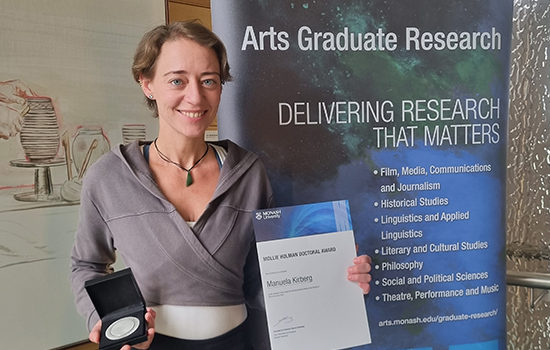
Congratulations to Philosophy PhD graduate Dr Manu Kirberg who has been awarded the 2023 Mollie Holman Award for her thesis titled “Comparing spontaneous thoughts across the sleep-wake-cycle”.
Awarded to a maximum of 10 doctoral students, the Mollie Holman Award is among the highest academic honours the University bestows, marking recipients as researchers of the highest order.
Dr Kirberg has also been awarded the Faculty of Arts Prize for Outstanding PhD Thesis. The $5,000 Faculty of Arts Prize for Outstanding PhD Thesis is endowed by the late Emeritus Professor John Rickard, who was a long-standing and generous philanthropic supporter and bequestor to Monash University and former member of the Historical Studies at Monash.
We recently caught up with Dr Kirberg to find out more about her PhD journey. Read the full interview below.
Tell us about yourself.
I am a Postdoctoral Researcher at the Monash Centre for Consciousness and Contemplative Studies (M3CS). My academic journey has been interdisciplinary, reflecting my broad curiosity. With a M.Sc. in Philosophy-Neuroscience-Cognition from the University of Magdeburg and a M.A. in Anthropology and Educational Science from the University of Leipzig, I earned my PhD at Monash University, focusing on the intersection of philosophy of mind and cognitive science. Growing up in Germany, my curious nature led me to Tanzania, East Africa, where I conducted ethnographic research, and now to Australia, as far from home as one can go. I think this describes me well: I am an explorer both of the mind and the world. I've always been interested in theoretical questions, like what lies beyond human perception and whether we can ever truly understand reality, but I’m just as much at home climbing rocks, hiking in nature, or living off the grid in a rainforest. I try to stay open to whatever comes my way, finding opportunities for discovery both conceptually and with the body and senses.
Can you provide a brief overview of your PhD project and insight into why you were drawn to the topic?
My PhD focused on the relationship between consciousness in sleep—specifically dreaming—and waking mind wandering, where our thoughts drift away from what we are currently doing. My work combined theoretical and empirical research, aiming to integrate leading approaches from philosophy and cognitive neuroscience. I proposed a new framework for investigating these spontaneous cognitive states, challenging the traditional division between sleep and wakefulness. A significant part of my research involved pioneering a method for the joint investigation of dreaming and mind wandering. This included designing a philosophically informed questionnaire to differentiate and compare these states and conducting the first-ever content analysis on mind-wandering reports, offering a fresh perspective on how dreaming and mind wandering intersect.
Why this topic? Dreams have fascinated me for as long as I can remember. From a young age, I was intrigued by how the mind could create vivid worlds, complete with people and places I’d never seen, all while I was asleep. The boundaries between dreams and reality puzzled me—how can something that feels so real be “just” a dream? This early curiosity evolved into deeper philosophical questions: How does the mind simulate reality? How do we know that waking life isn’t also a dream? Why can imaginary scenarios evoke real emotions? And where does all the, sometimes strange, material for our dreams, daydreams, and mind wandering come from? Why do we (day)dream at all? These questions continue to shape my research into how the mind creates the worlds we experience, whether in sleep or wakefulness.
How would you describe your PhD experience at Monash Arts, and how did your supervisors support your work?
I've been incredibly fortunate with the support and guidance I've received at Monash Arts. My primary supervisor, Jennifer Windt, is not only a brilliant philosopher but also created a space where I could confidently develop my own ideas. She taught me the art of collaborative writing, including the tough lesson of sacrificing ideas for better ones. Jennifer also connected me to international research communities and provided valuable opportunities for outreach and publication. My secondary supervisor, Jakob Hohwy, created such a supportive environment for both academic and personal growth. His leadership at the Cognition and Philosophy Lab and now M3CS has been key to my development. The collaborative and supportive atmosphere at Monash, from supervisors to centre members and the entire philosophy department, has been invaluable. Despite the challenges of being an international student during a global pandemic, the learning, connections, and support I've received have profoundly shaped my academic journey.
What advice would you give future PhD students looking to conduct their research?
Choose your supervisors and work environment carefully—they’re as crucial as your research topic. If something doesn’t feel right, don’t hesitate to make a change. Pick a topic you’re passionate about. A PhD is a long and challenging journey, full of ups and downs, and your passion for the subject will carry you through. As an international student, you’ll face extra hurdles—being far from home, navigating a second language, and adapting to an unfamiliar culture. Be kind to yourself; the pressure in academia is high enough without adding to it. Build a social network that can provide the support you miss from home. And remember, your PhD is just one part of who you are. Maintain a life outside of academia, keep up with your hobbies, and don’t tie your self-worth solely to academic achievements. Think about who you want to be, not just as a scholar, but as a whole person.